









Evidence boundary: no sewing machine was connected or tested for this guide. A same-name U.S. machine can carry different electrical values, so the delivered European label and manuals must lead.
Use STITCH for the whole sewing setup
| STITCH gate | Evidence to record | Stop condition |
|---|---|---|
| S — Supply label | Exact machine and controller model, volts, hertz, watts or amps, plug and regional manual. | Unreadable label, wrong regional supply or a travel adaptor used as a voltage solution. |
| T — Total connected set | Machine, foot controller, task light, phone charger and every item sharing the station. | Any load is missing or the one AC outlet leads to an improvised chain of adaptors. |
| I — Input behaviour | Motor or electronic-control notes, manufacturer start guidance and any external power supply. | Only a catalogue watt value is known, or the control system behaves abnormally. |
| T — Test the real seam | Dry, supervised test on scrap using the heaviest intended material and normal pedal control. | Trip, unstable speed, unusual sound, heat, smell, damaged cable or repeated failed start. |
| C — Cable and climate | Stable station position, ventilation, dry floor, protected cable route and allowed extension rating. | Dampness, pinch or trip hazard, wound reel, overload or daisy chain. |
| H — Headroom and hours | Measured active watts, idle watts, sewing minutes, reserve and a non-battery fallback. | The plan depends on nameplate-only runtime or uninterrupted production. |
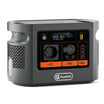
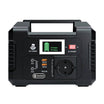
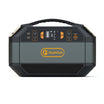
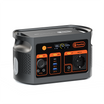
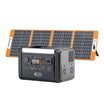
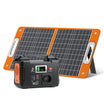
Decision step: Compare E106B with your completed STITCH sheet. Treat 384Wh as rated battery energy, not AC energy guaranteed at the needle.
Why the exact regional label matters
SINGER currently lists the Heavy Duty 4423 in Europe, but its accessible European page does not provide the delivered reader's electrical label. A separate U.S. listing for the same model name states 84W, 120V and 60Hz. That is a useful warning, not a European specification: those U.S. values must not be copied to a 230V machine.
| Evidence | What it answers | What it cannot answer |
|---|---|---|
| Delivered machine label | Regional voltage, frequency and input identity. | Actual watts through every fabric and pedal position. |
| Exact machine and controller manuals | Allowed supply, accessories, setup and manufacturer cautions. | E106B compatibility unless explicitly tested and documented. |
| Suitable power measurement | Observed complete-load watts for representative work. | Long-term reliability or every possible startup event. |
A practical supervised seam test
- Photograph the machine, controller and any power-supply labels; confirm the manuals match those exact models.
- List the machine, task light and every charger. Decide which can use USB directly and which requires AC, without exceeding port or shared-output limits.
- Place the E106B on a dry, stable, ventilated surface and route one correctly rated lead without a wound reel or daisy chain.
- Start with scrap fabric, then repeat the heaviest intended real seam while controlling the pedal normally. Record observed watts, warnings and behaviour.
- Stop on a trip, unstable control, abnormal noise, heat, smell or damaged cable. Do not force repeated starts to obtain a better result.
Plan energy from sewing minutes, not a single watt number
A sewing session usually alternates between active stitching, fabric positioning and idle time. Record each state instead of assuming the motor draws one constant value. A planning worksheet can multiply measured watts by hours in each state, then add task lighting and charging loads. Apply conversion loss and reserve, and keep the result as a range because fabric, speed, temperature and battery state change it.
When E106B fits—and when it does not
When FlashFish fits
- The exact European machine and controller labels match the delivered E106B supply.
- The complete measured load stays comfortably inside the relevant output and port limits.
- A supervised scrap-to-real-seam test is stable, and the planned session leaves energy reserve.
When FlashFish does not fit
- The label or manual is missing, the regional supply does not match, or a voltage converter would be improvised.
- The setup needs guaranteed uninterrupted production, unattended operation or a fixed runtime.
- The machine trips, controls erratically, overheats or exceeds a documented limit during a normal test.
FAQ
Is a sewing machine below 600W automatically compatible with E106B?
No. Rated watts are only one gate. The delivered machine's voltage and frequency, controller, startup behaviour, complete load set, cable path and exact E106B regional configuration also need checking.
Can I use the 84W SINGER 4423 figure for a European 4423?
No. The cited 84W value belongs to a 120V, 60Hz U.S. listing. Read the label and manual for the exact European machine rather than transferring a same-name regional value.
Should I include a sewing lamp in the load plan?
Yes. Include every device connected to the station, including a task light, phone charger or powered accessory. One overlooked load can change both total watts and energy use.
How should I test a sewing machine without claiming universal compatibility?
After label and manual checks, test the exact setup in a dry, stable, ventilated location under supervision. Use scrap fabric and the heaviest intended real seam, watch for trips or abnormal behaviour and stop rather than repeatedly forcing a failed start.
How long will E106B run a sewing machine?
This draft does not promise a runtime. Measure the complete setup during representative sewing, record active sewing minutes and idle periods, then plan from usable energy with conversion loss, variation and reserve included.
Sources and evidence notes
- FlashFish Europe E106B page and the local product database — current product identity and documented output limits; the local chemistry field remains blank.
- SINGER Europe 4423, SINGER U.S. 4423 and SINGER manuals — regional-transfer warning and exact-manual route.
- Electrical Safety First extension guidance — cable, overload and stop-use boundaries.
Editorial viewpoint: the useful question is not whether 'a sewing machine' fits a 600W station. It is whether one labelled machine, controller, light, cable path and real seam pass the same evidence screen.
Next step: Compare current FlashFish power-station classes for your measured setup if the completed load or energy plan is outside the E106B range.
Evidence checked . Human review is required for regional manuals, electrical wording, author/reviewer credentials, links, metadata, image crop and rendered FAQ/schema parity before publication.





Yorum yazın
Tüm yorumlar yayınlanmadan önce incelenir.
Bu site hCaptcha ile korunuyor. Ayrıca bu site için hCaptcha Gizlilik Politikası ve Hizmet Şartları geçerlidir.