

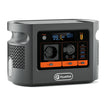
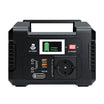

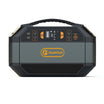
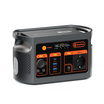






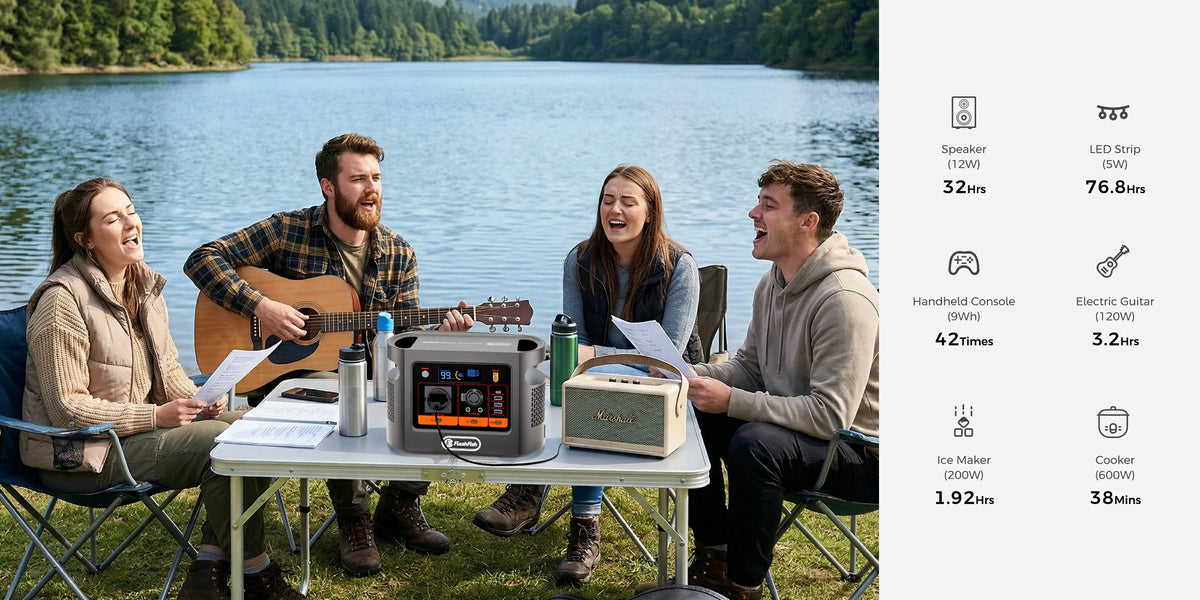
Short answer: E106B may suit a modest camping setup, but a 12V cool box cannot be approved from watt-hours or plug shape alone. In the worked Dometic CFX3 25 example, the manual's 10A maximum rated current equals the entire 10A limit of E106B's shared 12V DC group. Matching the ceiling is not current headroom, compatibility, runtime or food-safety proof.
Use COOLBOX-PATH-CURRENT-ENERGY-DRY-TEST: verify the exact voltage and plug, compare maximum current with the correct output group, budget measured trip energy, keep every connection dry and simulate the full campsite load before departure.
The 12V path is the first decision gate
| Check | Worked evidence | Decision | Still unknown |
|---|---|---|---|
| Voltage path | CFX3 supports a documented 12-24V DC path; E106B's car output is in a 12V group | Voltage category is plausible | Exact delivered plug, cable and fuse |
| Maximum current | CFX3 25: 10A maximum rated current; E106B DC group: 10A shared ceiling | No documented current headroom | Startup behaviour and protection response |
| Other DC loads | Two DC5521 outputs and car output share 10A/120W | Do not add their ratings as separate budgets | Which other DC devices will run simultaneously |
| Trip energy | E106B: 384Wh nominal | Useful planning input only | Cooler duty cycle, losses, weather and user behaviour |
Check E106B against your exact camping load, including the labels and connection path on the actual cool box.
Why 10A equals 10A is a stop-and-test result
The Dometic maximum rated current is not the same thing as average consumption. It is still the correct conservative figure for checking the output ceiling. When the appliance rating equals the supply group's documented limit, there is no published margin for connector loss, rating tolerance or any other load on that group. That does not prove failure; it means a blog cannot responsibly say the pairing is compatible.
Confirm the cooler's exact model and regional manual. Inspect the 12V plug and cable, use the correct fuse, and do not substitute an unverified adaptor. If the path is unclear, stop rather than switching to a different socket because it looks similar.
Keep phones and lights on clearly documented paths
E106B documents one USB-C Power Delivery port up to 100W, a second USB-C port up to 30W and a two-port USB-A group up to 30W. A phone can use a compatible USB path, while a small lamp can use a verified USB output or the station's built-in light. Those separate ports avoid casually adding another device to the 12V DC group, but they do not create a second battery. Every load still reduces the energy available for the trip.
Check each cable and device profile. A USB-C connector shape alone does not promise a particular negotiated rate, and an AC lamp adds inverter losses that a comparable DC light may avoid. Use the simplest documented path that meets the device instructions.
Build an energy budget from a measured simulation
- Charge the E106B fully using its current instructions and record the starting state.
- Load the cool box with representative contents, choose the planned temperature and place it in a realistic ambient environment.
- Connect the exact phones, cables and lights that will travel, using the same simultaneous-use pattern.
- Record elapsed time, displayed battery level, warnings, connector heat and the temperature inside the cool box.
- Repeat long enough to include normal compressor cycling and lid openings, then retain a conservative reserve rather than projecting to zero.
This is a trip simulation, not a laboratory capacity test. Nominal watt-hours cannot be divided by a single headline watt figure to establish runtime because cooling is cyclical and the environment changes the load.
Three campsite decisions
- CFX3 25 on the 12V car output plus two phones on USB: the cooler's 10A maximum equals the E106B DC-group ceiling, so the result is conditional, not approved. Verify the complete path and perform a supervised energy test; keep extra DC loads off that group.
- A smaller cool box with a documented 12V, 4A maximum and a USB lamp: the current screen has more apparent headroom, but the exact plug, starting behaviour and trip energy still decide fit.
- An unlabelled cool box from storage: stop. Connector fit and remembered performance on a car socket do not establish voltage, current, polarity, condition or energy use.
When E106B may fit
- The exact cool box has a documented 12V path, correct plug, intact cable and a maximum current below the applicable shared limit with useful headroom.
- Phones and lights use verified USB or built-in paths and the complete simultaneous load has been observed.
- A representative simulation demonstrates enough measured trip duration plus a conservative reserve.
- The station remains ventilated and all connectors stay dry, cool and protected from damage.
- A separate thermometer and food-safety plan verify the cooling outcome.
When it does not fit
- The cooler model, input label, plug, polarity, cable, fuse or current requirement is unknown.
- The plan treats a ceiling match as headroom or adds the three E106B DC outputs as independent 120W sources.
- The required trip duration comes only from dividing 384Wh by a catalogue watt figure.
- The setup will be exposed to rain, condensation, poor ventilation or unattended critical use.
- Food safety, medicine storage or another critical outcome depends on uninterrupted operation without a validated backup.
Frequently asked questions
Can E106B run a Dometic CFX3 25 from its 12V car output?
Do not treat it as confirmed. The CFX3 25 manual's 10A maximum rated current equals the entire documented 10A ceiling of E106B's shared 12V DC group. Equality leaves no documented current headroom, and the exact plug, cable, behaviour and energy use still need verification.
Can I charge phones while the cool box is running?
Phones can use separately verified USB paths, but the complete setup still draws from one battery. Confirm the phone and cable profiles, avoid loading the shared DC group with extra DC devices, and observe all simultaneous loads during a supervised test.
How long will a 384Wh station run a 12V fridge?
This article does not give a runtime. Cooler duty cycle, ambient temperature, set point, food load, lid openings, conversion losses, battery state and other devices all change the result. Measure a representative full trip simulation.
Is the 120W DC rating available from every E106B DC socket?
No. The authoritative record treats the two DC5521 outputs and the car output as one shared 12V, 10A, 120W group, not 120W per socket.
Does keeping a cool box powered prove food-safe temperature control?
No. Electrical operation is not temperature verification. Use the cooler manufacturer's instructions, an appropriate thermometer and a separate food-safety plan; do not rely on a station display or this article as proof.
Conclusion
A reliable camping decision starts with the exact 12V path, not the 384Wh headline. The worked CFX3 25 example reaches the E106B DC group's full current ceiling before phones or lights are considered, so it remains a conditional pairing that needs exact documentation and a supervised full-trip simulation. Ask FlashFish Europe about your 12V device path when any connector or station-side value remains unclear.
Sources and evidence limits
Checked 18 October 2026. E106B facts come from the authoritative local product record and current Europe page. Dometic supplies one named cool-box example and explains that maximum rated current is not average draw. The Camping and Caravanning Club supplies general electrical-use boundaries. FlashFish publishes this article. No cool box, phone, lamp or complete campsite setup was connected or measured; no compatibility, runtime, weather-resistance, food-safety or unattended-use result is claimed. The featured image is contextual only.



Yorum yazın
Bu site hCaptcha ile korunuyor. Ayrıca bu site için hCaptcha Gizlilik Politikası ve Hizmet Şartları geçerlidir.