

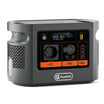
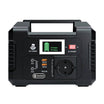

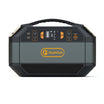
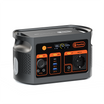


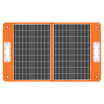
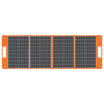


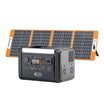

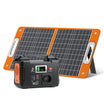

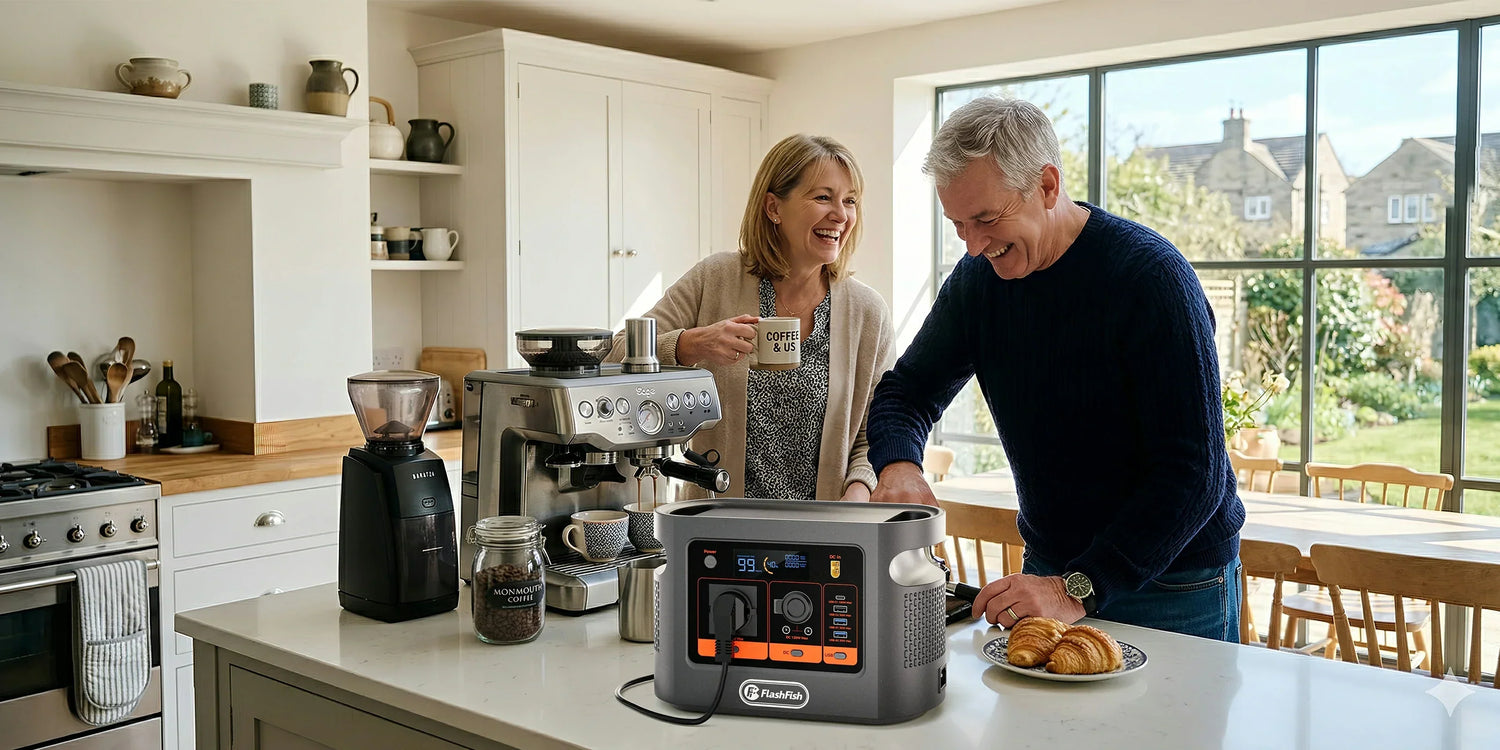
Short answer: choose the FlashFish E103 when a 3kg carry weight and small-device charging matter more than energy headroom. Choose the E106B when 384Wh capacity, 600W continuous AC output and up to 100W USB-C are worth carrying 5.2kg. Neither is automatically the better weekend station.
The decision turns on the route between the car and pitch, the heaviest simultaneous load, the full weekend watt-hour budget and the planned recharge method. Use the PACK comparison below instead of buying from a capacity number alone.
E106B vs E103: verified facts
| Factor | FlashFish E103 | FlashFish E106B | Why it matters at camp |
|---|---|---|---|
| Battery capacity | 179.2Wh | 384Wh | More capacity gives more energy-planning headroom, not a fixed runtime |
| Continuous AC output | 300W | 600W | Use the simultaneous nameplate total; output and capacity are different limits |
| Peak output | 600W | Not provided in local bundle | Do not invent E106B startup compatibility |
| USB-C output | Up to 60W | Up to 100W | Compatible devices may charge without an AC adapter |
| Maximum input recorded | 90W | Up to 200W solar input | Input ceilings do not promise real recharge speed |
| Weight | 3kg | 5.2kg | A 2.2kg difference matters on a long carry or small packing list |
| Dimensions | 274×147×163mm | 306×171×202mm | Measure the actual car, tent vestibule or storage location |
| Cycle record | 3000+ to 80%+ capacity | At least 3000; retention endpoint not provided | The figures are not fully comparable without the same endpoint and conditions |
| Commercial warranty record | 12 months | 12 months | Verify current country terms; this is separate from cycle life and legal rights |
Evidence boundary: the current E106B Europe storefront title contains “LiFePO4,” but the authoritative local product bundle leaves E106B chemistry blank. This draft does not use a chemistry claim. A human reviewer must reconcile the exact Europe manual before publication.
The PACK method
P — Portability is the first filter
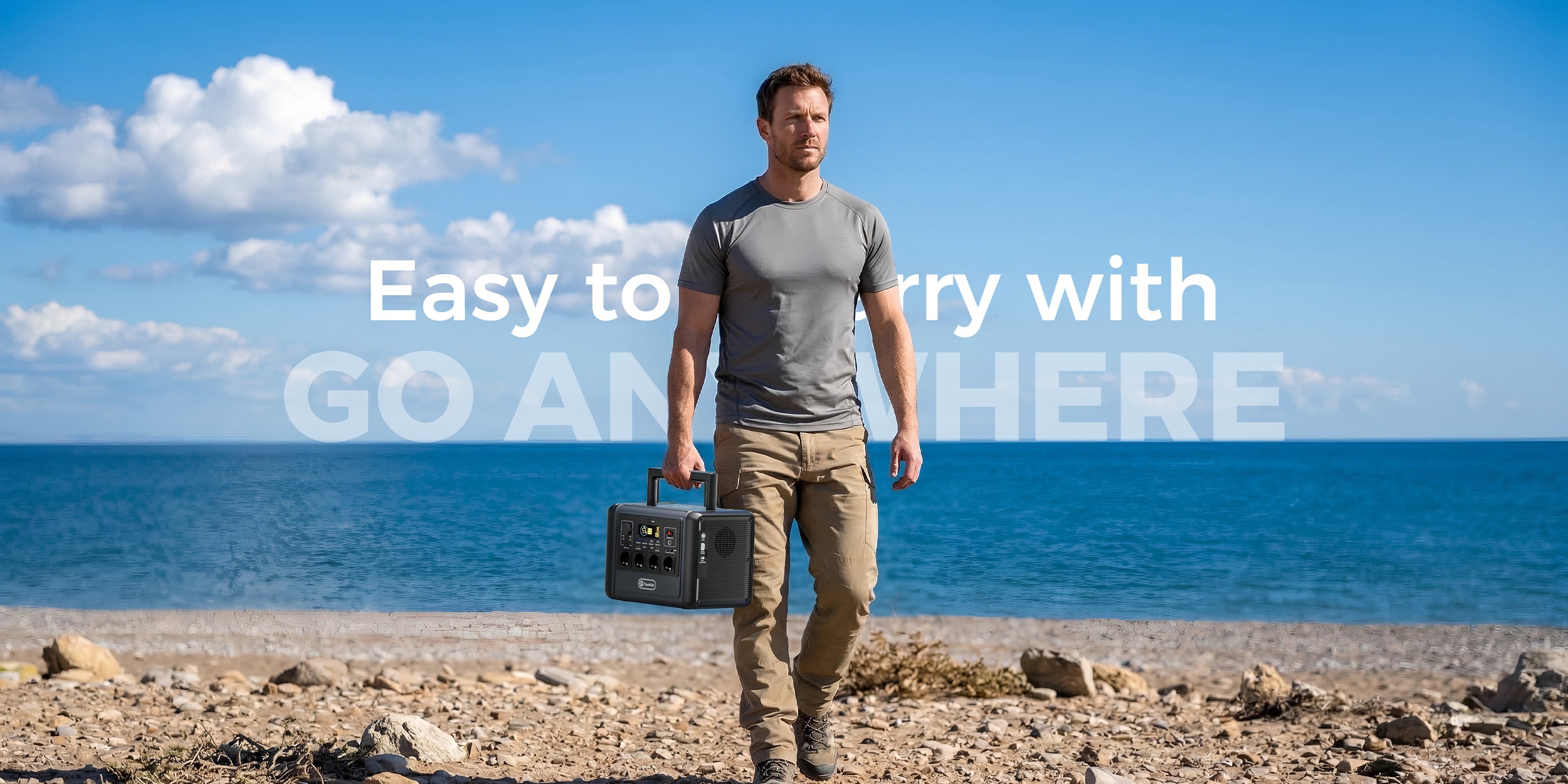
If the station travels 300 metres from a parked car to a pitch, 5.2kg may be easy. If it joins food, water, tents and camera gear on public transport or a long walk, the 3kg E103 may be more useful even with less energy. Add cables and chargers to the carried weight and measure the storage space.
E103 is not “better” because it is lighter. It is better only for a carry-constrained job that fits its lower limits.
A — Appliance and simultaneous-load ceiling
List every device that may operate together. E103 is recorded at 300W continuous AC and 600W peak. E106B is recorded at 600W continuous AC; its peak value is not provided in the local bundle, so no startup claim belongs here. Check each nameplate and regional plug/voltage compatibility against the current Europe manual.
Do not use heat appliances as casual examples. A kettle, heater or cooker may sit near or above a compact station’s output and can dominate its small energy store even when compatible. Campsite cooking rules and fire safety are separate.
C — Capacity budget
Multiply each device’s measured average watts by planned hours, add the watt-hours and reserve energy for the journey home. A phone charger, camera-battery charger, light and laptop all have different duty cycles. The 384Wh E106B starts with more than twice the nameplate energy of the 179.2Wh E103, but real delivered energy is lower after conversion and standby losses.
For example, a hypothetical kit using 20W of lighting for four hours, 80Wh of device charging and 60Wh of camera/laptop top-ups totals 220Wh before losses and reserve. That simple plan exceeds E103’s nameplate capacity but may fit E106B’s energy store. It is not a field test and does not predict actual results.
K — Keeping it charged
E103 has a 90W maximum input in the source record. E106B lists up to 200W solar input. These numbers are ceilings, not assured watts or charging times. Confirm compatible voltage, current, connectors and panel setup from the correct manual. Weather, shade, angle and temperature change solar input.
If the campsite offers mains hookup, follow its rules and use approved equipment. The Camping and Caravanning Club warns about dampness and electrical safety at tents and campsites. Keep stations and connections dry and never improvise a household-style distribution network outdoors.
Device-by-device decision table
| Weekend job | Likely starting point | Verify before choosing |
|---|---|---|
| Phones, cameras and low-power lights with a long carry | E103 | Total Wh, USB/charger profiles and reserve |
| Laptop plus shared device charging near the car | E106B | USB-C profile, charging windows and actual total energy |
| One moderate AC device below 300W | Either may fit | Startup behaviour, duty cycle and weekend Wh |
| AC load between 300W and 600W | E106B may fit on continuous rating | Exact nameplate, startup behaviour and missing E106B peak evidence |
| Heating/cooking or several AC devices | Neither until measured | Campsite rules, simultaneous watts, energy draw and safer alternatives |
| Safety-critical or medical continuity | Neither as the only plan | Manufacturer guidance and separately approved backup |
Set up either model safely
- Use a dry, stable, ventilated position away from sleeping materials and cooking heat.
- Inspect cables and plugs before travel; stop using damaged or overheated equipment.
- Do not daisy-chain extension leads. Fully unwind a cable reel and respect its rating.
- Keep leads out of shared walkways and away from water, vehicle routes and sharp edges.
- Stop use for abnormal heat, odour, swelling, liquid exposure, repeated errors or unexpected shutdowns.
Electrical Safety First supports the extension-rating, reel and daisy-chain precautions. The current product manual remains controlling.
When E103 fits
- The carry is long or packing space is tight.
- The complete load roster remains inside 300W continuous output and 179.2Wh before losses and reserve.
- Up to 60W USB-C and the available outputs match the verified devices.
- The group accepts a smaller energy store in exchange for 3kg weight.
When E106B fits
- The campsite is close to transport and 5.2kg is manageable.
- The job needs more than E103’s energy or continuous output but remains inside 384Wh and 600W after a real budget.
- Up to 100W USB-C is useful for compatible equipment.
- The buyer accepts that chemistry, peak output and cycle-retention endpoint need better documentation before being used as decision claims.
When neither fits
- The load plan depends on an unverified startup peak or a fixed weekend runtime.
- Heat appliances dominate the job or several AC loads may exceed 600W.
- Rain, condensation or unsafe cable routes cannot be controlled.
- Essential safety or medical needs have no independent continuity path.
Review the active FlashFish E103 and FlashFish E106B Europe pages, then compare the complete portable power station range if neither size class fits.
Frequently asked questions
Which is better for lightweight camping?
E103 is the stronger carry-first option on verified facts because it weighs 3kg versus 5.2kg. E106B trades more weight for more capacity and output.
Which has more battery capacity?
E106B is listed at 384Wh and E103 at 179.2Wh. That difference does not create a fixed runtime.
Which has higher USB-C output?
E106B is listed at up to 100W and E103 at up to 60W. The device and cable must support the charging profile.
Can either run a camping kettle?
Do not assume it. Check nameplate and startup behaviour, the station limit, campsite rules and the energy budget.
Is E106B LiFePO4?
The storefront title says LiFePO4, but the authoritative local product bundle leaves chemistry blank. This draft intentionally does not claim it pending exact Europe-manual confirmation.
How long will either last for a weekend?
No fixed duration is defensible without the actual device list, measured watts, duty cycles, losses, temperature, recharge and reserve.
Sources and evidence boundaries
- FlashFish Europe: E103, E106B and local product-source bundle — current identity and source-derived comparison facts.
- Camping and Caravanning Club: electricity — campsite, dampness and rule-check boundaries.
- Electrical Safety First: extension leads — rating, reel and daisy-chain precautions.
Human review note: this is a source-based comparison, not hands-on camping testing, a runtime guarantee or an overall winner claim.



Yorum yazın
Bu site hCaptcha ile korunuyor. Ayrıca bu site için hCaptcha Gizlilik Politikası ve Hizmet Şartları geçerlidir.