

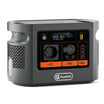
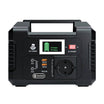

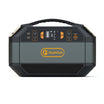
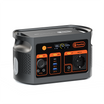


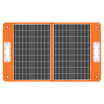
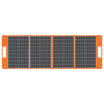


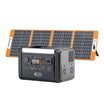

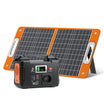


Short answer: choose FlashFish E106B when the verified load benefits from its larger published nominal energy: 384Wh versus 286Wh. Choose EcoFlow RIVER 3 Plus when lower listed mass, documented app control, extra-battery expansion or a published standby-UPS transfer specification matters more. Both list 600W continuous AC, but that headline alone does not make them interchangeable.
E106B vs RIVER 3 Plus: verified comparison
| Decision field | FlashFish E106B | EcoFlow RIVER 3 Plus | Why it matters |
|---|---|---|---|
| Nominal energy | 384Wh | 286Wh base station | E106B lists 98Wh more before conversion losses or reserve |
| Continuous AC | 600W pure sine | 600W pure sine for EU version | First load screen; not complete compatibility evidence |
| AC peak or boost | Not provided in local authoritative record | X-Boost documented separately by EcoFlow | Do not compare unlike peak or voltage-reduction claims |
| USB-C | 100W plus 30W ports | One 100W port in the manual | Check simultaneous limits and device protocol |
| 12V DC group | Shared 120W maximum | 126W car outlet maximum | Connector, polarity and startup still control |
| Solar input | 12-30V, 10A, 200W maximum | 11-55V, 13A, 220W maximum | Panel electrical fit matters before headline watts |
| Listed mass | About 5.2kg | About 4.7kg | RIVER 3 Plus is about 0.5kg lighter on the cited records |
| App, expansion, standby UPS | Not provided by the E106B evidence used here | Documented in EcoFlow's current manual | Choose documented continuity features when the use case requires them |
| Battery chemistry | Not provided by the authoritative local record | LFP in the official manual | Do not fill the E106B blank from a title or another market |
The energy difference is 98Wh, about 34% of the RIVER 3 Plus base figure. That arithmetic compares nominal labels only. It does not predict delivered AC energy, duration, ageing, standby draw or performance at a particular temperature.
Same 600W rating, different decision
A 600W continuous figure says a planned steady AC load must stay below that published ceiling. It does not describe start surge, voltage sensitivity, cable losses, every simultaneous port limit or how protection behaves. EcoFlow documents X-Boost as a separate operating feature with device restrictions; it should not be converted into an ordinary 1200W full-voltage comparison row.
The E106B record leaves peak output blank. A blank is not zero, but it is also not permission to borrow a figure from store-title copy, another version or a different model. For motor, compressor or protected-electronics loads, exact regional documentation and a controlled test remain necessary.
Three buyer cases make the trade-off concrete
- Measured light household loads, energy first: if every device is well inside 600W and the buyer values more nominal stored energy, E106B's 384Wh is the stronger documented starting point.
- Automatic continuity and app visibility: if a documented sub-10ms standby UPS, Wi-Fi/Bluetooth management or extra-battery path is required, RIVER 3 Plus has the clearer first-party evidence.
- Frequent carrying with a fixed load: RIVER 3 Plus lists about 0.5kg less mass, while E106B lists more nominal energy. The right choice depends on the measured energy need rather than mass or Wh alone.
None of these cases is a side-by-side result. They are decision paths based on equally defined published fields and explicit unknowns.
When FlashFish fits and when it does not
| E106B fits better when | E106B may not fit when |
|---|---|
| The load is within 600W and the extra 98Wh nominal energy matters | Automatic transfer with a published time is mandatory |
| Two separately listed USB-C outputs help the declared device set | App control or a documented expansion path is a purchase requirement |
| The buyer accepts about 5.2kg for the larger nominal energy figure | Every half-kilogram matters more than the additional nominal energy |
| Unknown fields can remain unknown until documentation improves | The decision depends on E106B chemistry, peak output or other unverified fields |
Compare E106B's published 384Wh and 600W envelope with your measured compact-backup load. Do not buy from the 600W row alone.
Compact-backup comparison checklist
- List every device, its normal watts, startup behaviour, voltage and required connector.
- Measure energy over the intended session; keep nominal Wh and delivered Wh separate.
- Decide whether manual changeover is acceptable or a documented transfer time is required.
- Check simultaneous USB and DC limits, not just the largest port number.
- Match panel open-circuit voltage, current, connector and polarity before solar charging.
- Recheck regional instructions, product status and checkout price on the decision day.
Electrical Safety First advises adding simultaneous loads, checking plugs, cables and adaptors for damage or heat and avoiding daisy-chained extension devices. Those steps apply regardless of brand.
Frequently asked questions
Is E106B a direct EcoFlow RIVER 3 Plus alternative?
It overlaps on 600W continuous AC and compact use, but it is not identical. E106B publishes more nominal energy; EcoFlow publishes lower mass, app control, UPS transfer evidence and expansion.
Which model stores more nominal energy?
The compared records list 384Wh for E106B and 286Wh for RIVER 3 Plus. Nominal watt-hours are not the same as delivered AC energy or a fixed appliance duration.
Do both stations have the same appliance capability because both say 600W?
No. A continuous AC figure is one gate. Start behaviour, voltage, waveform, all simultaneous loads, protection logic and device sensitivity still need model-specific evidence and testing.
Which model is better for automatic backup?
EcoFlow's manual documents standby UPS operation with transfer within 10ms. The E106B evidence used here does not publish an equivalent transfer specification, so do not assume one.
Which model is easier to carry?
The records list about 4.7kg for RIVER 3 Plus and about 5.2kg for E106B. Carry comfort still depends on shape, accessories, distance and the user's needs.
Conclusion: assign every advantage a job
E106B leads this paper comparison on nominal energy; RIVER 3 Plus leads on lower listed mass and documented app, UPS and expansion features. The winner changes with the load and continuity requirement. Use the Europe buying guide to check ports, energy, transfer needs and evidence gaps before choosing.
Sources and evidence boundaries
- FlashFish Europe E106B page plus the local product record for bounded FlashFish facts.
- EcoFlow Europe RIVER 3 Plus page for current model positioning.
- EcoFlow RIVER 3 Plus official manual for exact regional specifications and documented platform features.
- Electrical Safety First for load and cable checks.
Evidence checked 4 September 2026. No side-by-side test, price comparison or duration measurement was performed.





Yorum yazın
Bu site hCaptcha ile korunuyor. Ayrıca bu site için hCaptcha Gizlilik Politikası ve Hizmet Şartları geçerlidir.