


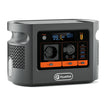
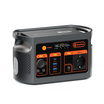

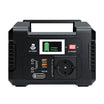
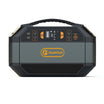
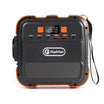

Direct answer: do not convert a shared maximum, headline wattage or guessed peak figure into a continuous AC rating. Leave the field unknown and pause the AC fit decision until an exact regional manual or written manufacturer answer defines it. You can still evaluate documented USB and DC paths separately, but only against the exact device input and every shared-group limit.
Method and limits. FlashFish Miles prepared this source-based FAQ from the exact E112B record, the current Europe support route and general equipment-suitability guidance. No E112B, AC appliance, USB or DC device, overload event, temperature condition, usable-energy result or runtime was tested.
1. Keep four power terms separate
| Term | Question it answers | What it cannot replace |
|---|---|---|
| Continuous AC | What running AC load the station can support under stated conditions | Peak magnitude, peak duration or appliance approval |
| Maximum or shared maximum | A stated ceiling across a named output or group | A continuous rating unless the source explicitly defines it that way |
| Peak or surge | A short-duration allowance with a stated magnitude and duration | Continuous running power |
| Nominal energy in Wh | A battery energy label | AC power, usable energy or fixed runtime |
2. Apply the rule to E112B
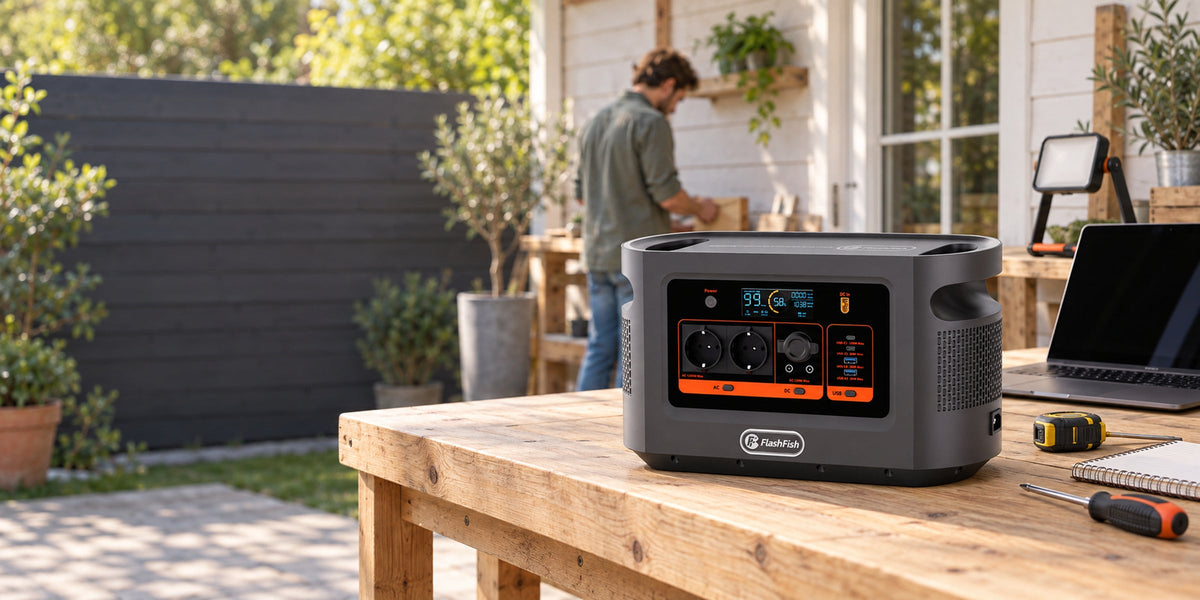
The current E112B Europe page is ACTIVE and sellable, and the exact record supports 1008Wh nominal capacity plus a 1200W shared maximum pure-sine AC figure. The continuous AC field and peak AC field remain unprovided. Therefore 1200W must stay labelled as a shared maximum, not a continuous or surge rating.
3. Use an evidence table before deciding
| Field | E112B evidence available | Decision status |
|---|---|---|
| Regional AC voltage | 230V for the EU version in the exact record | Still confirm the delivered regional variant |
| Continuous AC total | Not provided | Stop AC fit decision |
| Peak magnitude and duration | Not provided | Stop startup-demand decision |
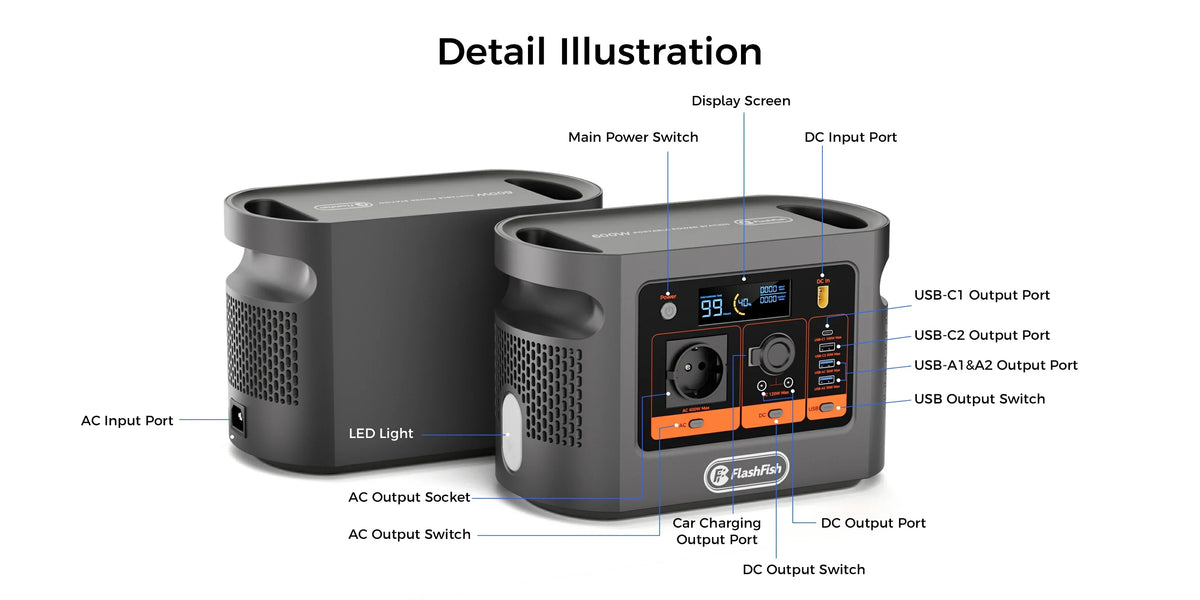
| USB-C | One output up to 100W and one up to 30W | Conditional on device profiles, cable and aggregate rules |
| USB-A | Two outputs up to 30W each | Conditional on device input and aggregate rules |
| 12V DC group | 12V/10A/120W shared | Conditional on connector, polarity, current and group total |
4. Do not use these substitutions
- Do not call 1200W continuous because it appears in the product name.
- Do not call 1200W peak because some other stations use headline watts for surge.
- Do not derive power from 1008Wh capacity.
- Do not copy a continuous rating from a related model.
- Do not use a short successful trial as the missing published rating.
5. Make the AC question exact
Write down the appliance model, regional voltage and frequency, running watts, startup or inrush evidence, waveform requirement, plug or adapter, operating temperature and the consequence of a shutdown. HSE guidance on electrically powered work equipment reinforces the need to check that equipment suits the task and supply and to use the rating plate or instruction book. A missing station rating is not spare headroom.
6. Request written clarification
Use the exact regional product name and ask: What is the E112B EU version's continuous AC output? Is the figure total across both outlets or per outlet? What is the peak magnitude and duration? What output frequency applies? Do temperature, battery state or other outputs cause derating? Which manual revision and test conditions define the answer?
Ask FlashFish EU support for the missing AC rating and preserve the written response with its date, regional scope and document revision.
7. Continue only with documented non-AC paths
You may screen a USB-C device against the documented 100W or 30W port, a USB-A device against its named port, or a 12V device against the shared 12V/10A/120W group. For every path, record the device input, cable, protocol, connector and any group or aggregate limit. The available record does not prove all port maxima are available at the same time.
8. Use three decision outcomes
| Outcome | When to use it | Next step |
|---|---|---|
| Supported non-AC path | Exact device input, cable and documented USB or DC output match | Run a supervised, bounded check |
| AC decision pending | Continuous or peak requirement is material and station evidence is missing | Obtain exact written evidence |
| Non-fit | The device requirement exceeds a documented limit or conflicts with the supplied path | Choose another supported supply; do not experiment around the limit |
Common mistakes
- Using a product-title wattage as every type of AC rating.
- Confusing energy capacity with output power.
- Assuming two AC outlets each receive the headline figure.
- Guessing peak output or duration from another model.
- Adding all USB and DC maxima as simultaneous output.
- Accepting a support answer that omits the regional version or rating definition.
FAQ
Can I use a 1200W maximum as a 1200W continuous rating?
No. Maximum, shared maximum, continuous and peak or surge are different definitions. Keep the continuous field unknown until an exact regional manual or written manufacturer answer supplies it.
Can I assume a peak rating from the maximum figure?
No. Peak magnitude and duration need their own evidence. A shared maximum does not define either one.
What can I still decide from E112B's documented fields?
You can screen exact USB-C, USB-A and 12V DC paths against their documented device inputs and shared-group limits, while keeping aggregate and simultaneous-use questions explicit.
Does 1008Wh answer the AC compatibility question?
No. Nominal energy and AC power are separate. Capacity does not supply a missing continuous output, startup capability, usable energy or runtime.
What should I ask support?
Name the regional variant and ask for continuous AC output, total versus per-outlet scope, peak magnitude and duration, frequency, temperature or derating conditions and the exact manual revision.
Decision and next step
A missing continuous AC rating is a decision boundary, not an invitation to choose a favourable number. Keep AC fit pending, continue only with fully documented USB or DC paths, and retain the exact written evidence that resolves the gap. If the answer remains ambiguous, choose a station whose continuous and peak definitions are explicit for the intended load.
Sources and further reading
- FlashFish Europe E112B
- FlashFish Europe Support Center
- HSE work using electrically powered equipment
Sources checked 5 November 2026. The E112B continuous and peak AC fields remain unprovided in the authoritative record used here.




Залишити коментар
Цей сайт захищено за допомогою hCaptcha. Застосовуються Політика конфіденційності та Умови надання послуг hCaptcha.