

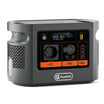
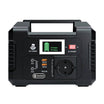

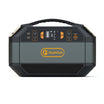
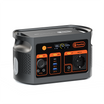


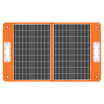
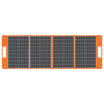


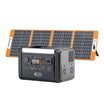

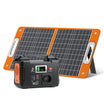


Short answer: FlashFish E106B can enter the shortlist for a small indoor event check-in desk when the exact laptop, scanner and receipt printer are mapped as separate power and data paths. Its documented envelope is 384Wh nominal energy, 600W shared continuous pure-sine AC, one AC outlet and USB-C output up to 100W on USB-C1. Those figures do not prove that an event system will work or last for a full session.
The useful planning question is not simply, “What is the total wattage?” A scanner may draw power from the laptop but still depend on the laptop for data. A receipt printer may use its own AC adapter and a separate USB or Ethernet link. The laptop may need USB-C Power Delivery or its original AC charger. Map all three paths, then test the complete workflow with a fallback admission plan.
Start with three separate paths
| Path | What to verify | Why it can fail |
|---|---|---|
| Laptop power | Exact USB-C input profile and cable, or the original AC adapter label | A 100W port does not mean that the laptop and cable negotiate that profile. |
| Scanner power and data | Host interface, proprietary cable, operating current, software and selected USB port | A powered scanner can still be unusable without a supported data host and configured event software. |
| Receipt-printer power and data | Regional adapter input, printer voltage, USB/Ethernet variant, print cycle and paper plan | The printer's internal voltage or mean current is not the same as maximum wall input. |
Next step: compare E106B with your complete check-in equipment list, including every charger and adapter rather than only the headline devices.
What the documented examples actually show
The authoritative E106B record lists one 600W shared AC output, a 100W USB-C1 port, a 30W USB-C2 port and two USB-A outputs. That can support a mixed-path plan, but shared groups and device negotiation still matter. Keep a written port map so a volunteer does not move the laptop onto a lower-power port or connect an unplanned appliance.
The Zebra DS2208 official support guidance provides one bounded scanner example: USB and keyboard-wedge host paths require the correct interface configuration. That shows why a powered barcode scanner can remain a critical data dependency. It does not prove that another scanner, cable or event application will behave the same way.
The Epson TM-T20III page supplies a separate receipt-printer example: an AC adapter, 24V operating voltage and USB or Ethernet variants. Its listed mean current must not be converted into a universal maximum wall watt figure. Use the delivered adapter's regional input label for the load screen.
A practical admission-desk worksheet
| Decision | Evidence to collect | Pass condition |
|---|---|---|
| Power ceiling | Maximum adapter inputs and every simultaneous AC load | Total remains within 600W with sensible margin; no unknown startup load. |
| USB-C path | Laptop input profiles and cable marking | The station, cable and laptop share a supported profile. |
| Data path | Scanner/printer interface, drivers, ports and event application | A complete offline test produces the correct attendee record and receipt. |
| Session energy | Measured representative period with real scanning and printing | Projected session includes reserve and is not based on an idle display. |
| Continuity | Offline list, manual admission and receipt fallback | The event can continue if battery, printer, network or software fails. |
Three examples that change the plan
1. A host-powered scanner and USB-C laptop
The scanner may add little electrical demand, but it consumes a laptop USB port and depends on the host. Confirm the scanner's proprietary cable, driver, keyboard mode or application interface, then confirm the laptop still receives adequate power from E106B USB-C1. A successful scan into a blank text field is not the same as a successful event check-in workflow.
2. An AC receipt printer plus an AC laptop charger
E106B has one AC outlet. A correctly rated extension may add sockets, but it does not increase the 600W ceiling. Record both adapter maximum inputs, keep the lead accessible and dry, and test a real burst of receipts. If the laptop can use a verified USB-C path, separating it from AC may simplify the outlet plan; it does not remove its energy use.
3. A desk that must keep admitting people after a fault
If a queue cannot stop, battery capacity is only one layer of resilience. Keep an offline attendee list, a charged secondary device and a manual record. Decide whether receipts can be issued later. This is more useful than promising a runtime that changes with screen brightness, networking, print frequency, battery condition and conversion losses.
When E106B fits
- The desk is indoors, dry and supervised.
- The exact combined AC load stays below 600W and the laptop has a verified power path.
- The scanner and printer complete a full data workflow before the event.
- The 5.2kg station and all accessories can be placed without obstructing visitors or cables.
- A measured representative session leaves a reserve for the planned operating window.
When E106B does not fit
- An essential device has an unknown or over-ceiling maximum input.
- The printer, scanner or software requires an unsupported interface.
- The desk is outdoors, damp or exposed to drinks, foot traffic or unstable placement.
- The event depends on uninterrupted operation but has no manual admission fallback.
- A longer-duration plan is based only on nominal Wh divided by one momentary watt reading.
Safety boundary: keep the station ventilated, place connections away from drinks and walking routes, and use only undamaged correctly rated leads. Do not daisy-chain adapters or treat a protection trip as permission to retry an overloaded setup. Follow each manufacturer manual and venue rules.
Frequently asked questions
Can I plug a USB ticket scanner directly into E106B?
Power alone is not enough. Many scanners also need a host data connection and configured event software. In the documented example, plan the scanner as a laptop peripheral unless its exact manual specifies another supported host path.
Can E106B power a receipt printer and laptop at the same time?
It may be a candidate when the exact printer adapter, laptop charging path and every other simultaneous load fit the documented output limits. Measure the complete print-and-scan workflow before depending on it.
Does a 100W USB-C port mean the laptop receives 100W?
No. The source, cable and laptop negotiate a supported profile. Confirm the laptop input requirement and cable rating rather than relying on a port headline.
How should I estimate event runtime?
Log energy over a representative session with scanning, screen use, network activity and real receipt printing. Do not divide 384Wh by one idle reading and call the result a promised event duration.
What is the minimum fallback for an admission desk?
Keep a charged laptop or phone with an offline attendee list, a manual check-in method and a plan for receipts or tickets if the printer or network becomes unavailable.
Before purchase: ask FlashFish support about your exact power paths, including the delivered regional labels and all concurrent devices.
Sources and evidence limits
Checked 8 October 2026. E106B specifications come from the authoritative FlashFish manual-derived local record; the current Europe page and Admin snapshot establish an active public route. Zebra and Epson manufacturer sources define the bounded device examples. USB-IF explains negotiated Power Delivery, and Electrical Safety First supplies general cable and combined-load context. FlashFish publishes this guide. No physical event station, runtime, queue, printer cycle or software stack was tested, and the selected image is context rather than evidence.





Залишити коментар
This site is protected by hCaptcha and the hCaptcha Privacy Policy and Terms of Service apply.