




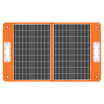
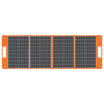


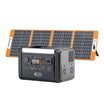

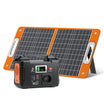

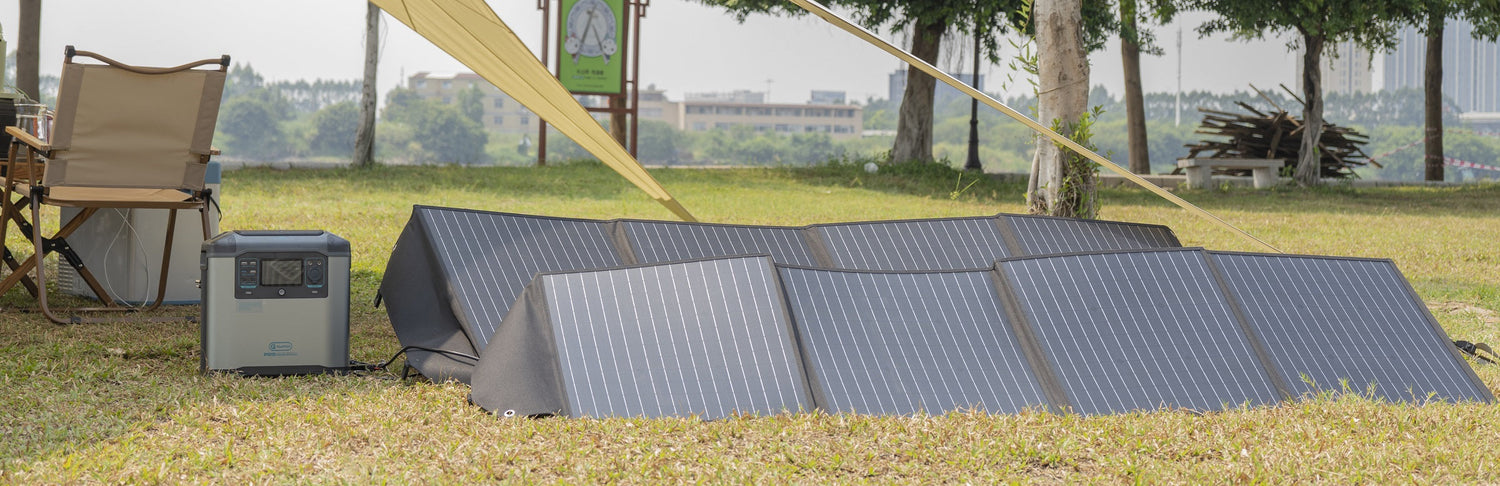
Short answer: do not decide from watts or connector shape alone. A compatible setup must pass four locks: panel voltage must stay inside the station’s accepted range, current must respect the input limit, useful power cannot exceed what the controller can accept, and the connector, polarity and approved configuration must match.
This guide gives European portable-power buyers a repeatable pre-purchase check. It does not provide a series/parallel wiring recipe or approve a panel that the current manuals do not explicitly support.
The four locks of solar-panel compatibility
| Lock | Read from the panel | Read from the station | Pass condition |
|---|---|---|---|
| Voltage | Voc and operating voltage/Vmp | Accepted/start voltage range and absolute maximum | All stated conditions remain within the manufacturer limits |
| Amps | Operating current/Imp and short-circuit current/Isc where required | Maximum accepted input current | The exact approved configuration respects the current rules |
| Maximum watts | Panel or array rated power | Maximum solar-input power | Planned power and manufacturer over-panel rules are explicit |
| Plug | Connector, polarity, cable and any control electronics | Input connector and permitted adapters | Physical and electrical interfaces both match |
V: start with open-circuit voltage, not nominal watts
Open-circuit voltage (Voc) is the panel voltage when no load is connected. It is not the same as a marketing label such as “18V panel.” The station’s manual should state an accepted operating range and a maximum PV voltage. The array’s worst credible Voc must remain below that maximum; do not assume protection circuitry makes an over-voltage design acceptable.
Victron’s MPPT guidance explains the general principle: the array Voc must remain below the controller’s maximum rating, and cold conditions can raise Voc. Its product-specific thresholds do not transfer to FlashFish; only the exact FlashFish manual and panel label control a FlashFish pairing.
A: current is a separate ceiling
Current tells you how much the panel can supply at its operating point. Compare the panel’s Imp—and Isc when the manual requires it—with the station’s accepted current and the rules for the exact configuration. Never infer a safe parallel arrangement merely because each individual panel looks small.
M: watts describe opportunity, not fixed input
Panel watts are a rated condition, while the station has its own input ceiling. A 400W input label does not promise 400W on a cloudy afternoon, and a higher-wattage panel is not automatically safe. The European Commission JRC PVGIS exists precisely because solar resource and PV performance change with location and time of year.
P: a plug is necessary but not sufficient
A connector adapter can make two plugs meet, but it cannot correct voltage, polarity, current, cable rating or an unsupported configuration. Record the exact connector at both ends, approved adapter, polarity and cable specification. If the manuals conflict or omit one of these facts, the pairing is not cleared by this checklist.
Worked example: T1200S and TSP100
The manual-derived FlashFish database records the T1200S solar input as 12–50V, 10A and 400W maximum. It records the TSP100 at 18V, 5.6A and 100W nominal DC output, with several connector adapters supplied.
| VAMP field | Available evidence | Decision |
|---|---|---|
| Voltage | T1200S input range is recorded; TSP100 nominal output is recorded, but TSP100 Voc is blank in the local bundle | Human/manual check required before calling the pairing electrically approved |
| Amps | T1200S 10A maximum; TSP100 5.6A nominal operating current | Promising for one-panel planning, but exact label/manual conditions still control |
| Maximum watts | T1200S 400W maximum; TSP100 100W rated | Watt labels alone do not close the voltage or connector gates |
| Plug | T1200S Anderson input; TSP100 record lists DC adapters | Confirm the exact supplied cable/adapter and polarity for the current Europe products |
This is an example of good evidence boundaries: three fields look compatible, but one missing safety-critical value prevents the database from proving the entire pairing. The correct next step is to check the current panel label and both regional manuals—not to fill the gap with an assumption.
Why a compatible setup can still charge slowly
Electrical compatibility only means the system can be used within documented limits. Input can remain below the panel label because of low sun angle, cloud, seasonal differences, panel temperature, shade, dirt, cable loss or the station controller ceiling. The PVGIS user manual models orientation, slope and horizon effects; use it for planning, then compare with real measurements rather than promising a recharge time.
Common solar-pairing mistakes
- Checking watts first: voltage is the safety gate that cannot be repaired by a lower load.
- Using “18V” as Voc: nominal or operating voltage is not automatically the open-circuit maximum.
- Treating an adapter as a converter: most simple adapters do not change electrical limits.
- Copying a multi-panel layout from another model: series/parallel rules are controller-specific.
- Promising nameplate input: solar conditions and controller behaviour vary.
- Ignoring cable and polarity: a mechanically fitting connector may still be electrically wrong.
Solar compatibility worksheet
| Field | Panel value/source | Station value/source | Pass / unresolved |
|---|---|---|---|
| Voc at stated conditions | ____________ | Maximum: ____________ | ____________ |
| Vmp / operating voltage | ____________ | Range: ____________ | ____________ |
| Imp / Isc where required | ____________ | Maximum: ____________ | ____________ |
| Rated panel/array W | ____________ | Maximum: ____________ | ____________ |
| Connector / polarity / cable | ____________ | Approved: ____________ | ____________ |
| Exact configuration allowed | Manual section: ______ | Manual section: ______ | ____________ |
When FlashFish fits
- The current panel and station labels complete all four VAMP fields without assumptions.
- The expected use is within the verified input range, current and power limits.
- The buyer accepts variable solar input and plans from location and season rather than a fixed recharge promise.
- The exact cable, adapter and polarity are approved by the current product instructions.
When FlashFish does not fit—or the pairing should pause
- Voc, polarity, connector or permitted configuration is missing or contradictory.
- The proposed array exceeds the station’s maximum voltage or depends on an unreviewed multi-panel design.
- The buyer needs a fixed daily harvest or recharge time.
- The plan requires cable modification, bypassing protection or live electrical measurements by an unqualified user.
Safety boundary
Do not open, modify or rewire the station or panel. Do not connect or disconnect damaged or wet equipment, and do not measure exposed PV conductors unless you are qualified and using the correct equipment. Follow the exact regional manuals. When the label data is missing, stop and ask the manufacturer or a qualified technician.
Frequently asked questions
Can I use any solar panel with a portable power station?
No. Voltage, current, watts, connector, polarity and approved configuration must all match.
Is matching panel watts enough?
No. A suitable watt label can coexist with an unsafe voltage or incompatible connector.
What is open-circuit voltage?
Voc is the panel voltage with no load connected. It is a critical maximum-value check.
Can I use a panel rated above the station’s watt input?
Only when the exact manufacturer instructions explicitly permit that design and every voltage/current/configuration rule is satisfied.
Does an adapter make products compatible?
No. It changes the physical interface, not the underlying electrical limits.
Why is real solar input below the panel label?
Sun, season, shade, temperature, dirt, cable loss and controller limits all affect observed input.
Sources and further reading
- European Commission JRC: PVGIS and PVGIS user manual—location, season, slope, orientation and horizon context.
- Victron Energy: MPPT troubleshooting—general maximum-voltage, shade and low-yield principles.
- FlashFish Europe: T1200S, TSP100 and the local product-source bundle—first-party product example and disclosed missing Voc field.
Human review note: confirm the current Europe labels and manuals, especially TSP100 Voc, exact cables and polarity, before publication.



Leave a comment
This site is protected by hCaptcha and the hCaptcha Privacy Policy and Terms of Service apply.