

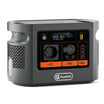
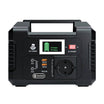

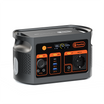






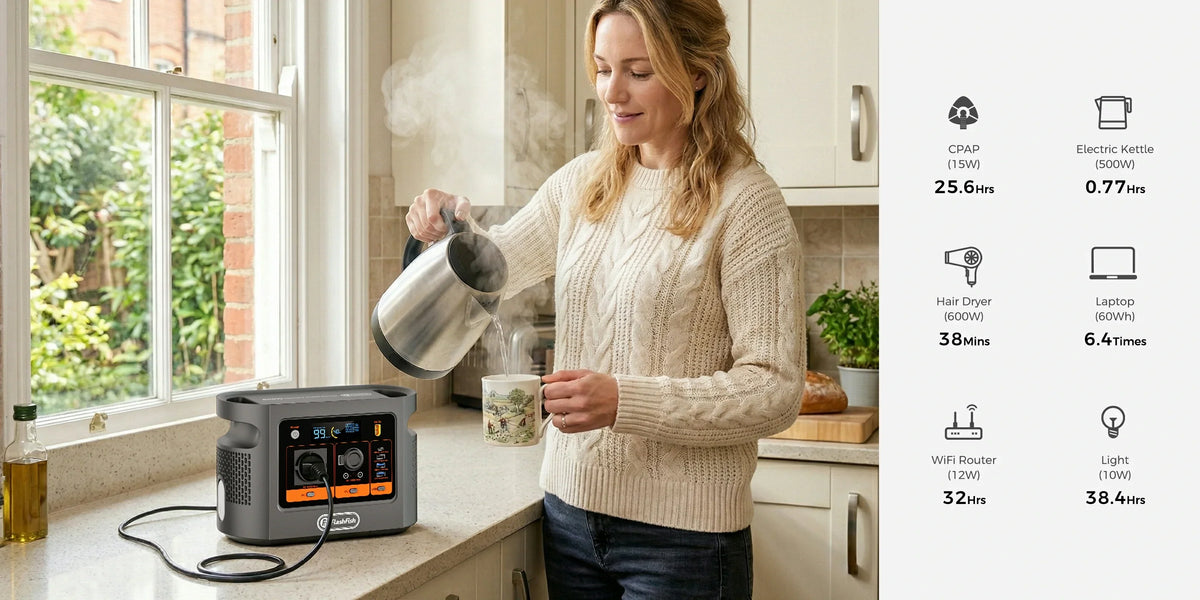
Short answer: E106B is a plausible power source for many small portable air purifiers when the exact purifier is compatible with the station's regional AC output. As a concrete screen, Philips lists 21W maximum power for its AC0920/10 purifier, far below E106B's 600W continuous AC rating. That comparison is not a compatibility test, a runtime promise or evidence of cleaner air in a particular home.
The decision needs two separate questions. First, can the electrical path support the exact purifier safely? Second, does running that purifier address the room's actual indoor-air goal? A low wattage can answer part of the first question; it cannot answer the second.
In this guide: AIR method · 21W example · measurement test · room limits · FAQ
Use the AIR method before connecting an air purifier
A — Appliance input: read the exact purifier label and manual. Record input voltage, frequency and maximum watts or amps. Confirm that the delivered plug and cable are intact and intended for the regional model. Do not transfer a value from a related purifier in the same series.
I — Inverter path: compare the appliance with the delivered E106B label. The authoritative local record lists 600W continuous pure-sine AC output and 110V or 230V regional variants. Confirm the regional voltage and frequency on the actual unit. One AC outlet is recorded, so avoid building a multi-appliance plan around an unexamined adaptor chain.
R — Room goal, reserve and fallback: define what the purifier is intended to do, choose an operating mode, measure the complete load and preserve energy for an orderly fallback. If indoor-air conditions become unsafe or the equipment cannot be verified, move to the household emergency plan rather than extending the experiment.
| AIR check | Record | Do not infer |
|---|---|---|
| Appliance | Exact model, input label and operating mode | That all purifiers use the same watts |
| Inverter | Regional AC voltage, frequency and continuous rating | Automatic UPS transfer or compatibility |
| Room | Room size, purifier CADR, pollutant source and ventilation option | A guaranteed health or smoke-removal outcome |
| Reserve | Measured watts, accumulated watt-hours and other loads | A duration obtained by dividing two label numbers |
What the 21W Philips example tells us
Philips lists the AC0920/10 at 21W maximum power, less than 1W standby, 100-240V input and 50/60Hz. It also lists a clean-air delivery rate of 250 cubic metres per hour and a room-size statement up to 65 square metres. These fields describe one exact appliance; they should be checked again on the delivered label.
On output power alone, 21W is comfortably below the E106B's 600W continuous AC rating. This is a useful rejection screen: the example is not obviously too large for the station. It still does not prove how the purifier electronics behave on the station, how long the station will run, whether other loads are connected, or whether the purifier is appropriate for the room.
Why a simple watt-hour division is not a runtime result
E106B's 384Wh figure is nominal stored energy. A purifier's published maximum is not necessarily its constant wall demand. AC conversion, station overhead, fan mode, filter loading, temperature and any other connected devices change the usable duration. A calculation using 384Wh divided by 21W would omit those variables and should not be presented as a promise.
The stronger method is to measure. Record the purifier's watts in each mode, then record accumulated watt-hours over a representative session. Repeat after the filter and room routine are established. Preserve a reserve for shutdown and for any higher-priority communication or lighting load in the household plan.
Run a controlled home test before an outage
- Verify the exact E106B regional label, purifier model and original power cord.
- Place the station and purifier on stable, dry, ventilated surfaces with both products' clearances respected.
- Disconnect other station loads so the purifier boundary is easy to measure.
- Start at the intended fan mode and observe both steady watts and any brief change when the unit starts or changes speed.
- Run a representative session and record accumulated watt-hours, not only one instant reading.
- Stop with a planned reserve and confirm the purifier restarts normally after a manual disconnect.
- Document the setup so a different family member does not add uncounted loads during an outage.
Do not put the station in the purifier's intake or exhaust path, cover either product, use damaged leads, or operate in wet conditions. E106B is not a generator-fume control device. Fuel-burning generators and combustion appliances introduce separate carbon-monoxide and ventilation hazards and belong outside this electrical fit check.
Electrical fit does not establish room performance
EPA guidance says portable air cleaners are intended to filter a single room and that CADR should be appropriate for the room. Higher fan speeds and longer operation generally filter more air, but an air cleaner cannot remove every pollutant. Source control and clean outdoor-air ventilation, when appropriate and safe, remain important.
This matters in a power cut because the household may close windows, stop mechanical ventilation or change cooking and heating behaviour. A purifier that draws modest power can still be the wrong response to an uncontrolled source, carbon monoxide, inadequate oxygen or an emergency that requires leaving the building. Follow local emergency and public-health guidance for the actual event.
| E106B can be considered when | Use another plan when |
|---|---|
| The exact purifier label fits the delivered regional AC output with substantial headroom. | The voltage, frequency, plug, cable or appliance identity is uncertain. |
| You can measure the purifier alone and preserve a reserve. | The plan depends on an untested duration or shares power with priority loads. |
| The purifier is one part of a documented room-air plan. | The situation involves combustion fumes, an evacuation notice or a medical requirement. |
| Manual connection and restart are acceptable. | You require verified uninterrupted transfer or remote unattended operation. |
For the electrical screen, Compare E106B with your purifier input label. Let the exact appliance label and a representative measurement decide, not the product category name.
FAQ
Can E106B run every portable air purifier?
No. Check the exact purifier input label, regional plug, starting behaviour and measured demand. The appliance name alone does not establish compatibility.
Does the 21W Philips example prove a long runtime?
No. It only supports an output-power screen for that exact model. Actual duration depends on operating mode, station overhead, usable energy, other loads, temperature and the reserve you keep.
Should I choose an air purifier only by room-size marketing?
No. Check the exact room, CADR, operating mode, filter condition and manufacturer instructions. A room-size claim is not an electrical or health guarantee.
Can I connect other appliances at the same time?
Only after counting their simultaneous demand and confirming the complete arrangement stays within every station, cable and appliance limit. Separate non-essential loads during an outage.
Is a portable air cleaner a substitute for ventilation or source control?
No. EPA guidance treats filtration as one part of indoor-air management and notes that air cleaners do not remove every pollutant.
Conclusion
E106B clears the first label screen for the exact 21W Philips example, but a responsible decision still needs the delivered labels, a measured session, a reserve and a separate room-air plan. If your use case extends beyond one purifier, Read more practical home-backup guides before assigning the station additional loads.
Sources and editorial notes
Station fields come from the authoritative local E106B manual-derived record and current Europe Shopify status. The appliance example comes from Philips' AC0920/10 product and support information. Indoor-air boundaries come from the US EPA. No product connection, runtime trial, CADR measurement, indoor-air measurement, medical outcome or uninterrupted-transfer result is claimed. Human review must check the exact regional labels, current source versions and rendered article before publication.



Leave a comment
This site is protected by hCaptcha and the hCaptcha Privacy Policy and Terms of Service apply.