

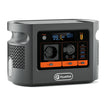
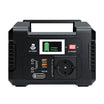

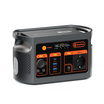






Short answer: the published labels for a Weller WE1010 230V station and ZeroSmog Shield Pro total 105W, which is below the FlashFish E106B's documented 600W continuous AC limit. That makes the pair plausible on paper, not proven compatible. You still need to verify the exact regional labels, plugs, cables, complete load, safe hot-tool placement and effective fume capture before a supervised first run.
Use LABEL-SUM-FUME-PLACEMENT-TEST: read each input label, total every device that will run together, treat fume control and bench layout as independent gates, then observe the complete setup without assuming runtime or uninterrupted operation.
The 105W calculation is a screen, not a test result
| Item | Documented input or limit | What it tells you | What remains unknown |
|---|---|---|---|
| Weller WE1010 Set 230V | 85W power unit; 230V model | Use 85W in the planning sum | Actual heater duty cycle and startup behaviour |
| ZeroSmog Shield Pro | 20W; 110-240V, 50/60Hz | Use 20W in the planning sum | Capture effectiveness at your placement and process |
| Worked pair | 85W + 20W = 105W | Below the E106B continuous AC limit on paper | Cables, accessories, behaviour and runtime |
| FlashFish E106B | 230V/50Hz pure-sine AC; 600W continuous | Defines the station-side AC envelope | No tool-specific approval or measured bench result |
Check E106B against your complete bench load after reading the labels on the actual equipment, not just the worked examples.
Start with the labels on your equipment
Record the soldering station's input voltage, frequency and watts. Do the same for the extractor, task lamp, microscope, hot-air tool, laptop charger and anything else that may be switched on. Use input ratings, not the soldering iron tip's advertised output alone. If an item shows amperes rather than watts, do not improvise a conclusion when power factor or control electronics are unclear; use the manufacturer's input specification or ask a competent person.
Fume control is not part of the watt calculation
A low electrical load does not make solder fume harmless. HSE identifies rosin-based solder flux fume as a health risk and recommends effective extraction, avoiding the plume and controlling temperature. An extractor must be positioned and maintained so it captures the plume at the work. A fan running somewhere on the bench is not evidence of effective capture, and the E106B's ability to energise it is not a workplace exposure assessment.
Hot-tool placement and cable routing are separate gates
Use the iron manufacturer's stand on a stable, non-combustible surface. Keep battery-station vents, mains leads, DC cables and flammable materials away from the hot tool. Route cables so an operator cannot pull the iron or extractor off the bench. Inspect plugs and insulation before use, and stop for damage, odour, abnormal heat, repeated trips or unstable operation.
Run a supervised first-use sequence
- With the tools unplugged, confirm the E106B regional label, ventilation clearance and sufficient state of charge.
- Connect only the extractor, position its inlet for the planned task and confirm normal airflow and sound.
- Add the soldering station, keep the iron in its stand during warm-up, and observe the full setup before beginning work.
- If another device is needed, stop, update the load sheet and repeat the complete-load check rather than adding it casually.
Three practical workbench examples
- WE1010 plus Shield Pro only: the 105W label sum passes the basic E106B power screen. Proceed only with verified 230V equipment, intact leads, safe placement and effective fume capture.
- The same pair plus a 300W hot-air rework station: the label sum becomes 405W before any other load. It remains below 600W arithmetically, but the exact hot-air unit, startup behaviour, simultaneous use and bench safety still need verification.
- An unidentified iron and a fan with unreadable labels: stop. Connector shape, appearance and past use on another supply do not replace input specifications.
When E106B may fit
- Every device is a correctly labelled European model and its total simultaneous input remains below the documented continuous AC limit.
- The soldering station, extractor and accessories use intact, correctly rated plugs and leads.
- The fume extractor is appropriate for the process, correctly placed and maintained.
- The hot tool has a stable stand, clear workspace and safe cable route.
- The first complete run is supervised and non-critical.
When it does not fit
- A device label, plug, input rating or protective requirement is unknown.
- The plan depends on a claimed surge margin, runtime or tool compatibility not documented here.
- The extractor cannot be positioned to capture the plume or suitable fume controls are unavailable.
- The setup obstructs E106B ventilation or places hot tools, liquids or combustible material near the station.
- The work requires validated uninterrupted power, formal workshop compliance or an exposure-control assessment.
Frequently asked questions
Can E106B run the Weller WE1010 and ZeroSmog Shield Pro together?
Their published input ratings total 105W, below E106B's documented 600W continuous AC limit. That is a paper power screen, not a compatibility result. Verify the exact 230V labels, plugs, cables, complete load, placement and behaviour during a supervised first run.
Does a 105W label total mean the setup will use exactly 105W?
No. Nameplate arithmetic supports planning; thermostat cycling, fan settings and measurement method affect observed draw. This guide makes no runtime or energy-use prediction.
Is a desktop fume extractor optional if the power load is small?
Power fit and fume control are separate decisions. HSE guidance treats solder fume as a health risk and recommends effective extraction and keeping the operator out of the plume.
Can I use a multiway adaptor for the two devices?
Use only suitable, undamaged, correctly rated equipment and follow each manufacturer's instructions. Do not daisy-chain adaptors, overload an accessory or use a lead that creates a trip or hot-tool hazard.
How long will E106B power the bench?
This article does not give a runtime figure. Heater duty cycle, extractor setting, conversion losses, ambient conditions, battery state and other simultaneous loads all change the result.
Conclusion
The named 85W soldering station and 20W extractor clear E106B's 600W continuous AC screen on paper, but the safe decision is built from the entire bench: labels, simultaneous loads, fume capture, hot-tool placement, cables and observed behaviour. Ask FlashFish Europe about the exact 230V load when a station-side value remains unclear.
Sources and evidence limits
Checked 17 October 2026. E106B facts come from the authoritative local product record and current Europe page. Weller supplies the two example product ratings; HSE supplies general fume-control and electrical-condition guidance. No E106B, soldering station, extractor or complete bench was connected or measured. No compatibility, solder quality, fume-capture, runtime, uninterrupted-operation or workshop-compliance result is claimed. The featured image is contextual only.



Leave a comment
This site is protected by hCaptcha and the hCaptcha Privacy Policy and Terms of Service apply.