

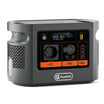
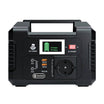

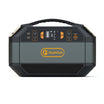
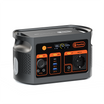


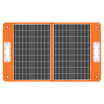
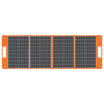


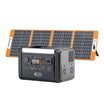

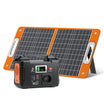

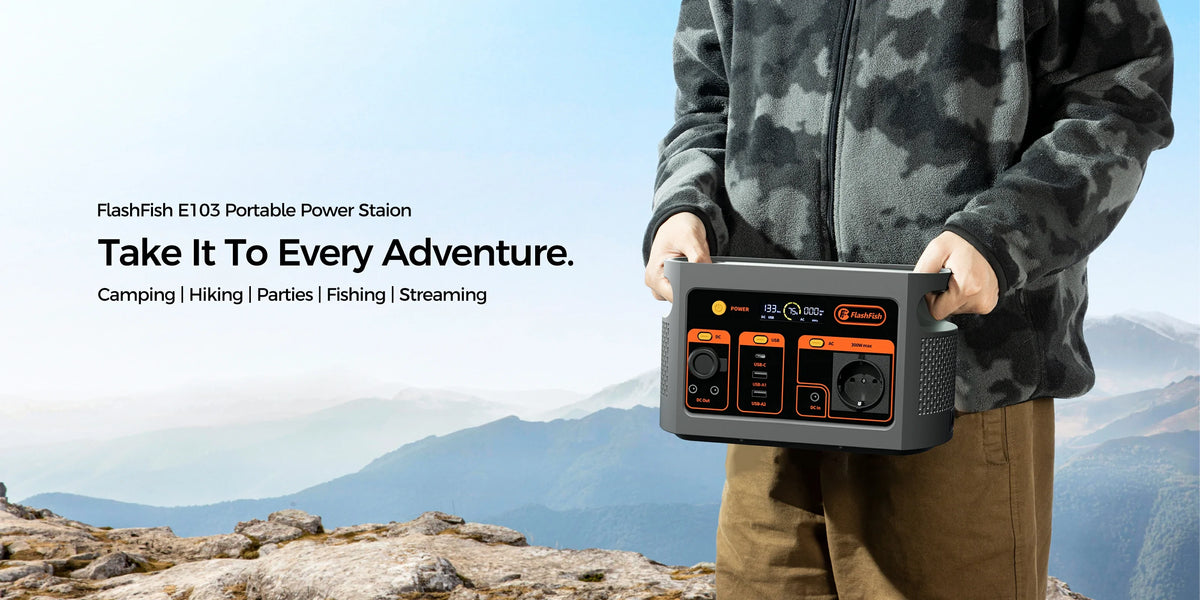
Short answer: choose E103 when the verified load needs up to 300W pure-sine AC, a 60W USB-C path or more nominal energy. Choose E200 when a lighter 1.85kg station is the stronger constraint and the device is documented for its 200W modified-sine AC or USB-A outputs. Neither is the universal winner: the device path decides before capacity or weight.
E103 vs E200: documented fields
| Decision field | FlashFish E103 | FlashFish E200 |
|---|---|---|
| Nominal battery energy | 179.2Wh | 151Wh; public page also labels 144.3Wh engineering battery energy |
| AC output | 300W continuous, 600W surge, pure sine wave | 200W continuous, 400W peak, modified sine wave |
| High-power USB path | One USB-C PD port up to 60W; two USB-A QC ports up to 18W each | No USB-C in the local record; two USB-A QC ports up to 18W and one 12W USB-A port |
| DC/solar input ceiling | Up to 90W | Up to 40W |
| Battery record | LiFePO4; 3000+ cycles to 80%+ in the local record | Lithium-ion 18650; more than 800 cycles in the local record |
| Listed mass | Approximately 3kg | Approximately 1.85kg net |
Use PATH-200-300 instead of choosing by one headline
- P - Power path. Decide whether the device uses AC, USB-C, USB-A or 12V DC. A 300W AC label says nothing about a USB port's ceiling.
- A - AC envelope. Check continuous watts, starting demand, voltage, frequency and waveform. Modified sine wave is a real decision boundary, not a minor footnote.
- T - Total energy and time. Compare nominal Wh only after the output path fits, then measure actual Wh and preserve reserve rather than promising runtime.
- H - Haul and recharge. Compare mass, size, included charger and input limits against the real trip. A lighter station may be the better tool for a smaller verified load.
Exactly three buyer examples
Example 1: a laptop that accepts 60W USB-C Power Delivery
E103 has the documented direct path: one USB-C PD output up to 60W. E200's local record has USB-A and AC but no USB-C output. Confirm the laptop's accepted PD profile and cable; 60W printed on one port does not prove every laptop will charge at 60W.
Example 2: camera batteries, phones and small USB-A accessories
Both models can serve documented USB-A loads within their port limits. E200 weighs about 1.15kg less, which may matter more than its lower nominal energy for a walk-in kit. Count every charger and its protocol before choosing; do not translate nominal Wh into a fixed number of battery charges.
Example 3: a 250W AC device that requires pure sine wave
E200 fails both the 200W continuous ceiling and the waveform requirement. E103 passes those two paper gates at 300W pure sine, but voltage, frequency, starting demand, grounding and the device manual still decide. Passing 250W on paper is not a compatibility test.
Where each model is strongest on paper
| Choose E103 when | Choose E200 when |
|---|---|
| The exact AC load needs pure sine wave and remains within 300W continuous with starting margin | The exact load stays within 200W and explicitly accepts modified-sine AC, or avoids AC entirely |
| A verified USB-C PD device needs up to 60W | The kit is USB-A based and the port limits are sufficient |
| 179.2Wh nominal energy and a 90W input ceiling improve the plan | Lower net mass and smaller dimensions matter more than the additional headroom |
| The documented LiFePO4 and cycle record matters to the buying brief | The documented lithium-ion record fits the budget and use case after all electrical checks |
What neither specification table proves
- Delivered AC or USB energy, because conversion losses and station overhead are not measured here.
- A fixed runtime or charge count for any device.
- Noise, thermal behaviour, charging speed in actual weather, long-term reliability or service outcome.
- Compatibility with a medical, precision, motor-driven, audio or waveform-sensitive device.
- That a public sale price or inventory count will still be current at publication.
When FlashFish fits - and when it does not
| FlashFish may fit when | Choose another class or verify more evidence when |
|---|---|
| The exact path, waveform and continuous load are documented and inside one model's port limits | The device label, starting demand or waveform requirement is missing |
| The measured session fits the energy plan with reserve | The decision depends on nominal Wh divided by label watts as a promise |
| The carry burden and charging-input ceiling match the trip | The trip requires weather exposure, unattended critical continuity or an undocumented connector |
| A current Europe page and regional manual match the delivered product | The delivered label conflicts with the page or local record |
Choose E103 when your verified path needs 300W pure-sine AC or 60W USB-C. Choose E200 when lower carry mass fits a verified light-duty load.
Frequently asked questions
What is the main difference between E103 and E200?
E103 documents 300W pure-sine AC and 60W USB-C, while E200 documents 200W modified-sine AC, USB-A outputs and lower carry mass. Start with the device path, not the model name.
Which has more nominal battery energy?
The authoritative local records list E103 at 179.2Wh and E200 at 151Wh nominal capacity. Neither figure is measured usable AC energy or a runtime promise.
Is E200 better because it is lighter?
Only when its 200W modified-sine AC and USB-A paths fit the exact load. Lower mass does not override device requirements, but it is a genuine advantage for a small verified kit.
Is E103 suitable for every device under 300W?
No. Voltage, frequency, waveform, starting demand, connector, individual port limit and the device manual still have to match. Rated watts alone never establish compatibility.
Which model has faster solar input?
The local records list up to 90W DC/solar input for E103 and 40W for E200. Panel voltage, current, connector, polarity, sunlight and temperature still govern compatibility and real charging.
Sources and evidence limits
- FlashFish E103 Europe page and the manual-derived local record.
- FlashFish E200 Europe page and the manual-derived local record, including the visible capacity boundary.
- FlashFish Europe portable power station collection - current category context only.
- FlashFish Europe Support Center - regional documentation route.
No hands-on test, price comparison, runtime measurement, charging-speed result or universal winner is claimed.
Conclusion
E103 is the stronger paper fit for higher AC headroom, pure-sine requirements and a 60W USB-C path. E200 is the lighter option for verified light-duty USB-A or compatible AC loads. Choose E200 when lower carry mass fits a verified light-duty load, or finish the choice with PATH-200-300 and the delivered regional labels before browsing the wider collection.



Leave a comment
This site is protected by hCaptcha and the hCaptcha Privacy Policy and Terms of Service apply.