

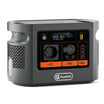
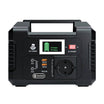

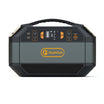
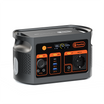






Disclosure: this comparison is published by FlashFish. It uses current manufacturer product pages, the EcoFlow regional manual and the authoritative local FlashFish product database. No side-by-side test was performed, and this is not an independent review.
Important E103 evidence issue: the current FlashFish Europe page contains conflicting AC-waveform wording and inconsistent outlet copy. Those fields are excluded from the comparison. Confirm the corrected regional page/manual before making a waveform-dependent purchase.
TRAIL comparison table
| TRAIL factor | FlashFish E103 | EcoFlow RIVER 3 | Buyer takeaway |
|---|---|---|---|
| T — Total energy | 179.2Wh | 245Wh | RIVER 3 lists 65.8Wh more rated capacity; this is not a fixed runtime difference. |
| R — Rated AC load | 300W continuous; 600W peak/surge listed | 300W rated; 600W surge/X-Boost class listed | Same continuous class. Do not equate X-Boost with startup compatibility. |
| A — Access and ports | USB-C up to 60W; DC/solar input up to 90W | USB-C up to 100W; solar input up to 110W | RIVER 3 has higher headline USB-C and solar ceilings. |
| I — Interface and continuity | No comparable app/EPS evidence established here | App control; EPS below 20ms listed | RIVER 3 has clearer evidence when those features are required. |
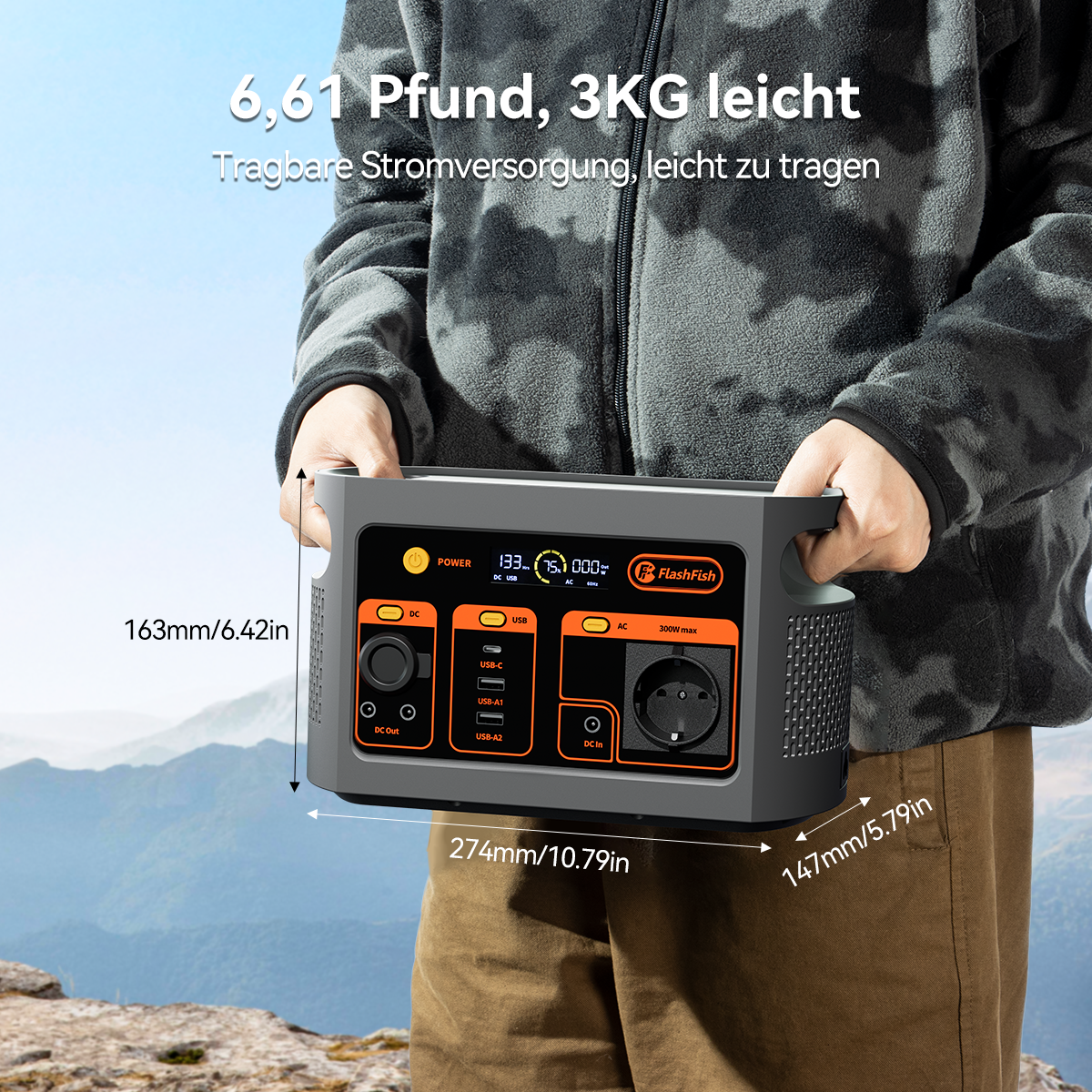
| L — Load and carry trade-off | 3kg; 274 × 147 × 163mm | 3.55kg; 255 × 212 × 113mm | E103 is 0.55kg lighter; shape and packing footprint differ. |
T — Start with the actual energy list
RIVER 3's 245Wh rating is 65.8Wh above E103's 179.2Wh. That can create useful reserve, but neither number promises a fixed count of laptop charges or a number of camping hours. USB/DC/AC conversion, inverter overhead, temperature, device charging behaviour and retained reserve all change delivered energy.
Write the watt-hours needed by phones, lights, cameras and computers before choosing. A buyer who does not need RIVER 3's extra rated energy may reasonably prioritise the E103's lower listed mass; a buyer with a longer load list may reasonably accept the additional 0.55kg.
R — A shared 300W class is not blanket appliance approval
Both manufacturers list 300W continuous AC output. E103 lists 600W peak/surge; EcoFlow presents a 600W surge/X-Boost class. These labels do not prove that a motor, heater, fridge or cooking appliance will start or operate correctly. Check the exact appliance label and manual, regional voltage/frequency, waveform requirement, startup behaviour and simultaneous loads.
For a light-camping comparison, high-heat appliances are usually a poor basis for choosing a compact 300W-class station even when a label appears near the ceiling. Small differences, cycling and surge behaviour can remove the margin.
A — USB-C and solar input can matter more than an extra socket
E103 is listed with USB-C output up to 60W and DC/solar input up to 90W. RIVER 3 is listed with USB-C up to 100W and solar input up to 110W. A laptop that genuinely accepts more than 60W by USB-C can favour RIVER 3; a 60W-or-less device list may not benefit from the larger ceiling.
Solar-input watts alone do not establish recharge time. Panel voltage/current, connector, angle, cloud, shade, temperature and the station's control logic matter. Use only compatible panels and current manuals; do not exceed electrical input limits.
I and L — Features versus carry burden
EcoFlow documents app control and EPS switch-over below 20ms for RIVER 3. No comparable E103 evidence was established for this article. If remote settings or documented automatic continuity is essential, EcoFlow has the clearer paper case. An EPS does not establish zero-interruption UPS behaviour for every sensitive device.
E103 is listed at 3kg, versus 3.55kg for RIVER 3. The difference is 0.55kg, but dimensions show different shapes: E103 is taller and narrower; RIVER 3 is wider and shallower. Pack the whole system—station, charger, panel, cables and protection—not the power station alone.
Three light-camping cases
1. Phone, camera and a compact laptop
If the laptop accepts 60W or less by USB-C and the measured energy list fits 179.2Wh with reserve, E103's lower listed mass can be the practical choice. If the laptop benefits from 100W USB-C or the energy list is longer, RIVER 3 has the stronger specification.
2. A campsite setup needing app checks or automatic continuity
RIVER 3 has documented app and EPS features. Choose it only if those functions solve a defined use case and the connected device accepts the documented switch-over behaviour. Do not infer an E103 feature that is absent from the evidence.
3. A load close to 300W or with a motor
Choose neither from the headline rating alone. Confirm running input, startup behaviour, waveform, regional voltage/frequency and cable safety. If the plan needs exact-limit operation, undocumented surge or an adaptor chain, move to a better-matched system.
Where FlashFish E103 fits
- Your measured light-load plan fits 179.2Wh with a practical reserve.
- You need no more than 300W continuous AC and have verified appliance startup and waveform requirements.
- A 60W USB-C ceiling and 90W solar/DC input fit the device and recharge plan.
- The 3kg listed mass and narrow 274 × 147 × 163mm form factor suit the carry route.
- You do not require RIVER 3's documented app or EPS feature.
Where FlashFish E103 does not fit
- You need RIVER 3's extra 65.8Wh rated capacity.
- Your laptop or device plan benefits from documented 100W USB-C.
- You need the documented 110W solar-input ceiling, app control or EPS feature.
- Your decision depends on E103 waveform or outlet details before FlashFish resolves the current page conflict.
- You require independent side-by-side evidence for runtime, noise, reliability, weather resistance or charge time.
A pre-purchase TRAIL worksheet
- Total every device's energy need and keep a reserve.
- Record the highest continuous and startup AC demand, not just average watts.
- Map each device to AC, USB-C, USB-A or DC and check shared limits.
- Decide whether app control or documented EPS behaviour is genuinely required.
- Confirm the exact regional SKU, sockets, voltage/frequency, waveform and current manuals.
- Pack the charger, panel and cables, then compare whole-kit mass and shape.
- Recheck price, warranty, returns and stock on purchase day; they are outside this comparison.
Outdoor electrical safety
Neither station should be exposed to rain, spray, condensation or a wet surface unless the exact manual explicitly permits it. Inspect plugs and cables, avoid damaged or overloaded adaptors, keep ventilation clear and do not place a station inside a sealed hot tent or vehicle. Campsite rules and a qualified electrical assessment take priority where earthing or RCD behaviour is uncertain.
FAQ
Is FlashFish E103 an alternative to EcoFlow RIVER 3?
It can be for light camping plans that fit 179.2Wh, 300W continuous AC output, 60W USB-C and 90W input, especially when the E103's 3kg listed mass matters. RIVER 3 offers more rated capacity, higher USB-C and solar-input ceilings, plus documented app and EPS features.
Which has more battery capacity?
EcoFlow lists RIVER 3 at 245Wh, while FlashFish lists E103 at 179.2Wh. That is a 65.8Wh rated-capacity difference before conversion losses, standby use and reserve.
Can either station run any 300W appliance?
No. A 300W continuous rating is a ceiling, not blanket compatibility. Check the appliance's regional label, startup behaviour, waveform requirement, duty cycle, simultaneous loads and both manuals, then keep margin.
Which is easier to carry?
FlashFish lists E103 at 3kg and EcoFlow lists RIVER 3 at 3.55kg, so E103 is 0.55kg lighter by catalogue values. Dimensions, handle comfort and the rest of the kit also matter.
Which is better for app control or automatic continuity?
EcoFlow documents app connectivity and an EPS switch-over time below 20ms for RIVER 3. Comparable E103 features are not established in the evidence used here, so RIVER 3 has the clearer documented case for those requirements.
Sources and evidence notes
- FlashFish Europe E103 page and authoritative local product database — E103 facts and the explicit copy-conflict boundary.
- EcoFlow Europe RIVER 3 page — current manufacturer specifications; price and stock excluded.
- EcoFlow RIVER 3 manual — regional product and feature context.
- Electrical Safety First extension-lead guidance — independent cable and overload context.
Editorial viewpoint: E103 trades some catalogue energy and feature evidence for lower listed mass; RIVER 3 trades 0.55kg of added mass for more rated energy, higher USB-C/solar ceilings and documented interface/continuity features. The right alternative is the one whose difference solves a measured camping job.
Evidence checked . Human review required before publication: competitor facts, E103 page correction, regional manuals, disclosure, author/reviewer credentials, links, image crop and rendered FAQ/schema parity.



Leave a comment
This site is protected by hCaptcha and the hCaptcha Privacy Policy and Terms of Service apply.