

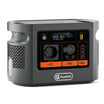
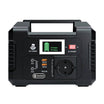

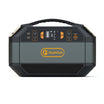
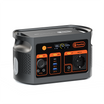


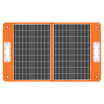
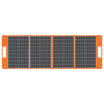


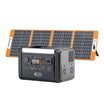

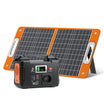

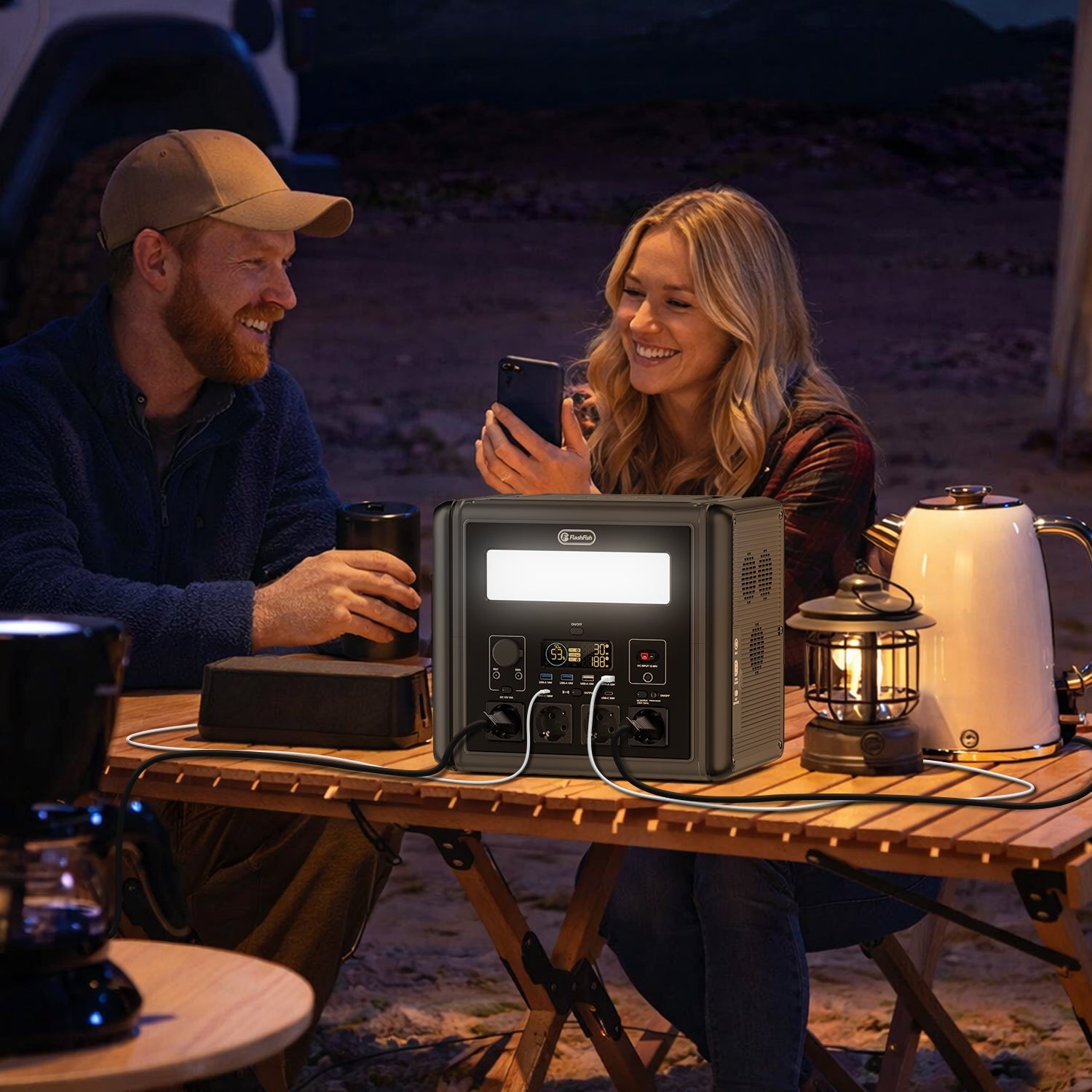
Short answer: sometimes, but the cooling number on an EU energy label is not the electrical input. Start with the exact air conditioner's input or hourly electricity consumption, confirm compressor starting behaviour and setup rules, add every simultaneous load, then compare those facts with the power station's continuous output. The FlashFish T1200S provides 1200W continuous output and 768Wh; T2000 provides 2000W and 1536Wh. Neither specification alone promises compatibility or runtime.
Read the air-conditioner label without confusing cooling and input
The European Commission says room air-conditioner labels communicate efficiency and electricity consumption as well as cooling or heating performance. These are different quantities. A unit described as 2.5kW cooling is not automatically a 2500W electrical load.
An official EPREL record for one De'Longhi PAC EL92 SILENT model illustrates the distinction: it lists 2.5kW cooling capacity, an energy-efficiency ratio of 3.1 and hourly electricity consumption of 0.8kWh per 60 minutes. That example suggests roughly 800Wh used during the standard-hour condition; it does not establish instantaneous input, compressor startup, your room conditions or compatibility with any FlashFish model.
| Label/manual field | Use it for | Do not use it for |
|---|---|---|
| Cooling capacity (kW) | Cooling-performance context | Direct inverter-watt comparison |
| Hourly electricity consumption (kWh/60 min) | Energy planning under the stated test basis | Startup demand or fixed runtime |
| Rated input power (W), if documented | First continuous-output gate | Proving every compressor start |
| EER/SEER | Efficiency comparison under the label method | A substitute for input and startup data |
| Model-specific manual | Supply, exhaust, condensate, clearances and warnings | Permission to ignore station limits |
Build the load list before choosing a station
- Record the full air-conditioner model and regional supply requirement.
- Find rated electrical input and any manufacturer information about starting current or inverter-generator use.
- Add the watts of anything powered at the same time, including chargers or a separate fan.
- Confirm the plug, voltage and frequency of both regional products.
- Leave margin instead of planning at the station's continuous ceiling.
- If the manufacturer does not supply enough startup information, mark compatibility unproven until an appropriately controlled test is possible.
T1200S or T2000: use the envelope, not the product name
| Decision field | FlashFish T1200S | FlashFish T2000 | Interpretation |
|---|---|---|---|
| Catalog capacity | 768Wh | 1536Wh | T2000 has twice the catalog energy; delivered AC energy will be lower. |
| Continuous AC output | 1200W | 2000W | Compare exact appliance input plus other loads and margin. |
| Peak output | 2400W | 4000W | Does not prove every compressor can start. |
| Inverter | Pure sine wave | Pure sine wave | Useful supply characteristic, but not complete compatibility proof. |
| Catalog mass | 12.45kg | 19.2kg | The larger energy/output envelope has a carry trade-off. |
When T1200S may fit: the exact regional air conditioner has documented operating input comfortably below the station's 1200W ceiling, startup behaviour is supported rather than assumed, setup is permitted and the owner accepts the smaller energy reserve. When it does not fit: the appliance's continuous input exceeds 1200W, the combined load leaves no margin, startup is unverified or the installation violates the AC manual.
When T2000 may fit: the exact load needs an envelope above T1200S but remains within the documented 2000W continuous limit with margin, and the owner accepts the larger 19.2kg station. When it does not fit: the AC or combined load exceeds the limit, compressor behaviour remains unknown, required duration is unsupported, or a fixed installation/transfer system is needed.
Why this guide does not publish a runtime promise
A rough upper-bound calculation begins with catalog watt-hours divided by an energy-use rate. For the EPREL example's 0.8kWh-per-hour standard value, 768Wh divided by 800Wh per hour equals 0.96 hours before losses and reserve; 1536Wh divided by 800Wh per hour equals 1.92 hours before losses and reserve. These are not expected runtimes.
Real duration is shorter or variable because an inverter consumes energy, usable battery energy is below the catalog figure, compressors cycle, ambient heat changes demand, fan modes differ and prudent operation keeps reserve. A responsible estimate needs an exact appliance, measured stable draw under relevant conditions and a documented reserve. No such pair test was performed for this article.
The electrical match is only one gate
- Use the exact portable air-conditioner manual for exhaust-hose routing, clearances, ventilation and condensate handling.
- Keep the power station within its documented temperature and moisture limits and never expose it to condensate or rain.
- Use the supplied or manufacturer-approved cables and do not improvise an underspecified extension arrangement.
- Do not connect a portable station to building wiring or attempt backfeed.
- Stop if plugs, cables or either appliance become abnormally hot or show a fault.
- Do not rely on cooling equipment powered this way for medical or life-safety continuity.
A worked decision without a compatibility promise
Imagine an owner sees “2.5kW” on the front of a portable AC. The wrong decision is to reject both stations because 2500W exceeds their continuous ratings. The next wrong decision is to accept both because an hourly label shows 0.8kWh. COOL keeps the quantities separate: 2.5kW is cooling capacity; 0.8kWh/60 minutes is standard-period energy; neither states exact startup behaviour.
The owner must obtain the model's electrical input and manufacturer guidance. If verified continuous input plus all other loads fits 1200W with margin and startup is supported, T1200S can enter the shortlist. If it needs a larger continuous and energy envelope that still fits 2000W, T2000 can enter. If evidence is missing, neither is yet a confirmed fit.
Frequently asked questions
Is an air conditioner's cooling capacity its electrical input?
No. Cooling capacity describes heat-removal performance, while electrical input is the power the appliance consumes. Use the input or consumption values from the exact label, EPREL record and manual.
Can I divide watt-hours by air-conditioner watts to promise runtime?
No. That quotient is only a rough planning boundary. Compressor cycling, ambient temperature, conversion losses, fan mode, thermostat setting, other loads and reserve all change delivered duration.
Does a 2400W or 4000W peak rating prove compressor startup?
No. Peak ratings do not prove the duration, waveform or behaviour required by an exact compressor. The air-conditioner manufacturer and a controlled test of the exact regional models are needed.
Which is the safer first shortlist: T1200S or T2000?
Use the smaller model only when the exact appliance input, starting behaviour and all simultaneous loads fit its documented limits with sensible margin. T2000 offers the larger 2000W/1536Wh envelope, but does not prove universal compatibility.
Can I run a portable air conditioner inside a tent or sealed room?
Follow the exact appliance manual for exhaust, clearances, condensate, ventilation and permitted locations. A power station does not make an unsuitable air-conditioner installation safe.
Sources and evidence limits
- European Commission: air conditioners and comfort fans — EU label fields and product scope.
- EPREL: De'Longhi PAC EL92 SILENT — a label-reading example, not a FlashFish compatibility test.
- FlashFish Europe T1200S and FlashFish Europe T2000 — current regional product context cross-checked against the local product database.
No paired appliance test, startup capture, runtime measurement, environmental approval or universal compatibility claim is provided.




Leave a comment
This site is protected by hCaptcha and the hCaptcha Privacy Policy and Terms of Service apply.