








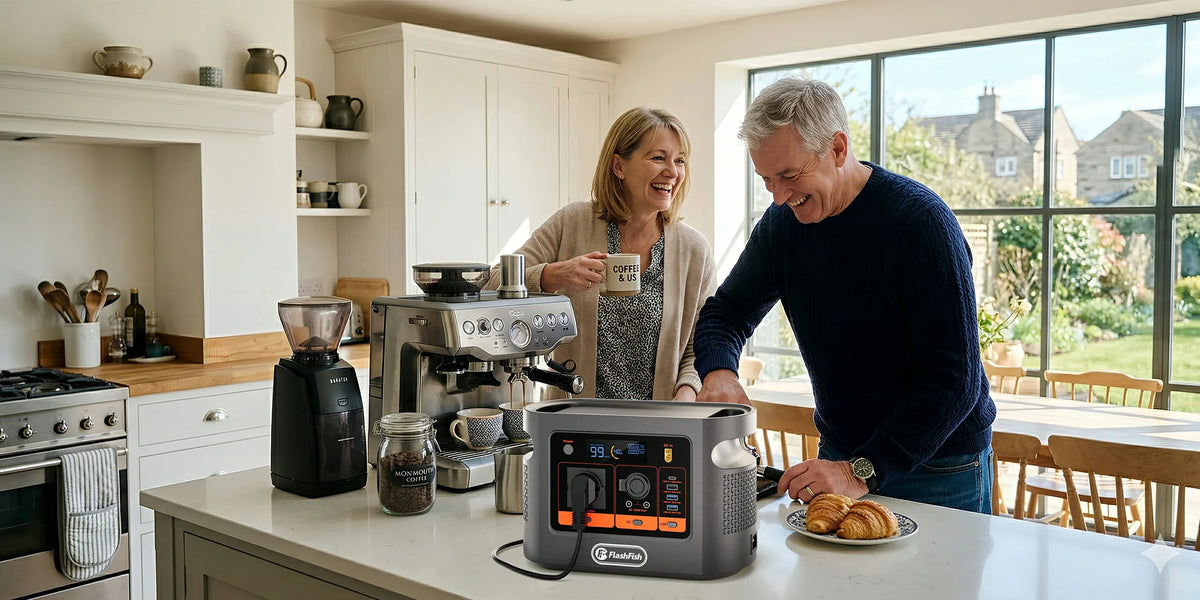
Short answer: battery internal resistance is the effective opposition inside a cell or pack that contributes to voltage drop and heat when current flows. It is not a fixed quality score. Load, temperature, state of charge, ageing, connectors and the system's protection thresholds all affect what a portable power station can deliver at that moment.
Internal resistance is a model of loaded behaviour
A simple first approximation is voltage drop ≈ current × resistance. If current rises while effective resistance stays similar, the terminal voltage falls further under load. A real battery is electrochemical and changes over time, so engineers often use a frequency- and condition-dependent impedance model rather than pretending the pack contains one literal resistor.
Texas Instruments describes internal resistance as one input to battery gauging alongside chemical capacity, charge moved, present load and temperature. The same source notes that resistance varies with temperature, ageing and state of charge. That is why a single reading without conditions is weak evidence.
The DROP card separates four questions
| DROP field | Question | Buyer-visible evidence | What stays unknown |
|---|---|---|---|
| Demand | How much current or power does the load request, including changes? | Device label, measured wall watts, startup trace where appropriate | Cell current if the architecture is unpublished |
| Resistance | How much effective opposition exists in cells, conductors and connections? | Manufacturer test data when supplied | Pack impedance from Wh or AC watts alone |
| Operating conditions | What are temperature, state of charge, age and load history? | Display, ambient measurement, documented test conditions | Cell temperature and chemistry behaviour unless exposed |
| Protection boundary | When does the system reduce output or stop? | Exact manual, displayed event and manufacturer diagnosis | BMS thresholds, reserve and weak-cell identity if unpublished |
The method prevents a common category mistake: treating a nominal energy figure as if it also described voltage sag, peak current, efficiency, state-of-health and every low-temperature outcome.
Three examples show why conditions matter
- Light load versus heavy load: a larger current produces a larger voltage drop across the same effective resistance. An external display may therefore behave differently when a high-power device starts than when only a phone charger is connected.
- Moderate temperature versus cold conditions: TI notes that resistance changes with temperature. A result observed in a warm room should not be copied to a cold vehicle or winter campsite.
- Higher state of charge versus near the lower boundary: impedance and the system's available-capacity model can change through discharge, so a late-session load step may reach a protection or terminate-voltage boundary sooner.
These are mechanism examples, not FlashFish test results. They do not identify a faulty cell, predict a shutdown point or establish a remaining duration.
Why voltage sag changes capacity estimates
TI's Impedance Track documentation models voltage drop for an expected load and simulates until the battery reaches a defined terminate voltage. In that framework, remaining capacity and state of charge depend on the assumed load and temperature, not only on charge counted in and out.
This helps explain why a battery percentage may move after a load changes. It does not mean every display change is caused by resistance, and it does not let a user diagnose a cell from the front panel. Calibration, estimation logic, standby demand, temperature and pack protection may all contribute.
Wh and output watts answer different questions
Watt-hours are a nominal energy quantity. Continuous AC watts are an external inverter-output ceiling. Neither one publishes the cells' impedance, conductor resistance, contact quality, internal temperature, state-of-health or BMS thresholds.
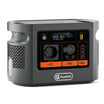
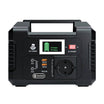
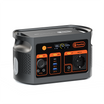
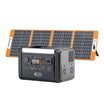
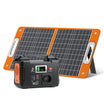
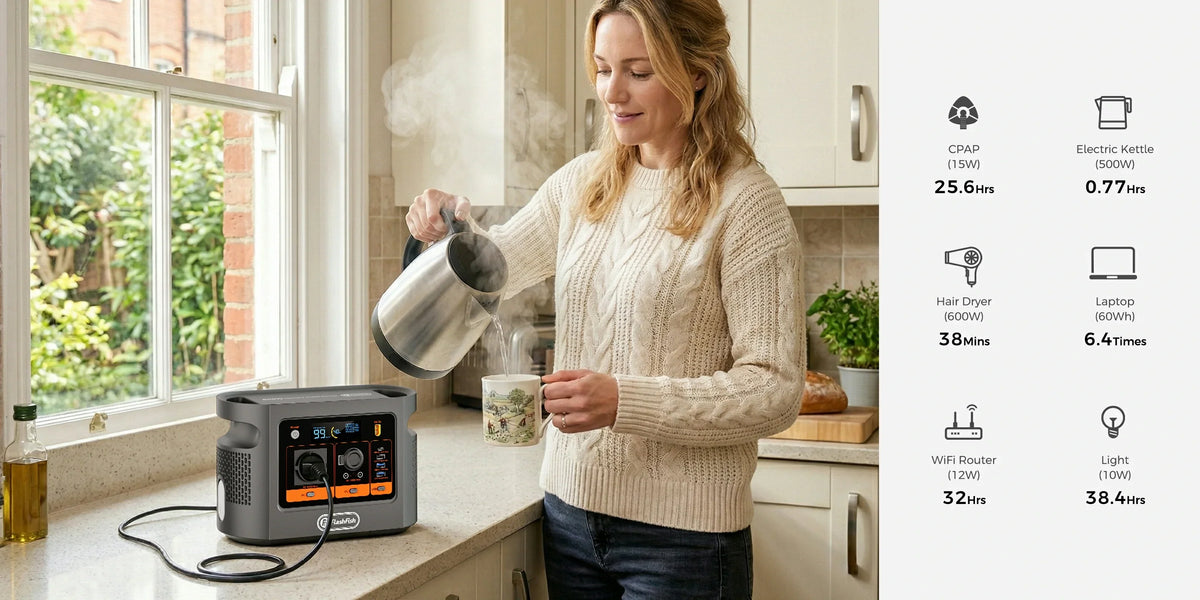
For example, the FlashFish E106B local record lists 384Wh nominal energy and 600W continuous pure-sine AC. Those are useful buyer facts, but the same record does not publish pack internal resistance. This article therefore leaves that value unknown instead of calculating one.
Buyer evidence checklist
- Compare nominal Wh and continuous output as separate external specifications.
- Ask for test temperature, load, state-of-charge window and end condition behind any performance chart.
- Do not accept one no-load voltage or one percentage change as a complete health diagnosis.
- Check the exact model's operating-temperature and protection guidance.
- Record the load, ambient condition, displayed event and repeatability before contacting support.
- Leave cell-level resistance, balancing, repair and thresholds to documented manufacturer or qualified-service procedures.
Compare published energy and output specifications without inventing an internal-resistance value. A trustworthy table can contain blanks.
Common mistakes
- Dividing nominal voltage by output watts and calling the result battery resistance.
- Comparing measurements taken at different temperatures or states of charge.
- Treating a brief voltage drop as proof of a damaged cell.
- Assuming a larger Wh label always means lower internal resistance.
- Opening a sealed station to obtain a number that the product documentation does not provide.
Do not turn the concept into a repair procedure
Portable power stations contain high-energy cells, conductors and protection electronics. Do not open the case, probe cell groups, short terminals, bypass protection or attach undocumented test equipment. If a station shows repeated faults, abnormal heat, odour, swelling, physical damage or liquid exposure, stop as directed by the product instructions and contact the manufacturer.
Frequently asked questions
What is battery internal resistance?
It is the effective opposition inside a battery and its current path that contributes to voltage drop and heat when current flows. Real battery behaviour is dynamic, so engineers often model impedance rather than one fixed resistor.
Does higher internal resistance reduce usable energy?
It can reduce the energy available to a particular system under a particular load because voltage may reach the system's lower limit earlier. The effect depends on current, temperature, state of charge and the system threshold.
Can I calculate a power station's internal resistance from its Wh and W ratings?
No. Nominal watt-hours describe stored energy and output watts describe an external power limit. Neither publishes the pack's internal impedance, cell matching, conductor resistance or protection thresholds.
Why can battery percentage change when a heavy load starts or stops?
Battery gauges may account for current, voltage, temperature and impedance. A changing load alters voltage drop and the model's estimate, so a displayed percentage can move without proving a specific fault.
Should I measure internal resistance inside a portable power station?
Do not open or probe a sealed station. Internal energy and protection systems require manufacturer procedures and qualified service equipment. Record external symptoms and contact support when faults, heat, odour, swelling or damage occur.
Conclusion: use resistance to ask better questions
Internal resistance helps explain why load and conditions affect voltage and available capacity. It is not recoverable from Wh or W labels and should not be used as a DIY diagnosis. Use DROP: demand, resistance, operating conditions and protection boundary.
Sources and evidence boundaries
- Texas Instruments: Getting the most battery life from portable systems for the capacity-model inputs and resistance dependencies.
- Texas Instruments: Impedance Track configuration for dynamic loads for load-, temperature- and threshold-dependent remaining-capacity modelling.
- Texas Instruments battery fuel-gauge overview for the separation of depth of discharge, capacity, resistance, load and temperature.
- The FlashFish local product database for the bounded E106B external-specification example; no internal-resistance value is supplied or inferred.
Evidence checked 4 September 2026. No cell, pack, BMS or inverter was physically inspected or tested.



Dejar un comentario
Este sitio está protegido por hCaptcha y se aplican la Política de privacidad de hCaptcha y los Términos del servicio.