




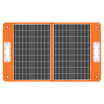
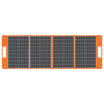


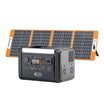

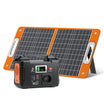

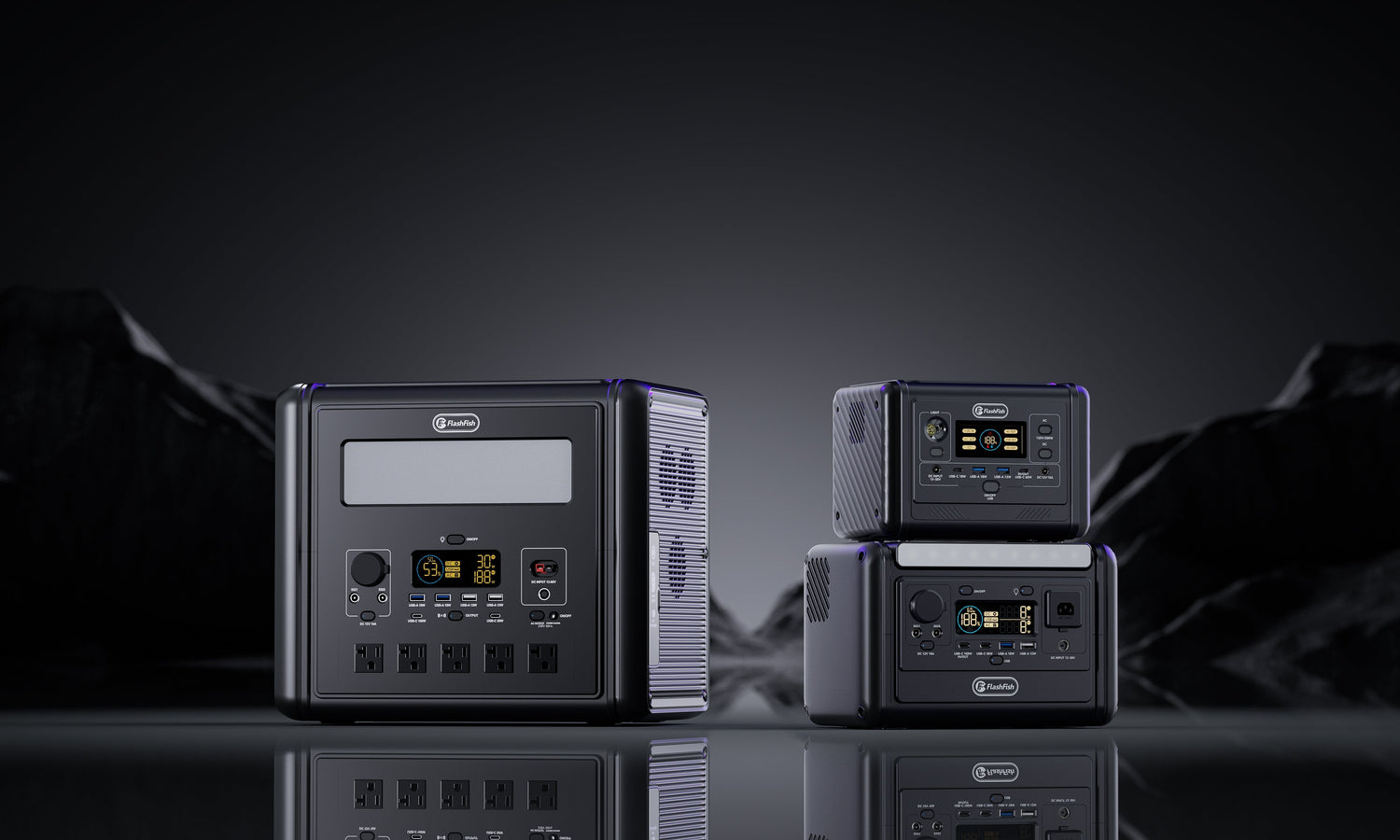
Short answer: several ports can often operate together, but the number of sockets does not mean every port can deliver its label maximum simultaneously. The safe answer comes from four ceilings: the station's continuous AC limit, the largest startup event, shared DC or USB group limits, and the rating of each cable and connected device.
This guide is for campers, home-backup planners and mobile workers connecting more than one load. It explains how to build a port map before switching everything on; it does not promise compatibility for an appliance that has not been checked.
The four ceilings that decide simultaneous port use
| Ceiling | Question to answer | Evidence to use |
|---|---|---|
| 1. Station total | What is the combined continuous AC or output limit? | Exact regional manual and product label |
| 2. Startup event | Can the inverter handle the largest motor, compressor or power-supply start while other loads run? | Appliance label/manual and measured start where appropriate |
| 3. Shared group | Which DC or USB ports draw from one group budget? | Port diagram, footnotes and manual |
| 4. Cable/device | Is every plug, adaptor and cable rated for its current, voltage and negotiated USB power? | Original cable/device markings and safety instructions |
Ceiling 1: add running loads, not socket labels
For AC devices, start with simultaneous running watts = device 1 W + device 2 W + .... Four outlets on one 2000W inverter still share that inverter. A 900W coffee machine, 500W hotplate and 150W laptop supply total 1550W while all three are running; adding a nominal 600W appliance would move the nameplate sum to 2150W before startup behaviour is considered.
Use appliance input ratings, not marketing categories, and treat variable or cycling loads as ranges. A refrigerator, pump or power tool may draw much more for a brief start than it does after stabilising.
Ceiling 2: check the largest start while the base load remains on
A peak rating is not a second continuous rating. Test the decision as base running load + largest credible startup event, following both manuals. If the manufacturer does not publish a usable startup figure for the exact appliance, a blog cannot safely invent one. Sequence loads or obtain a measured value under qualified supervision.
Ceiling 3: find every shared group
USB Implementers Forum material distinguishes assured-capacity USB ports from shared-capacity groups. On a shared group, one device can reduce what remains for another. The same design idea can appear in DC output groups, but the exact grouping is product-specific: copy the diagram and footnotes from the station manual rather than assuming all visible ports are independent.
Ceiling 4: the smallest rating wins
A 100W USB-C port cannot deliver 100W through a cable or device that negotiates less. Likewise, an adaptor does not increase an AC strip's current rating. Electrical Safety First advises calculating the combined load, avoiding daisy-chained extensions, checking for damage and fully unwinding cable reels before use.
Worked example: a campsite work table
Imagine a table with a 60W laptop supply, a 25W camera-battery charger, two 12W phone chargers and a 45W portable fridge. The simple running total is 154W, but that number is only the first gate.
- Map the interfaces: decide which loads genuinely need AC and which can use USB-C or regulated DC.
- Mark groups: place every DC barrel/car socket in its documented shared group and every USB port in its documented group.
- Check the fridge start: use the appliance evidence; do not substitute the 45W running label for an unknown start.
- Check cables: confirm USB-PD rating, connector polarity where relevant, cable-reel condition and weather protection.
- Add in stages: connect the base loads first, then the highest-risk start, watching for heat, errors or unstable operation.
This is planning logic, not a field-test result. Actual energy use also varies over time, so passing the watt test does not calculate runtime.
Common mistakes when many ports are available
- Multiplying outlet count by outlet rating: the inverter total still controls.
- Adding peak output to continuous output: peak is short headroom, not an extra permanent budget.
- Ignoring port-group footnotes: two labels can share one 130W or other documented ceiling.
- Counting empty ports as spare power: access and available watts are different.
- Using the wrong cable: a cable can cap USB power or create heat even when the station port is adequate.
- Planning runtime from the watt snapshot: Wh, conversion losses and duty cycles are separate questions.
Pre-use port map
| Load | Interface | Running W | Start/peak evidence | Shared group | Cable checked |
|---|---|---|---|---|---|
| ________________ | AC / USB / DC | ______ | ________________ | ________________ | Yes / No |
| ________________ | AC / USB / DC | ______ | ________________ | ________________ | Yes / No |
| ________________ | AC / USB / DC | ______ | ________________ | ________________ | Yes / No |
FlashFish product context
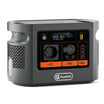
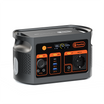
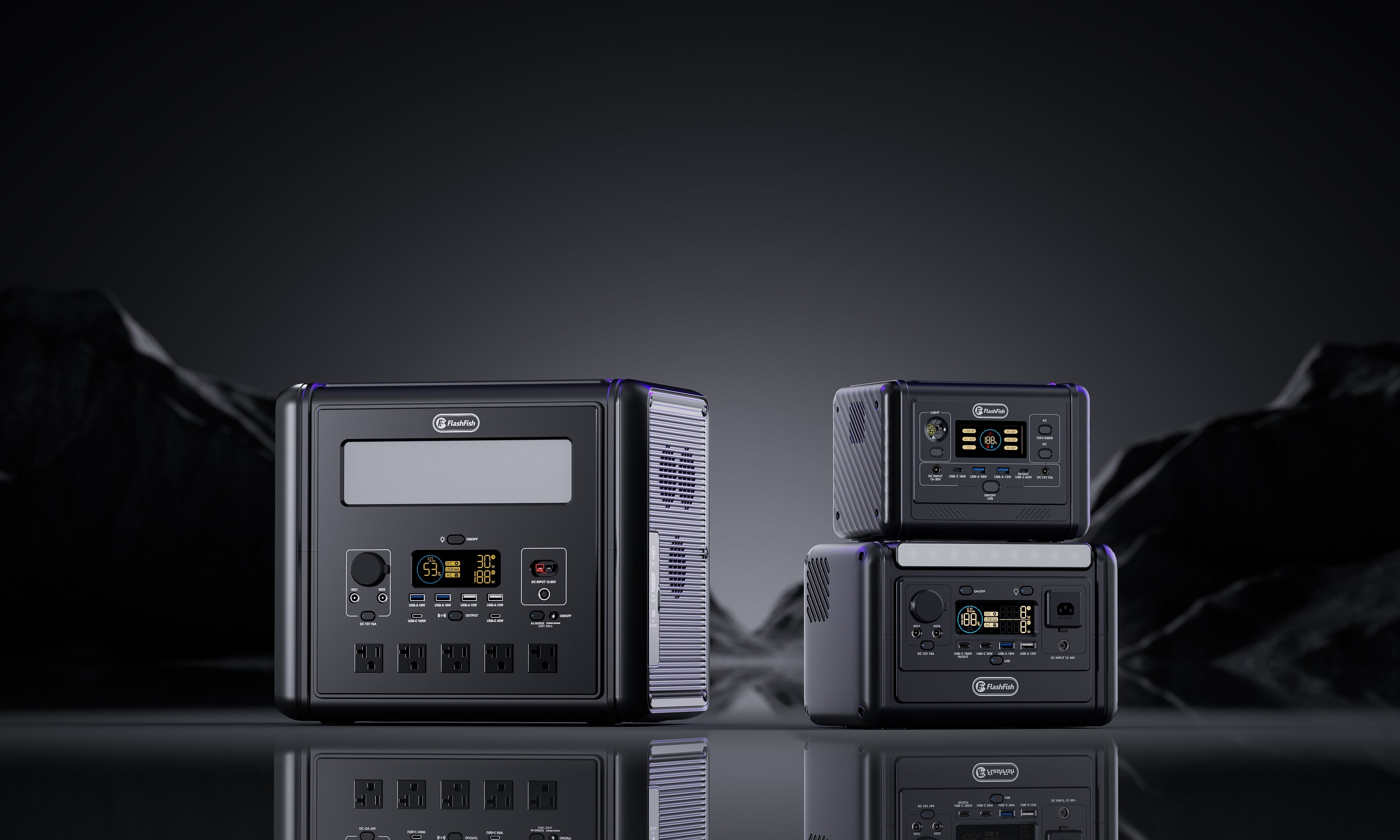
The current Europe FlashFish T2000 product page lists four AC outlets with a 2000W total, 4000W peak, a 100W and 30W USB-C port, four USB-A ports and a 130W shared limit across the car and DC barrel outputs. The local product-source record also lists a 130W shared DC group for T1200S. These are exactly the kinds of group notes a port map must preserve.
T2000 may fit when the measured simultaneous AC load stays below 2000W with credible startup headroom and each DC/USB group remains within its own documented limit. It does not fit merely because 14 physical outputs are visible, and the 4000W peak value is not proof that a particular compressor or tool will start.
Safety boundary
Keep the station dry, ventilated and within its manual conditions. Stop if plugs, cables or sockets become damaged or abnormally hot. Do not daisy-chain adaptors, back-feed building wiring, bypass protection or use a coiled cable reel under significant load. For critical equipment, use an approved continuity plan rather than assuming simultaneous ports create redundancy.
Frequently asked questions
Can all portable power station ports work at the same time?
Often several can, but not necessarily at every maximum. Check station total, startup event, shared groups and cable/device ratings.
Do four AC outlets give four times the power?
No. Outlet count is access. All four may share one inverter total.
Why can USB-C slow down when another port is used?
Some multi-port products share a group power budget, leaving less power when another device draws from the same group.
Can peak watts be used continuously?
No. Treat peak or surge as short-duration headroom and continuous watts as the sustained ceiling.
How should I calculate simultaneous AC load?
Add all running watts, then check the largest credible startup event separately and leave reserve for uncertainty.
Can I connect a power strip?
Only if both manuals allow it and the strip, plug, cable and combined load stay within their ratings; never daisy-chain adaptors.
Sources and further reading
- USB Implementers Forum: USB Power Delivery — shared and assured port-capacity concepts.
- Electrical Safety First: extension leads and cable reels — combined-load and cable safety.
- FlashFish Europe: T2000 and local product-source bundle — current first-party port and output specifications.
Human review note: verify exact Europe manuals, socket variants, visible FAQ/schema parity and reviewer credentials before publication.



Dejar un comentario
Este sitio está protegido por hCaptcha y se aplican la Política de privacidad de hCaptcha y los Términos del servicio.