









Short answer: do not plug in a device just because the plug fits. Avoid loads that exceed the station's continuous output, high-startup motor loads you have not checked, heating or cooking appliances that draw heavy power, improvised extension-lead chains, damaged cables, and any critical device where a failure would create a safety problem.
Why this matters before you buy or pack
A portable power station is a battery, inverter and set of output ports. Each part has a limit. The useful question is not whether the appliance is common, but whether its label, startup behavior, plug, cable and runtime need match the station. The wrong load can trip protection, drain the battery quickly, overheat a cable or leave you without power for the devices that actually matter.
This is especially important for camping and apartment backup plans because people often mix small electronics with high-draw comfort appliances. Phones and LED lights are usually very different from kettles, heaters, microwaves, compressors and pumps.
A simple decision framework
| Check | What to read | Why it matters | If you are unsure |
|---|---|---|---|
| Continuous watts | Device label or manual | The station must supply the running load without exceeding its AC or DC rating | Do not plug it in until the rating is clear |
| Startup demand | Manual, manufacturer support or measured data | Motors, compressors and pumps may need more power at startup than while running | Choose a lower-risk load or ask the appliance maker |
| Energy need | Watts multiplied by hours | Battery capacity is finite and real use needs a conversion-loss margin | Use a conservative plan rather than a fixed runtime promise |
| Waveform and sensitivity | Station AC-output type and device requirements | Some equipment may not suit modified sine output | Use device guidance or a pure sine source when required |
| Cable and adaptor rating | Markings on extension leads, reels and adaptors | Electrical Safety First warns against overloaded leads and chained extensions | Use one correctly rated lead or do not connect the setup |
Loads to be careful with
- Heating appliances: fan heaters, electric blankets, hot plates, hair dryers and similar devices often draw heavy power and can drain a battery quickly.
- Cooking appliances: kettles, microwaves, induction hobs, air fryers and coffee machines need label-by-label checking; many are poor matches for compact stations.
- Compressors and pumps: fridges, cool boxes with compressor behavior, air pumps and water pumps can have startup demand that is not obvious from casual use.
- Large AC motor loads: the FlashFish product-source bundle specifically says the E200 is not suitable for long-term AC-motor loads such as refrigerators, microwaves or compressors.
- Unrated cables or adaptors: the cable is part of the system; a weak lead can be the problem even when the station and appliance seem suitable.
- Critical equipment without a backup plan: use the provider or manufacturer guidance first for any equipment where loss of power would create a serious risk.
Practical example: campsite devices
Imagine a camper wants to power two phones, a small LED lamp and a cool box. The phones and lamp are usually straightforward low-power loads. The cool box needs more checking: does it run from 12V DC or 230V AC, what is its rated wattage, does it have a compressor, and will it run continuously in hot weather? The answer comes from the cool box label and manual, not from the word "camping" on the packaging.
A useful formula is: estimated energy need = device watts x hours used. Then add a margin for inverter loss, temperature, standby use and battery ageing. This gives a planning range, not a publication-ready runtime claim.
Common mistakes
- Using peak output as if it were the normal continuous rating.
- Adding all plug sockets together but ignoring the shared output limit.
- Assuming every appliance with the same name draws the same watts.
- Running a cable reel while it is still wound up.
- Plugging one extension lead into another extension lead.
- Forgetting that solar input is weather and angle dependent.
FlashFish product context
| Model | Product-source facts | Can fit | Do not use it for |
|---|---|---|---|
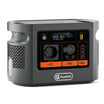
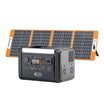
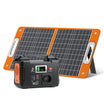
| E200 | 151Wh, 200W modified sine AC output, 400W peak, 40W max solar/DC charging, 1.85kg | Light camping electronics, phones, lamps, cameras and small loads that fit the rating | Long-term AC motor loads, high-watt appliances or sensitive AC devices that require pure sine output |
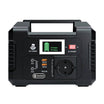
| E103 | 179.2Wh, 300W pure sine AC output, 90W max DC charging input, 60W max USB-C, 3.0kg | Small laptop, phone and light-duty AC plans within 300W | High-watt appliances or claims about battery chemistry and peak output, which the database does not provide |
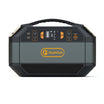
| T1200S | 768Wh LiFePO4, 1200W continuous AC output, 2400W peak, 400W solar input, 100W max USB-C, 12.45kg | Mid-capacity camping or selected-load backup where the labels fit | Every appliance at once, hard-wired building circuits or unsupported startup loads |
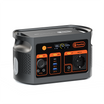
| T2000 | 1536Wh LiFePO4, 2000W continuous AC output, 4000W peak, 600W solar input, 100W max USB-C, 19.2kg | Higher selected-load plans after checking labels and startup demand | Permanent building wiring, unsupported high-draw loads or a plan with no cable-rating check |
When FlashFish fits
- The device label is visible and stays within the relevant AC, DC or USB output rating.
- You know which loads will run at the same time.
- The energy budget includes a sensible margin rather than a fixed promise.
- You use rated cables and avoid chained extension leads.
- The plan is for portable selected loads, not permanent wiring.
When it does not fit
- The appliance label is missing or unclear.
- The appliance is a heavy heater, cooker, compressor or pump and startup demand is unknown.
- The device maker requires a supply type the station does not provide.
- The cable or adaptor rating is unknown.
- The load is safety-critical and has not been cleared by the relevant provider or manufacturer.
Frequently asked questions
Can I plug in a kettle?
Only after reading the kettle label and checking the station's continuous output. Many kettles draw heavy power, so a lower-watt camping kettle or another hot-water plan may be more realistic.
Can I plug in a fridge or compressor cool box?
Check the device label, startup demand and station output first. Do not infer suitability from capacity alone. Compact stations are usually poor matches for long-running compressor loads.
Is peak output the number I should plan around?
No. Peak output is temporary. Plan around the continuous output and use peak output only as context for startup behavior.
Can I use an extension lead?
Use only a correctly rated lead in good condition. Electrical Safety First says not to exceed the extension lead rating and not to plug one extension lead into another.
Does a larger battery make every appliance safe?
No. Battery capacity and output rating are different. A large battery can still be the wrong match if the appliance exceeds the inverter, port, cable or waveform requirement.
Sources and evidence notes
- FlashFish product-source bundle, accessed 7 July 2026, for E200, E103, T1200S and T2000 specifications and missing-value boundaries.
- Shopify discovery cache, accessed 7 July 2026, for active Europe product URLs.
- Electrical Safety First: overloading sockets, accessed 7 July 2026, for extension-lead and socket safety guidance.
Soft next step: compare the device label with the relevant FlashFish model page before packing a camping setup or relying on a selected-load backup plan.




Dejar un comentario
Este sitio está protegido por hCaptcha y se aplican la Política de privacidad de hCaptcha y los Términos del servicio.