

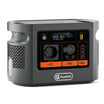







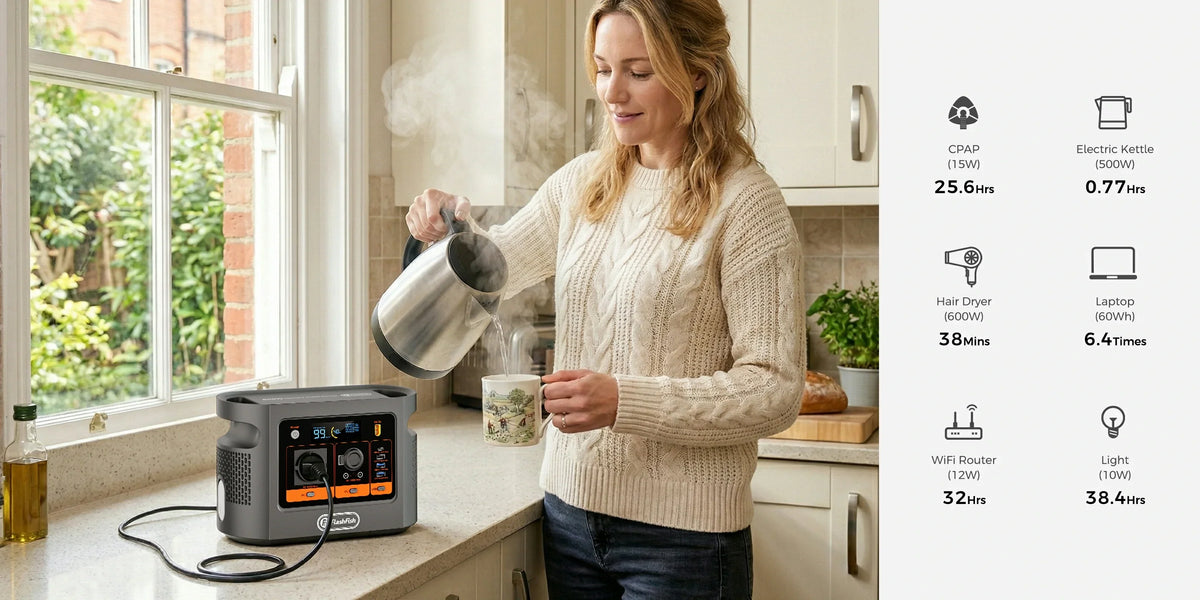
Short answer: FlashFish E106B can be a reasonable first screen for a small rehearsal rig when the exact keyboard, mixer, active speaker and every adapter stay comfortably below its documented 600W continuous pure-sine AC limit. That is not the same as proven compatibility. Read the mains-input evidence for every device, check the heaviest real rehearsal mode, protect the cable route and measure session energy before depending on the setup.
Use SOUND before connecting the rehearsal rig
- S — Source labels. List the exact regional keyboard adapter, mixer adapter, active-speaker inlet and any pedalboard, laptop, wireless receiver or charger sharing the station.
- O — Output path. Record whether each item uses regional AC, USB-C, USB-A or DC. Connector shape alone is not a power specification.
- U — Understand the rating type. Separate mains input or power consumption from audio amplifier output, speaker programme watts and adapter DC output.
- N — Normal and heaviest demand. Measure the complete rig during quiet setup and the loudest intended rehearsal; retain headroom for unknown changes and devices whose published field is not a maximum.
- D — Dry route and fallback. Keep the station ventilated and dry, secure cables away from feet and stands, agree a controlled shutdown and keep a mains or acoustic fallback.
What the published figures do—and do not—show
| Example item | Published field | Use in the screen | Do not assume |
|---|---|---|---|
| Yamaha P-225 keyboard | 9W consumption with PA-150B; adapter output 12V, 1.5A | Include the original adapter and its regional AC input | 9W is every performance mode or wall maximum |
| Yamaha MG10XU mixer | 22.9W consumption | Count the mixer and its approved adapter as a separate load | Phantom power, connected USB gear or another mixer cannot change demand |
| Yamaha DBR10 active speaker | 60W at 1/8 power; 700W dynamic amplifier output | Use 60W only as a manufacturer test-condition field, then measure the real speaker | 700W audio output equals 700W mains demand, or 60W is maximum demand |
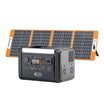
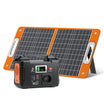
| FlashFish E106B | 600W continuous pure-sine AC; 384Wh nominal energy | Screen continuous load and plan measured energy with reserve | A peak rating, tested audio compatibility or 384Wh of delivered AC energy |
The three example consumption fields add to 91.9W, but that arithmetic is only a catalogue screen. It mixes a keyboard consumption value, a mixer consumption value and a speaker's 1/8-power test condition. It does not establish the wall maximum, startup behaviour or energy use of a live rehearsal. The useful result is that the example deserves measurement—not that it is guaranteed to work.
Three rehearsal examples
1. Keyboard and mixer only
A P-225 and MG10XU produce a 31.9W published-field sum before adapter losses or extra equipment. This is well below 600W on paper, but the exact regional adapters, extensions and any laptop or wireless receiver must still be included. Measure the complete AC group rather than treating the sum as a runtime promise.
2. One keyboard, mixer and DBR10
Adding the DBR10's 60W at 1/8 power produces the 91.9W catalogue screen. Because 1/8 power is a stated test condition rather than a maximum mains-input rating, use the speaker label and a suitable wall meter during the loudest intended rehearsal. Do not substitute the 700W dynamic audio-amplifier number.
3. Two active speakers or added production gear
A second speaker, laptop, interface, pedalboard and wireless receivers change both instantaneous demand and session energy. Inventory each one. If any decisive input or startup field is missing, or the measured group approaches the station ceiling without documented transient evidence, reduce the rig or choose a better-documented power plan.
Capacity is not rehearsal time
E106B stores 384Wh nominally. Real AC energy is lower and variable because the inverter, station electronics, reserve, temperature, battery condition and changing audio demand all consume energy. Use a meter to record watt-hours for setup plus the loudest representative session, add soundcheck and teardown, then preserve a reserve. A single average-watt reading cannot prove the entire rehearsal duration.
Do not treat the station as an uninterruptible power supply. A controlled start and stop is safer for speakers, mixers and computers than assuming seamless transfer or discovering an overload during a performance.
Rehearsal setup checklist
- Photograph every model label and adapter input/output rating.
- Confirm the delivered E106B regional voltage and frequency against every AC device.
- Use the original or expressly approved adapters and correctly rated leads.
- Count keyboards, mixers, both speakers, laptop supplies, interfaces, pedalboards, wireless receivers, phone chargers and lights.
- Measure quiet setup, normal rehearsal and the heaviest intended passage.
- Keep the station off the floor where spills, blocked airflow or accidental switches are likely.
- Route and protect cables so people, stands, doors and vehicles cannot damage them.
- Stop after overheating, smell, damaged cables, repeated trips, audible instability or an unexplained reset.
- Agree a safe shutdown order and a no-power fallback before the session starts.
When E106B fits—and when it does not
| E106B may fit | Do not rely on this setup |
|---|---|
| Exact regional AC ratings match and the complete measured group remains comfortably below 600W | A device input, earth requirement, startup behaviour or regional version is unresolved |
| The rig is small, supervised, dry and arranged with protected cable routes | The station would sit in rain, a spill zone, a blocked enclosure or a public trip route |
| Measured watt-hours cover soundcheck, session, teardown and reserve | 384Wh is being treated as guaranteed delivered energy or a fixed rehearsal duration |
| A controlled stop and mains or acoustic fallback are acceptable | The event depends on seamless changeover, emergency systems or venue approval that has not been obtained |
Check the current Europe E106B output paths against your complete rehearsal list. Choose it for a verified load and power path, not because one speaker headline watt figure looks smaller than 600W.
Common mistakes
- Adding a speaker's 700W dynamic audio rating as if it were AC input demand.
- Treating a 1/8-power consumption figure as a worst-case maximum.
- Forgetting mixer, keyboard, laptop and wireless-system adapters.
- Assuming pure sine wave alone proves audio compatibility or absence of noise.
- Estimating runtime from 384Wh divided by one momentary watt reading.
- Leaving leads loose across doors, aisles or stand legs.
- Assuming a battery station satisfies venue electrical, emergency-power or insurance requirements.
FAQ
Is a 700W active speaker automatically too large for E106B?
No. A 700W amplifier-output figure is not automatically the speaker's mains input. Find the exact input or consumption evidence, then measure the speaker in the intended mode. Do not infer compatibility from either number alone.
Can I use the 91.9W example to calculate rehearsal time?
No. It combines different manufacturer rating conditions and is not a measured session. Record real watt-hours for the complete rig and keep reserve.
Does pure sine wave guarantee clean audio?
No. It describes the AC waveform. Grounding, cables, adapters, gain structure, interference and equipment design can still affect noise or operation; no audio test was performed.
Can E106B act as a UPS for the mixer and speakers?
Do not assume that. This article plans a controlled temporary supply and makes no automatic-transfer or zero-interruption claim.
What should I check first at the venue?
Confirm the responsible person's rules, equipment condition, dry placement, ventilation, cable routes, earthing or RCD requirements, total measured demand and shutdown plan.
Conclusion
E106B's 600W continuous pure-sine AC rating gives a small rehearsal rig a plausible starting point, not a pass certificate. Apply SOUND: source labels, output path, rating type, normal and heaviest demand, then a dry cable-and-fallback plan. Plan measured rehearsal energy with the FlashFish runtime calculator, retain reserve and stop when a decisive field is missing.
Sources and evidence limits
- FlashFish Europe E106B page plus the authoritative local manual-derived record.
- Yamaha P-225 official specifications.
- Yamaha MG Series official specifications for the MG10XU consumption field.
- Yamaha DBR Series official specifications for DBR10 rating conditions.
- UK HSE event electrical safety guidance.
Evidence checked 26 September 2026. No physical rehearsal or runtime test was performed.




Dejar un comentario
Este sitio está protegido por hCaptcha y se aplican la Política de privacidad de hCaptcha y los Términos del servicio.