

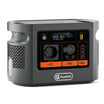
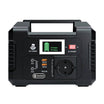

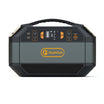
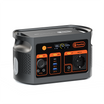


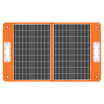
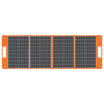


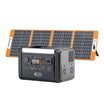

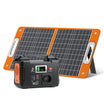


FlashFish E103 vs Anker SOLIX C300 DC for USB-First Camping
Short answer: choose by the required output path before comparing watt-hours. FlashFish E103 is the clearer fit when the trip includes one verified 230V AC device inside its 300W continuous limit. Anker SOLIX C300 DC has more published nominal energy, stronger USB-C output and app evidence, but its exact manual lists USB and a 12V car socket rather than an AC outlet.
Use DIRECT: list Devices, mark each Input path, compare Rated ports, budget nominal Energy, count Carry burden and verify exact source Terms. This FlashFish-authored comparison uses vendor specifications and does not report a hands-on result.
Quick comparison: the first split is AC versus DC
| Decision field | FlashFish E103 | Anker SOLIX C300 DC | Buyer meaning |
|---|---|---|---|
| Nominal energy | 179.2Wh | 288Wh | C300 DC publishes more nominal energy; neither figure proves device runtime |
| AC output | One 230V pure-sine outlet, 300W continuous/600W peak | No AC outlet listed in the exact C300 DC manual | An AC-only device moves the decision toward E103 or another AC station |
| USB-C | One port up to 60W | Four USB-C outputs; two up to 140W, one 100W and one 15W, subject to sharing | C300 DC has the stronger published direct-USB envelope |
| 12V output | Shared 12V/10A/120W DC group | 12V/10A car socket | Connector, polarity, current and sharing still require exact checks |
| Solar input | 12-30V, 4A, up to 90W in the local record | 11-28V, up to 100W | Do not transfer panels or cables between products from watts alone |
| Listed mass | About 3.0kg | 2.8kg | C300 DC is 0.2kg lighter on published figures |
| App evidence | No app control used in this comparison | Bluetooth/Wi-Fi app control documented | Choose the feature only if it solves a real trip need |
Resolve the C300 DC source ambiguity before comparing
Anker's grouped C300 DC/C300 product presentation contains an option label reading “AC & DC Outlets.” That wording is ambiguous because it groups related models. The exact C300 DC manual identifies USB-C, USB-A and a 12V car socket and provides no AC-outlet specification. This article therefore treats C300 DC as a DC-output product unless Anker publishes newer exact-model evidence.
This source choice matters more than a marketing headline. Comparing the wrong C300 variant would give a false answer to the buyer's most important question.
Three device cards produce different winners
| Trip card | Decisive evidence | Better documented fit |
|---|---|---|
| One AC-only camera charger under 300W | Requires approved 230V adapter; no direct USB/DC alternative verified | E103, subject to exact charger and total-load checks |
| One laptop requiring a supported 100-140W USB-C profile | Exact laptop and cable support high-power USB-C | C300 DC has the stronger published direct-USB path |
| 12V cool box plus phones | Exact voltage, current, connector, polarity, start behaviour and daily Wh | Neither wins from the port shape alone; complete the device evidence first |
Where FlashFish E103 fits
- The trip has at least one necessary 230V AC device that stays inside the E103 continuous limit.
- 179.2Wh is enough for the measured low-energy plan with reserve.
- A 60W USB-C ceiling matches the laptop or other direct-charge device.
- The 3.0kg station and charger kit fit the carry plan.
The E103 advantage here is not that AC is always better. It is that an AC outlet keeps an approved device adapter usable when no safe direct-DC path has been verified.
Where Anker SOLIX C300 DC may fit better
- Every planned device is genuinely USB-C, USB-A or verified 12V; no AC outlet is needed.
- The trip benefits from 288Wh nominal energy and published 140W USB-C paths.
- The 2.8kg mass and app controls matter more than AC-adapter flexibility.
- The buyer can supply the correct chargers, high-power cables and any required solar/car accessories.
Its stronger USB-C evidence is a real advantage for compatible devices, not evidence that every USB-C laptop will accept 140W. USB Power Delivery profiles and cable power capability still have to match.
When neither product fits
- An essential AC device exceeds E103's 300W continuous rating or has unresolved start demand.
- The daily measured energy need is too large for either nominal capacity with reserve.
- A 12V device has unknown connector, polarity or startup behaviour.
- The trip depends on weatherproof operation, medical continuity or an untested transfer function.
Compare E103 with your completed DIRECT device card.
Do not convert nominal Wh into a promised runtime
C300 DC's larger 288Wh figure is useful for classifying stored energy, but delivered duration depends on the output path, conversion losses, device behaviour, temperature, standby settings and reserve. The same device may use different power through USB-C and its AC adapter. Measure the actual trip setup instead of applying one efficiency percentage to both products.
USB-C and 12V paths need complete contracts
USB-IF's current program marks compliant USB-C-to-USB-C cables for power capability, but a 60W or 240W cable marking is only one field. The source, device and cable still must negotiate a supported profile. For 12V, record voltage, current, connector, polarity and shared limits; a car-socket shape does not settle compatibility.
FAQ
Is E103 an alternative to Anker SOLIX C300 DC?
Yes for some compact plans, but E103 includes AC while C300 DC is documented around USB and 12V outputs. Start with the device connection list.
Which has more nominal energy?
C300 DC publishes 288Wh versus E103 at 179.2Wh. Nominal Wh is not a promised delivered runtime.
Which is better for a high-power USB-C laptop?
C300 DC has the stronger published USB-C envelope. Verify the laptop profile and cable; otherwise use an approved AC adapter with a suitable AC station.
Can either run every 12V camping device?
No. Match voltage, current, connector, polarity, start behaviour and any shared limit.
Which is the universal winner?
Neither. E103 fits verified AC needs; C300 DC fits a genuine USB/12V-first kit with stronger direct-port evidence.
Decision
E103 and C300 DC are not interchangeable 300W boxes. The decisive difference is the available output path: one includes AC; the other concentrates evidence on USB and 12V. If your device list still contains unresolved connections or neither energy class fits, compare current FlashFish models if neither connection plan fits.
Sources and evidence boundaries
- FlashFish Europe E103 page and local product database — current external E103 evidence.
- Anker SOLIX C300 DC page and exact manual — vendor specifications and port inventory.
- USB-IF cable and connector guidance — cable power marking and compliance context.
- Camping and Caravanning Club electricity guidance — 12V/230V and campsite-condition context.




Dejar un comentario
Este sitio está protegido por hCaptcha y se aplican la Política de privacidad de hCaptcha y los Términos del servicio.