

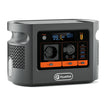

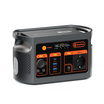






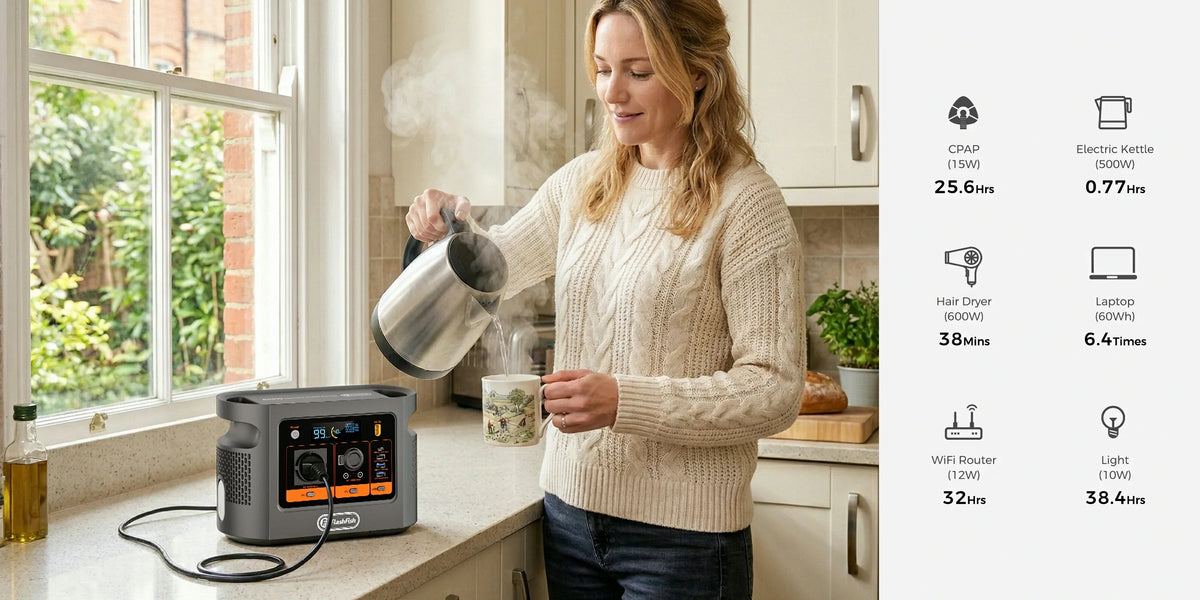
Short answer: no. The Russell Hobbs 23840-70 travel kettle is declared at 1000W, while FlashFish E106B has a documented 600W continuous AC limit. Because the kettle is a sustained heating load, the 400W gap ends the compatibility check before battery capacity, boiling time or runtime is considered.
Do not search for a missing surge figure to reverse that result. E106B's peak AC output is not provided in the authoritative product record, and a brief peak rating would not replace the continuous rating needed while a 1kW element heats water.
The four-part decision
| Check | Evidence for this pairing | Decision |
|---|---|---|
| Label | Russell Hobbs lists model 23840-70 at 1000W | Use the exact appliance figure, not a generic travel-kettle estimate |
| Continuous | E106B is documented at 600W continuous pure-sine AC | 1000W is above the continuous ceiling: stop |
| Location | Water, hot surfaces, cables and campsite rules create separate constraints | Even an electrically compatible alternative still needs a dry, permitted setup |
| Alternative | Lower-power appliance, approved hookup or non-electric method | Verify the chosen option from its own instructions; do not transfer this article's conclusion |
Check the E106B's documented output paths before assigning any appliance. The product route is useful evidence, not a substitute for the appliance label.
Why watt-hours do not rescue the pairing
E106B's 384Wh figure describes nominal stored energy. It does not raise the inverter's documented 600W continuous output. Capacity can help estimate how long a compatible load might operate, after accounting for conversion losses and real conditions, but it cannot make a 1000W sustained load fit a 600W source.
This order matters: first check voltage, frequency, connector and continuous power; then check any starting behaviour; only after the output path is supported should energy and runtime enter the plan. Stopping at the first failed gate avoids false precision.
Three practical decisions
- The named 1000W kettle: reject the E106B pairing. Do not repeatedly switch it on to see whether protection trips.
- An unnamed kettle advertised as lower power: do not approve it from a marketplace headline. Read the exact rating plate and current manual, confirm the regional voltage and plug, keep continuous demand below the station limit with sensible headroom, and follow the kettle's placement rules.
- A campsite or non-electric alternative: treat it as a new system. Confirm the campsite's hookup rules or the non-electric appliance's instructions, keep hot water and electrical connectors separated, and plan for safe handling of hot surfaces and steam.
These are decision examples, not test results or endorsements. The only product-specific result here is the rating mismatch between one named 1000W kettle and E106B's 600W continuous output.
A travel-kettle screening checklist
- Record the full kettle model and regional version.
- Read watts, volts and frequency from the appliance label or current manufacturer manual.
- Compare the appliance's sustained input with the station's continuous AC rating; do not substitute peak, surge or battery capacity.
- Inspect the plug and lead. Do not use damaged equipment or an improvised adapter.
- Use a stable, dry surface with ventilation and clear space around the hot appliance.
- Keep water and steam away from the station, socket and any lead connection.
- Follow campsite rules and retain a fallback that does not depend on an uncertain electrical path.
Common mistakes
- Using watt-hours as watts: stored energy and output power answer different questions.
- Treating unknown peak watts as permission: a missing value is an evidence gap, not hidden headroom.
- Testing until a protection trip: protection is a stop response, not a compatibility method.
- Assuming 'travel' means low power: the named compact kettle is still declared at 1000W.
- Ignoring the setting: an electrically plausible appliance can still be unsuitable near water, on unstable ground or where site rules prohibit the setup.
When E106B may fit a hot-drink plan
E106B may still support separate low-power parts of a camping setup, such as a phone or light on a verified USB path. It may also be considered with a different water-heating appliance only after that exact appliance passes voltage, plug, continuous-power, instruction and location checks. This article does not identify or approve such a kettle.
When it does not fit
- The exact appliance declares more than 600W sustained AC input.
- The model or regional rating cannot be verified.
- The plan depends on an unknown E106B peak figure, repeated overload attempts or an improvised adapter.
- Water, condensation, a damaged cable, an unstable surface or site rules make the setup unsafe or prohibited.
- Hot water is critical and there is no independent fallback.
Frequently asked questions
Can E106B run the Russell Hobbs 23840-70 travel kettle?
No. The kettle's European product page declares 1000W, while E106B's authoritative record documents 600W continuous AC output. The sustained appliance demand exceeds the station's documented continuous ceiling.
Could the E106B peak output run the kettle briefly?
That is not a valid route. E106B's peak value is not provided, and a kettle is a sustained heating load while it boils. An unknown short-duration peak figure cannot replace the 600W continuous limit.
Does 384Wh tell me whether the kettle will work?
No. Watt-hours describe nominal stored energy; watts describe the appliance's demand and the station's output limit. Output fit must be checked before any energy or runtime estimate.
Will every kettle under 600W work with E106B?
Not automatically. Check the exact model's voltage, frequency, plug, continuous input, instructions, condition and intended location. Keep headroom and preserve any missing field as unknown.
What is the best hot-water alternative?
There is no universal answer. Compare a genuinely lower-power appliance, an approved campsite hookup or a non-electric method using each option's own instructions, site rules and safety requirements.
Conclusion
For the named 1000W Russell Hobbs travel kettle, the answer is no: its sustained rating exceeds E106B's documented 600W continuous AC limit. Choose an alternative by repeating the full LABEL-CONTINUOUS-LOCATION-ALTERNATIVE check rather than searching for a loophole in capacity or peak terminology. For a different exact model, Ask FlashFish Europe about a different kettle model and include the appliance label and manual.
Sources and evidence limits
Checked 20 October 2026. FlashFish supplies the E106B product route and authoritative declared output facts. Russell Hobbs supplies the named kettle's 1000W specification and instructions. Camping and electrical-safety sources support general setup boundaries. No kettle was connected to E106B, no boiling cycle or runtime was measured, and no alternative kettle, hookup or non-electric method is approved by this article.



Laat een reactie achter
Deze site wordt beschermd door hCaptcha en het privacybeleid en de servicevoorwaarden van hCaptcha zijn van toepassing.