

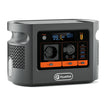
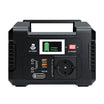

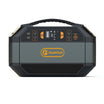
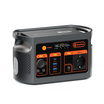


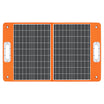
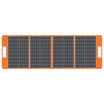


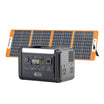

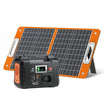


Short answer: the authoritative E106B product record documents 600W continuous pure-sine AC output but does not provide a peak AC value. That means a motor, compressor, pump or ballast cannot be approved from its running watts alone. Find the exact appliance startup requirement or obtain a qualified, supervised measurement. If neither exists, treat compatibility as unknown.
Do not fill the gap with a generic multiplier. Use RUN-START-SOURCE-TEST-FALLBACK: screen running demand, identify the startup event, require primary evidence, test only under a safe qualified plan, and keep a fallback that does not depend on the uncertain load.
The five-step startup-load worksheet
| Step | Record | Reject the pairing when |
|---|---|---|
| Run | Exact steady input from the appliance label or manual, including voltage and frequency | The running demand exceeds 600W or is missing |
| Start | Manufacturer startup current/watts, locked-rotor data or a qualified inrush measurement | Only a guessed multiplier or another model's value is available |
| Source | Current E106B and appliance instructions for waveform, connection and restrictions | The evidence comes only from a marketplace summary or search snippet |
| Test | A safe supervised plan, suitable instrument if needed, no critical dependency and defined stop conditions | Live access, repeated trips or an unqualified procedure would be required |
| Fallback | A tested alternative if the appliance cannot start or protection operates | Food, medicine, safety, medical or essential operation depends on success |
Ask FlashFish Europe about an unresolved E106B startup load, but provide the exact appliance model and primary data. A support conversation still should not replace the appliance manufacturer's requirements or a qualified safety assessment.
Why 600W continuous does not answer startup
Continuous output describes sustained station capability under documented conditions. Some motors draw a brief energisation current that differs from the later running current. Fluke's inrush guidance explains the mechanism and the need for an inrush-capable measurement method; it does not supply an E106B peak number or a universal multiplier.
Peak, surge and power-lifting labels can also use different definitions and time windows. Because the E106B peak field is missing in the authoritative record, any numerical compatibility calculation that requires it stops there.
Three worked decisions
- 400W resistive heater: the label is below 600W and no motor startup is involved, but that does not create automatic approval. Confirm the regional voltage, continuous input, plug, instructions, ventilation and intended environment.
- 120W compressor with no startup data: running demand alone is insufficient. Do not multiply 120W by a rule of thumb and present the result as compatibility; obtain the exact manual data or a qualified measurement.
- 500W pump with an unresolved starting event: only 100W remains below the documented continuous ceiling, and no peak value is available. Treat the pairing as unsupported and choose a verified alternative rather than testing until protection trips.
These are decision examples, not E106B test results. Actual controls, voltage, mechanical load, temperature and restart conditions can change the event.
Use the appliance's primary evidence first
- Record the full appliance model, regional voltage, frequency and plug.
- Read the nameplate and current manufacturer instructions for running power or current.
- Look for startup, inrush or locked-rotor data that applies to the exact model and operating condition.
- Confirm waveform requirements, electronic controls and whether the manufacturer restricts generator or inverter use.
- Preserve every missing field as unknown.
Measurement is not a casual consumer workaround
A normal meter display may miss a short inrush event. A suitable instrument, correct setup and competent person are needed. Do not open equipment, expose live conductors, bypass protection or improvise a measurement from this article. If safe measurement access is not available, ask the appliance manufacturer or a qualified technician.
Protection is a stop signal, not proof
If the station trips, the appliance fails to start, a cable becomes warm or the setup produces unusual smell or noise, stop. Overload protection is valuable, but deliberately repeating an uncertain startup is not a compatibility method. Repeated attempts can add stress without answering the missing evidence question.
When E106B may fit
- The exact running demand is below the documented 600W continuous rating.
- The appliance manufacturer supplies startup evidence that can be assessed without inventing the station's peak value.
- Waveform, voltage, frequency, connector and operating conditions all match.
- A supervised, non-critical test and independent fallback are available.
When it does not fit
- Compatibility depends on an E106B peak number that the authoritative record does not provide.
- The device has a motor, compressor, pump or ballast but only running watts are known.
- The application requires repeated restart under pressure, cold or another untested condition.
- Failure would affect medical equipment, safety systems, essential pumping, food or medicine storage.
Frequently asked questions
What is the E106B peak AC output?
The authoritative product record used for this article does not provide a peak AC output value. The responsible answer is unknown; do not copy a figure from another FlashFish model, market or reseller page.
Does a motor rated below 600W automatically work with E106B?
No. The 600W figure is documented continuous AC output. A motor or compressor can have a separate startup event, and waveform, controls and manufacturer requirements also matter.
Can I multiply running watts by a standard number to estimate startup watts?
Not for a compatibility promise. Generic ranges can explain why startup matters, but the real event depends on the exact device and conditions. Use the current appliance documentation or a qualified measurement.
Does overload protection prove the appliance is compatible?
No. A protection trip is a stop response after the setup has exceeded or violated a condition; it is not a substitute for primary evidence or permission to repeat an uncertain test.
How should inrush current be measured?
Use the appliance manufacturer's data where available. If measurement is necessary, it should be planned by a qualified person with a suitable inrush-capable instrument and safe access; this article does not provide live-conductor instructions.
Conclusion
E106B's documented 600W continuous rating is useful, but the missing peak field is a real evidence boundary. Do not turn it into an estimate. Resolve RUN-START-SOURCE-TEST-FALLBACK for the exact appliance, or choose a verified alternative that does not depend on an unknown startup event.
Sources and evidence limits
Checked 19 October 2026. FlashFish provides the current European route and authoritative declared continuous-output facts. Fluke explains inrush measurement concepts, and Electrical Safety First supports checking appliance rating information. No motor, compressor, pump, ballast or E106B was physically tested, and no peak output, compatibility, runtime, qualified electrical approval or safety-critical use is claimed. Review the documented E106B output paths without inferring the missing peak value.



Laat een reactie achter
Deze site wordt beschermd door hCaptcha en het privacybeleid en de servicevoorwaarden van hCaptcha zijn van toepassing.