

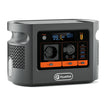
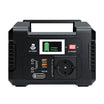

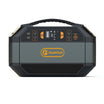
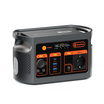


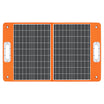
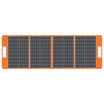


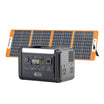

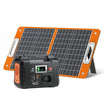

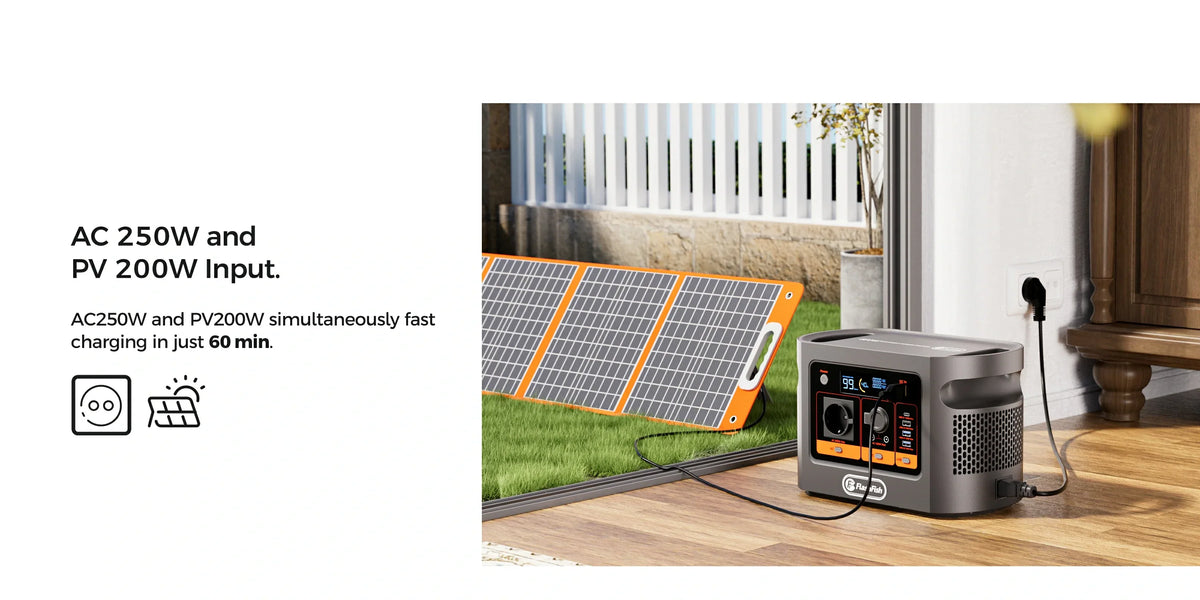
Short answer: three currently sellable FlashFish Europe kits were below €500 in the German market context checked on 18 October 2026. Choose by the laptop's actual power path first: E200 plus TSP60 is the lowest-priced light-duty option, E103 plus TSP60 is the compact direct-USB-C choice up to a documented 60W ceiling, and E106B plus TSP100 gives the largest energy and output envelope with a 100W USB-C1 port—but also the heaviest station.
Use PRICE-PATH-CARRY-INPUT: confirm the dated price, match every device to a documented output path, compare station and panel weight separately, and check the station's solar-input ceiling before treating the panel label as usable charging power.
Dated comparison: three complete kits below €500
| Kit | Price checked 18 Oct 2026 | Laptop path | Station / panel | Best fit and main limit |
|---|---|---|---|---|
| E200 + TSP60 | €159.99 | No verified station USB-C laptop output; exact 230V adaptor may use 200W modified-sine AC only if the laptop maker accepts it | 151Wh, 200W AC; 1.85kg station / 60W, 1.9kg panel; station solar/DC input max 40W | Low-demand lighting and a carefully verified AC path; not the first choice for USB-C laptops |
| E103 + TSP60 | €209.98 | USB-C Power Delivery up to 60W or 300W pure-sine AC | 179.2Wh, 300W AC; 3.0kg station / 60W, 1.9kg panel; solar input max 90W | Compact USB-C laptop and light kit; 60W may not meet higher-power laptops |
| E106B + TSP100 | €298.99 | USB-C1 up to 100W, USB-C2 up to 30W or 600W pure-sine AC | 384Wh, 600W AC; 5.2kg station / 100W, 2.8kg panel; solar input max 200W | More device headroom and nominal energy; higher station and panel mass |
The prices are dated German market-context observations, not promised checkout totals. Delivery, taxes, location, promotions and availability can change. The inconsistent lower compare-at value captured for the E106B kit was excluded, so this guide makes no discount or savings claim.
Compare the three verified kit paths, then reopen the exact kit page and checkout before making a price decision.
Start with the laptop, not the battery size
Read the laptop manufacturer's input requirements and decide whether it can use USB-C Power Delivery or requires its 230V adaptor. A USB-C socket does not establish a compatible profile, and a 100W ceiling does not force the laptop to take 100W. Use a correctly rated cable and the laptop's intended charging port.
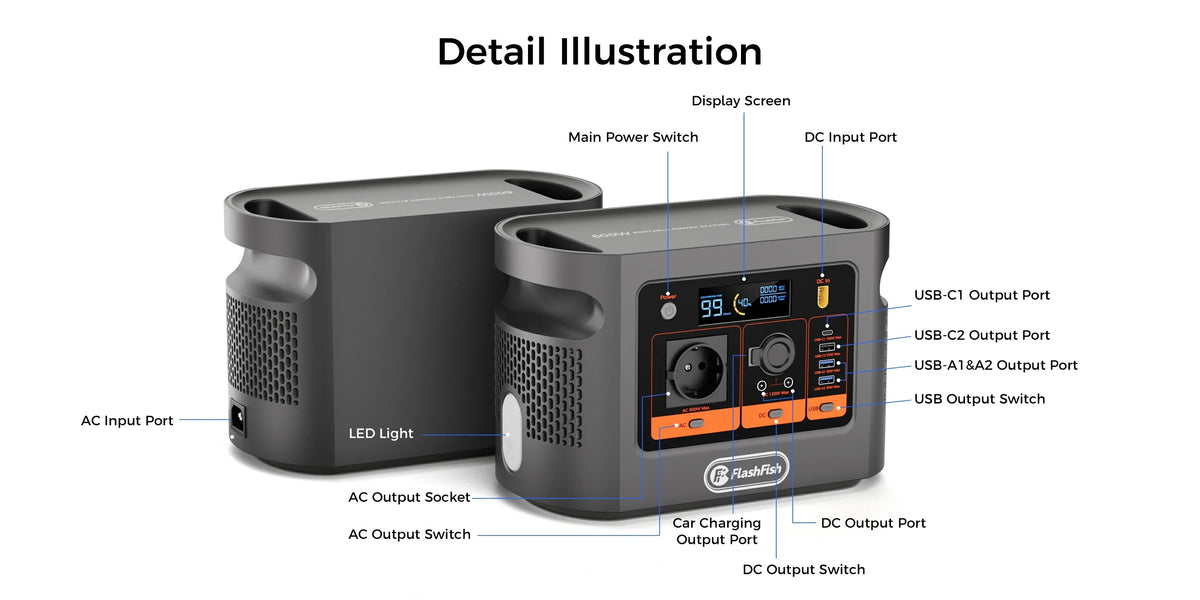
E103 is the smallest of the three stations with a documented direct USB-C laptop path, capped at 60W. E106B raises that documented ceiling to 100W on USB-C1. E200's authoritative record does not provide a station-side USB-C laptop output, so a laptop decision would depend on its exact mains adaptor and acceptance of the station's modified-sine AC. If the laptop maker does not support that waveform or the evidence is unclear, reject the path.
Match lights to a simple, efficient output
Small USB lights can use a verified USB output, while 230V lamps must be counted against AC output and add inverter loss. Record the lamp's input watts and the number used simultaneously. Built-in station lights may cover simple orientation or emergency use, but their presence does not establish campsite illumination quality or runtime.
Panel watts and station input are different ceilings
The E200 and TSP60 combination illustrates the rule: the panel is rated 60W, while the authoritative station record documents a maximum 40W solar/DC input. The lower active ceiling governs the station path before sunlight is considered. E103 documents up to 90W solar input with the 60W panel, while E106B documents up to 200W solar input with the 100W panel. None of those pairings promises the panel nameplate at the station.
JRC PVGIS guidance shows why real solar production changes with location, irradiance, orientation, module temperature and system conditions. Shade, cable loss and controller behaviour add more variation. Do not turn panel watts into a fixed recharge time.
Carry weight is more than one station number
The listed masses are 1.85kg for E200, 3.0kg for E103 and 5.2kg for E106B. TSP60 is listed at 1.9kg and TSP100 at 2.8kg. Keep the values separate: cables, adaptors, packaging and accessories were not included in a verified total carried mass. Pack the complete kit and judge it against the distance and transport method you actually use.
Three buyer decisions
- A 45W USB-C ultrabook and two 5W USB lights: E103 plus TSP60 may be the balanced shortlist if the laptop accepts a matching profile and cable. E106B adds energy and port headroom but more mass.
- A laptop whose 230V adaptor is labelled 90W and requires pure-sine AC: reject E200 for that path; compare E103 and E106B after checking the complete simultaneous load and any USB-C alternative.
- Mostly lighting, no USB-C laptop requirement and the lowest initial price matters: E200 plus TSP60 may fit, but the 40W station solar-input ceiling and modified-sine AC remain explicit constraints.
When each kit may fit
- E200 + TSP60: verified low-demand DC/USB lighting and an exact AC device path that accepts modified-sine output, with no assumption that the 60W panel can enter the station above 40W.
- E103 + TSP60: a laptop documented for no more than the available 60W USB-C profile, modest lights and a preference for lower station mass than E106B.
- E106B + TSP100: a laptop documented for a compatible profile up to 100W, more simultaneous devices or a larger nominal-energy reserve where the additional mass is acceptable.
When none of these kits fits
- The laptop input, USB-C profile, proprietary charger or waveform requirement is unknown.
- The complete simultaneous load exceeds the documented output path or depends on peak power not supplied by the authoritative record.
- The plan requires an assured solar yield, recharge time or laptop runtime.
- The budget must include a final delivered total that has not yet been checked for the buyer's country.
- The setup powers critical equipment without a tested reserve and independent fallback.
Frequently asked questions
Which kit is the best under €500?
There is no universal winner. E200 plus TSP60 is the lowest dated price but lacks a verified direct USB-C laptop path and uses modified-sine AC. E103 plus TSP60 adds 60W USB-C and pure-sine AC. E106B plus TSP100 offers the largest documented energy and output envelope but is heavier.
Can a 60W USB-C port charge every laptop?
No. The laptop must accept a matching USB Power Delivery profile through the selected port and cable. Some laptops need more than 60W, use a proprietary charger or may charge slowly under load.
Will a 60W panel deliver 60W into E200?
Do not assume so. The authoritative E200 record documents a maximum 40W solar/DC input, and real solar production also varies with conditions. The lower active limit governs the path.
Are the listed prices the final amount at checkout?
No. They are German market-context prices captured on 18 October 2026. Taxes, delivery, location, promotions and availability may alter the final checkout amount.
How long will one of these kits run my laptop and lights?
This guide does not promise runtime. Measure the laptop's real workload and the lights' draw, include conversion losses and other loads, and test the complete setup with a reserve.
Conclusion
The useful under-€500 choice is the least expensive kit that supports the laptop's real path and leaves a practical energy and carry margin—not simply the lowest price or largest panel label. Recheck the live route and final checkout, then test the exact laptop, cable and lights. Ask FlashFish Europe to check your laptop and panel path when any output profile or input ceiling remains unclear.
Sources and evidence limits
Checked 18 October 2026. Current sellability, routes, availability and German market-context prices were verified against the FlashFish Europe Shopify Admin; product values come from the authoritative local FlashFish records. JRC PVGIS supplies solar-variability context. FlashFish publishes this comparison. No kit, laptop, lamp or solar panel was field-tested; no discount, checkout total, compatibility, runtime, solar yield, charging time or universal-winner result is claimed. The featured image shows one shortlisted kit and is contextual only.



Laat een reactie achter
Deze site wordt beschermd door hCaptcha en het privacybeleid en de servicevoorwaarden van hCaptcha zijn van toepassing.