

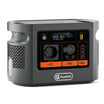
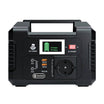

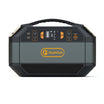
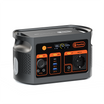




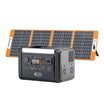

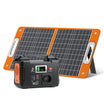


Short answer: a FlashFish T1200S is a plausible power source for a correctly identified Starlink kit because it provides 768Wh of nominal energy and 1200W of continuous pure-sine AC output. That is a rating screen, not a compatibility or runtime promise. The decision changes with the Starlink generation, the power path, actual session energy, sky obstruction, temperature and campsite conditions.
Start with a complete DISH card
| DISH check | Record this | Stop or verify when |
|---|---|---|
| Device | Mini, Standard, Performance or another exact generation; router and accessories included | The kit name or supply label is unclear |
| Input | Original AC supply or manufacturer-documented DC/USB path, voltage, current, cable and connector | Only headline watts match |
| Session | Measured watt-hours for the intended hours and traffic pattern, plus reserve | Planning relies on an average-watt figure alone |
| Horizon | Clear sky, safe cable route, dry ventilated station location, site rules and communications fallback | Obstruction, moisture, unattended equipment or no fallback remains |
Compare your measured Starlink session with the T1200S energy and output limits. Use the exact delivered regional unit and its instructions, not specifications copied from another market.
Starlink model names change the power question
Starlink's official guidance lists average complete-kit AC input of 20–40W for Mini, 75–100W for Standard and 110–150W for Performance. Those are published averages, not proven maxima. Starlink explicitly says temperature, location and utilisation affect demand. A cold, busy session cannot be planned from the low end of a range.
The T1200S continuous AC rating is above those published averages, but AC headroom and energy duration are different checks. The Starlink supply, other camp devices and station overhead all draw from the battery. Do not add a kettle, heater, cool box or laptop after doing a Starlink-only calculation without re-measuring the complete simultaneous load.
Three setup examples
- Starlink Mini through its original AC supply: this keeps Starlink's supplied conversion path in the chain. Verify the supply's regional input label and T1200S outlet before use, then measure the complete AC session. Extra conversion overhead means the published 20–40W Mini average cannot be divided directly into 768Wh.
- Starlink Mini through a USB-C accessory cable: Starlink requires a 100W 20V/5A USB-PD source and its specified cable. T1200S is documented locally as having a 100W USB-C PD port, but the exact voltage profiles are not listed. Treat this as an unresolved compatibility check, not a confirmed shortcut.
- Starlink Standard through its original AC supply: Starlink publishes a higher 75–100W average complete-kit range. Re-measure the actual kit with its router and intended traffic, and reserve more energy than a Mini-only plan would require.
These examples explain the method; none is a FlashFish test result. Hardware versions, regional supplies, firmware, temperature, obstructions and network use can change the outcome.
Build a session-energy worksheet, not a runtime promise
- Charge the exact T1200S according to its regional instructions and place it in the intended dry, ventilated location.
- Run the exact Starlink kit through the intended input path with the traffic pattern you expect.
- Record watt-hours for a representative session, not only an instantaneous watt reading.
- Add every simultaneous camp load and repeat the measurement if the operating mode changes.
- Choose a reserve for weather, lower temperature, route changes and communications needs.
A simple planning expression is: planned sessions = conservative usable energy budget ÷ measured watt-hours per session. The conservative usable budget must be lower than the 768Wh nominal figure because conversion, station electronics, temperature and cut-off behaviour consume or restrict energy. This article does not assign a universal efficiency percentage.
Sky view belongs in the power plan
A full battery cannot solve an obstructed sky view or unavailable service. Use Starlink's current setup and obstruction tools before routing cables. Keep a charged phone or another locally suitable communications method because station power does not ensure satellite coverage, account status, network capacity or emergency access.
Do not stretch power cables across vehicle routes, public paths or tent entrances. Starlink's Mini USB-C guidance warns that the USB-C end should not be exposed outdoors. Keep every connection end and the power station protected according to the manufacturers' exact instructions.
When T1200S is a reasonable candidate
| Proceed to a controlled test when | Choose another plan when |
|---|---|
| The exact Starlink generation and complete kit are known | The hardware or regional power supply is unidentified |
| The input path is manufacturer-documented end to end | The plan depends on a cable or PD profile that is only assumed |
| A representative session has been measured in watt-hours | The plan divides 768Wh by a marketing average and calls it runtime |
| Dry, ventilated, supervised placement and a safe cable route exist | Equipment must sit in rain, condensation or an unattended public route |
| A separate communications fallback remains available | Starlink is treated as assured emergency communication |
Common mistakes
- Using the word Starlink without naming Mini, Standard or the exact generation.
- Treating average watts as maximum demand or measured session energy.
- Assuming every 100W USB-C port offers Starlink's required 20V/5A profile.
- Ignoring the router, power supply, station overhead and other simultaneous loads.
- Planning signal coverage and electrical power as if they were the same problem.
Frequently asked questions
Can the T1200S power every Starlink model?
No universal compatibility is established. Identify the exact Starlink generation, current power supply or documented DC requirement, the delivered regional T1200S and the complete load before deciding.
Can Starlink Mini plug directly into the T1200S USB-C port?
Do not assume so from the shared 100W headline. Starlink specifies a 100W 20V/5A USB-PD source and its accessory cable, while the local T1200S record does not list exact USB-PD profiles. Confirm both labels and documentation.
How long will a 768Wh T1200S run Starlink?
Nominal watt-hours do not determine a fixed runtime. Measure the exact kit over a representative session, account for conversion and station overhead, temperature and changing network demand, then keep a reserve.
Is the T1200S safe to leave outside with Starlink?
This article establishes no outdoor or weatherproof rating. Keep the station and connection ends dry, ventilated and placed according to their delivered instructions and campsite rules.
Will power from T1200S ensure internet access?
No. Power availability cannot ensure Starlink coverage, subscription status, a clear sky view, network capacity or service continuity. Keep an alternative communications plan.
Conclusion: verify the whole DISH, not the headline watts
A T1200S can be screened for Starlink only after the Device, Input, Session and Horizon checks are complete. Use the Europe buying guide if your complete camp load needs a different power class, and keep the decision tied to measured energy and exact regional documentation.
Sources and evidence boundaries
- FlashFish Europe T1200S page and local product database for bounded station facts.
- Starlink power-needs guidance for model-specific average AC ranges and variability.
- Starlink Mini USB-C guidance for the exact direct-power requirements.
- Camping and Caravanning Club for general campsite electrical practice.
Evidence checked 8 September 2026. No Starlink kit or T1200S combination was physically tested.




Laat een reactie achter
Deze site wordt beschermd door hCaptcha en het privacybeleid en de servicevoorwaarden van hCaptcha zijn van toepassing.