

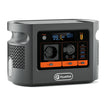
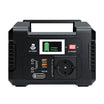

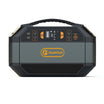
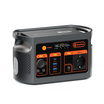


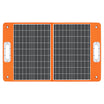
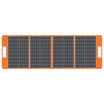


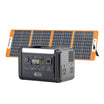

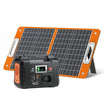


Short answer: use one E106B when the two work sessions are staggered and the complete kit can be stopped, disconnected, moved and rechecked safely. Consider two independent E106B stations only when the bays genuinely operate at the same time or a shared cable or movement route is unsuitable. Two stations do not combine AC power, and they do not automatically create redundancy.
Start with the work pattern, not doubled watt-hours
The exact E106B record lists a 384Wh nominal battery, 600W continuous pure-sine AC output, one AC outlet and a station weight of 5.2kg. The current E106B Europe page is ACTIVE with a sellable EU-plug variant. Those facts do not establish peak output, full-kit weight, runtime, a safe room route or failover between units.
| Decision factor | One E106B moved between bays | Two independent E106B stations | No-purchase option |
|---|---|---|---|
| Session timing | Best fit when work is staggered | Consider when bounded sessions overlap | Reschedule one bay |
| Movement | Needs a permitted route and time to stop, disconnect, move and recheck | Less routine moving, but two complete kits still need handling | Move the task to approved mains |
| Cables | A short local connection at each bay; do not energise a move | Each bay gets a separate checked route | Use approved venue outlets or have fixed sockets assessed |
| Load checks | Repeat the check after each move | Check each station and bay separately | Use the site's approved supply procedure |
| Continuity | Moving creates an intentional stop | Independent units can separate sessions but do not prove failover | Save work and use a planned pause |
| Charging | One recharge schedule serves both sessions | Each station needs its own verified charging plan | Remove the battery dependency |
Choose one movable station when the sessions are truly staggered
One E106B keeps inventory and charging simpler, but only if the first bay can stop before the second starts. Build enough time for a controlled shutdown, cable inspection, movement and a new pre-use check. The 5.2kg record covers the station, not every charger, lead, case or connected device. Weigh and rehearse the complete kit that people will actually carry.
- Write the end time for bay one and the earliest start time for bay two.
- Define who stops the load and who confirms the destination is ready.
- Keep the travel route clear, dry and permitted.
- Recheck the exact load and cable layout at the destination.
- Keep a saved-work or approved-mains fallback for a delayed move.
Consider two independent stations only for a real separation need
Two stations may be useful when sessions overlap or when moving one complete kit would interrupt work. Each station must still be treated as its own supply. Do not join AC or DC outputs, do not split one load across both units and do not describe the pair as redundant until a specific failover design has been reviewed and tested.
| Bay A record | Bay B record |
|---|---|
| Exact devices and adapter labels | Exact devices and adapter labels |
| Continuous and starting behaviour to verify | Continuous and starting behaviour to verify |
| Local cable and placement plan | Local cable and placement plan |
| Operator and stop rule | Operator and stop rule |
| Charging and fallback route | Charging and fallback route |
Rule out a cable-route problem before buying hardware
The HSE event electrical guidance identifies layout, power requirements, timing, environment and cable routing as planning inputs. It also recommends routing cables to reduce trip hazards and mechanical damage. The page is general UK guidance, not approval of a particular two-room setup.
If an extension device is part of an approved plan, follow its marked rating and local rules. Electrical Safety First advises fully unwinding cable reels, avoiding daisy-chained extensions and staying within the device's maximum rating. A second battery is not a substitute for fixing an unsafe route.
Use this allocation decision
- No overlap and easy verified movement: trial one E106B with a controlled stop-and-move procedure.
- True overlap and two independently verified loads: compare two separate stations with approved mains and schedule changes.
- Unsafe route, unclear labels or missing permission: stop. Change the location, schedule or supply plan.
- Critical work or automatic continuity required: this comparison is not the approval path.
Check the current E106B configuration for each work bay. Keep each unit and load independent.
Frequently asked questions
Can two E106B stations be connected together for more power?
No such output-paralleling capability is established in the available record. Treat two stations as separate supplies for separately checked loads; never connect their outputs together.
When is one movable E106B the better plan?
It can be the lower-complexity option when sessions do not overlap, the complete kit can be moved through a permitted route and there is time to stop, disconnect, relocate and recheck it.
When can two independent stations make sense?
They can make sense when two bounded non-critical sessions genuinely overlap and each bay has its own verified load, placement, cable plan, operator and fallback.
Do two stations provide assured redundancy?
No. Independence is not proof of redundancy. Common charging, procedure, environment, cable or load failures can still affect both bays, and no failover was tested.
Should I buy a second station to avoid a long extension lead?
First ask whether approved venue mains, a revised schedule or moving the task removes the problem. If a second station remains necessary, verify each bay separately.
Sources and next step
This comparison uses the exact E106B record and current Europe route, plus HSE and Electrical Safety First planning guidance. It is not a site approval, handling test or redundancy test. For exact model and regional questions, Ask FlashFish Europe about the exact loads for each bay and include both work-bay load lists plus the labels from the delivered equipment.



Laat een reactie achter
Deze site wordt beschermd door hCaptcha en het privacybeleid en de servicevoorwaarden van hCaptcha zijn van toepassing.