







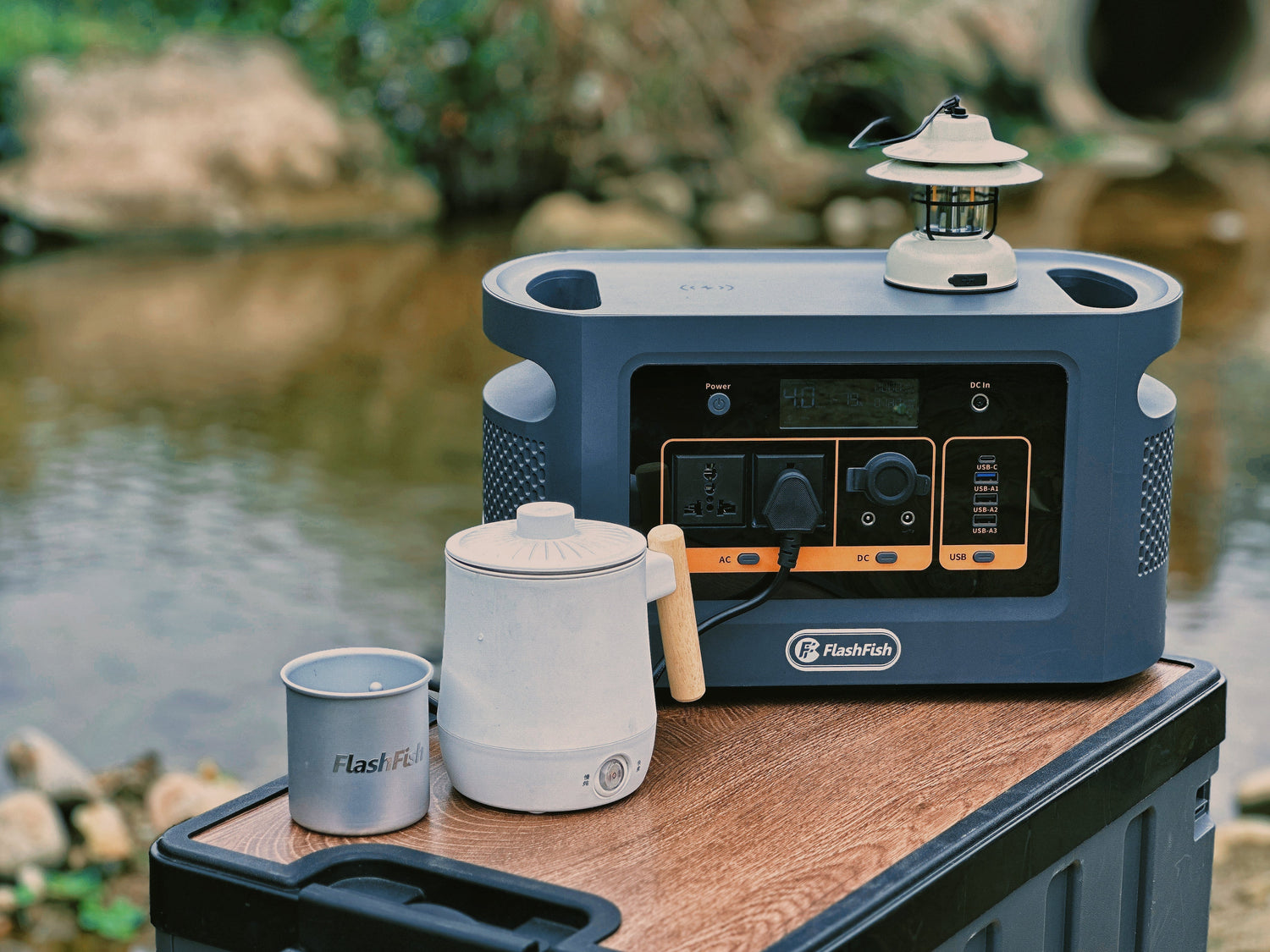
Short answer: sometimes, but only if the coffee appliance label fits the station's continuous output, any startup demand is supported, and the energy use still makes sense for the trip. Do not choose from the phrase "coffee machine" alone; choose from the exact watt label on your appliance.
Why camping coffee is a hard load to generalise
Coffee gear ranges from small chargers and grinders to high-power kettles, pod machines and espresso machines. Two appliances that look similar can have very different input ratings. The label on the appliance, or the manufacturer's manual, is the starting point.
Campsite power is also finite. The Caravan and Motorhome Club explains that many of its UK Club sites provide a maximum 16 amp hook-up, and connected appliances must stay within the available supply. A portable station is different from a hook-up, but the lesson is the same: add the loads rather than guessing.
FlashFish examples
| Model | Local database facts | Best camping coffee role | Not a good fit when... |
|---|---|---|---|
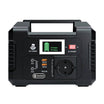
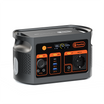
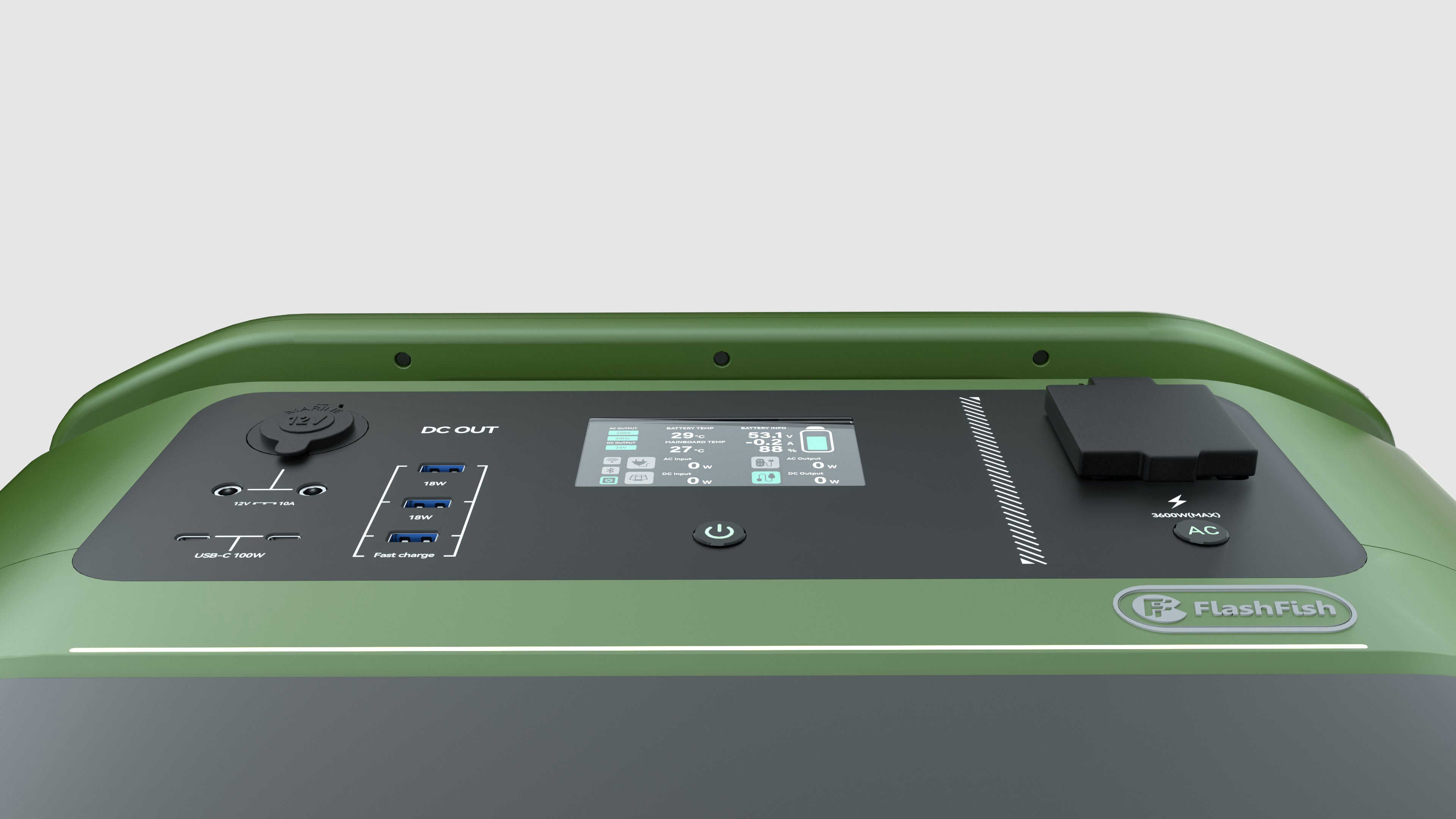
| T1200S | 768Wh LiFePO4 battery, 1,200W continuous AC output, 2,400W peak, 400W solar input, 12.45kg | Appliances whose label and startup demand fit a 1,200W plan, plus phones, lights and small electronics | The coffee appliance label exceeds the station rating or you also need to run other high-watt loads |
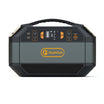
| T2000 | 1,536Wh LiFePO4 battery, 2,000W continuous AC output, 4,000W peak, 600W solar input, 19.2kg | Higher-output camping setups where the appliance label fits 2,000W and the extra weight is acceptable | You need an exact runtime without measuring the appliance, or the appliance manual excludes portable power use |
A label-first decision table
| Your coffee setup | Main check | Likely decision |
|---|---|---|
| USB grinder, lights and phone charging | Add charger input watts and USB needs | Usually an energy and port-planning question rather than an inverter limit question |
| Low-power brewer or travel kettle | Read the exact input watt label | May fit T1200S or T2000 if the label and simultaneous loads stay within limits |
| Pod or espresso machine | Check heating wattage and any startup or pump demand | Often better suited to T2000-class output, but only after checking the appliance manual |
| Full campsite kitchen setup | Add kettle, cooker, fridge, lights and chargers together | Use a full load budget; do not size from the coffee appliance alone |
How to check before the trip
- Find the coffee appliance input label in watts.
- If the label lists volts and amps, check the manual or calculate volts x amps as a cautious label check.
- Add every device that may run at the same time.
- Compare that simultaneous total with the station's continuous AC output.
- Check the appliance manual for startup, heating or pump behaviour.
- Run a short supervised test at home before relying on it at camp.
- Plan what you will do if weather, solar charging or the appliance draw reduces available energy.
When FlashFish fits
The T1200S fits campers who want a portable station with 1,200W continuous AC output and a 768Wh battery, and whose coffee appliance stays within that plan. It is the more portable of the two examples here.
The T2000 fits campers who need more output headroom and more stored energy, and who accept the 19.2kg weight. It is a better candidate for higher-watt appliances, but still needs the exact appliance label check.
When FlashFish does not fit
- The appliance label exceeds the station's continuous AC output.
- The appliance has a startup or pump demand that the manual does not support for this setup.
- You need to run coffee gear at the same time as a heater, cooker, fridge or other high-watt device.
- The cable, adaptor or extension path would be overloaded.
- You cannot place the station on a dry, ventilated and stable surface.
Practical camping coffee alternatives
If the watt label is too high, switch the problem. Boil water with an approved campsite method, use an insulated flask, choose a lower-power brewer, or use manual coffee gear. Often the best power-station plan is to reserve stored energy for lighting, phones, camera batteries, routers or laptops instead of repeated heat cycles.
Frequently asked questions
Will T1200S run my coffee machine?
Only if your appliance label, startup behaviour and simultaneous loads fit within 1,200W continuous output and your energy plan fits 768Wh before losses.
Will T2000 run a pod coffee machine?
It may, if the specific machine's input and startup demand fit 2,000W continuous output. Check the machine manual before assuming compatibility.
Can I use peak output as my normal coffee-machine rating?
No. Use continuous output for normal operation. Peak output is only brief startup headroom when the appliance and station documentation support it.
Does solar charging make repeated coffee cycles unlimited?
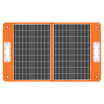
No. Solar input depends on panel size, weather, angle and available daylight. Treat solar as a recharge source, not a reason to ignore the watt-hour budget.
Should I run other appliances at the same time?
Only after adding the watt labels. Coffee gear plus a fridge, heater or cooker can exceed the practical camping load plan quickly.
Sources and evidence notes
- FlashFish product-source bundle, accessed 6 July 2026, for T1200S and T2000 specifications.
- Shopify discovery cache, accessed 6 July 2026, for active EU product URLs.
- Caravan and Motorhome Club: hooking up to the mains, accessed 6 July 2026, for campsite hook-up load-limit context.
- Electrical Safety First: overloading sockets, accessed 6 July 2026, for extension and socket safety guidance.



Yorum yazın
Tüm yorumlar yayınlanmadan önce incelenir.
Bu site hCaptcha ile korunuyor. Ayrıca bu site için hCaptcha Gizlilik Politikası ve Hizmet Şartları geçerlidir.