

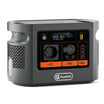
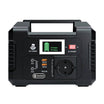

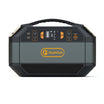
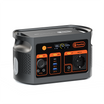






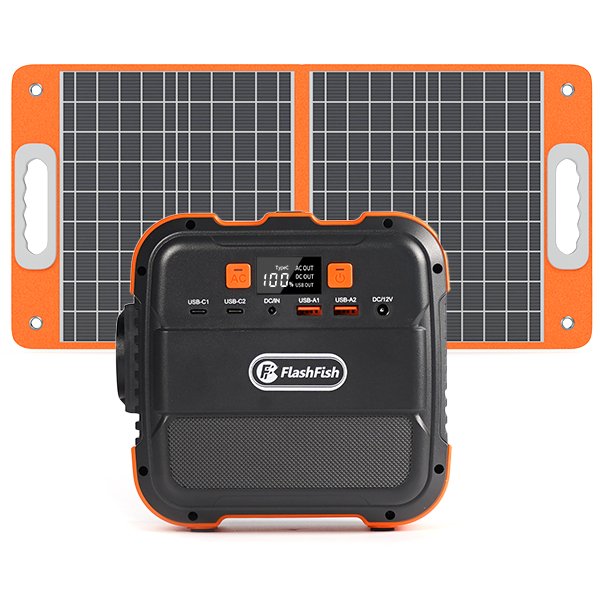

Short answer: a portable power station can run some original e-bike chargers on paper, but the station's watt rating is only one gate. Use the battery manufacturer's authorised charger, match its regional AC input, charge on a hard dry surface while awake and present, keep exits clear, and stop if the battery or charger is damaged, unusually hot, swollen, noisy, leaking, smoking or smells unusual. E106B is one specification screen here, not an e-bike compatibility or fire-safety approval.
Use CHARGE before connecting the battery
- C - Correct charger. Use only the charger supplied with the e-bike battery or a replacement authorised by its manufacturer. A connector that fits is not evidence of battery compatibility.
- H - Hardware and label screen. Record the charger model, AC input voltage, frequency and current or watts. Then compare those values with the exact regional station output and every simultaneous load.
- A - Awake and attending. Charge only while a responsible adult is present and alert. Do not charge while sleeping or away.
- R - Route and placement. Use a hard, flat, dry surface away from combustible material and escape routes. Do not cover the charger or battery.
- G - Gauge a complete session. Measure station watts and Wh for the exact charger and battery state. Preserve energy for lighting, communications and a safe return.
- E - Exit on warning signs. Stop for damage, swelling, leaks, extreme heat, hissing, cracking, unusual smell, smoke or repeated charger errors, and follow the manufacturer and emergency guidance.
What the documents establish
| Decision field | Documented evidence | What remains unknown |
|---|---|---|
| E106B AC screen | Current Europe evidence lists 230V/50Hz, 600W continuous shared pure-sine AC and 384Wh nominal energy | Compatibility with an e-bike charger, delivered AC Wh and charge completion |
| Exact charger example | Shimano SM-BCE60 lists 100-240V AC, 1.5-0.65A, 50/60Hz and specific compatible batteries | Measured input watts, another charger's requirements and E106B behaviour |
| Charging authority | UK transport and product-safety guidance says to use the supplied or manufacturer-authorised charger | Whether a battery or charger outside those instructions is safe |
| Location and supervision | Charge on a hard flat surface, away from exits, while awake and present | The reader's building, campsite and country-specific requirements |
Exactly three charging examples
Example 1: an authorised charger with a complete regional label
The charger names the battery family and lists an AC input that falls within the exact Europe station output. That passes the first paper screen only. Inspect the battery and charger, follow their instructions, use a dry hard surface, remain present and measure one complete session before depending on the setup.
Example 2: a cheap replacement charger with the right plug
Stop. A matching connector does not prove the voltage, charging algorithm, polarity, temperature sensing or battery communication is correct. Government and fire-service guidance prioritises the supplied or manufacturer-authorised charger, regardless of whether a power station could energise the replacement.
Example 3: an original charger beside a tent exit overnight
Stop and redesign the plan. The charger may be genuine, but sleeping, blocking an escape route, soft surfaces, damp and unattended operation fail the safety gates. Moving the same charger to a portable power station does not remove the battery-fire risk.
The charging location matters as much as the watts
- Let a battery that is hot after riding cool as its manufacturer instructs before charging.
- Keep the battery and charger on a hard, stable, uncovered surface with heat able to dissipate.
- Do not charge in an escape route, stairwell, doorway or shared corridor.
- Keep the station, plugs, charger and battery dry; the Shimano example explicitly prohibits outdoor or high-humidity charging.
- Do not charge a dropped, damaged, swollen, leaking or abnormally hot battery.
- If smoke or fire appears, raise the alarm, get out, stay out and call the local emergency service.
Measure energy without promising a charge count
| Record | Why it matters |
|---|---|
| Battery model and starting state | Defines the actual session instead of a generic e-bike claim |
| Charger model and AC label | Separates authorised battery charging from station output |
| Observed station watts and Wh | Replaces a nominal-capacity division with measured demand |
| Temperature, error lights and end condition | Shows whether the session remained inside documented behaviour |
| Energy reserve | Protects essential lights and communications from being consumed unintentionally |
Do not divide 384Wh by the e-bike battery capacity and publish the result as a charge count. AC conversion, charger losses, battery state, temperature, tapering and the reserve all matter.
When E106B fits - and when it does not
| E106B may pass the first screen when | Choose another plan when |
|---|---|
| The exact authorised charger accepts the regional 230V/50Hz supply and stays within the shared 600W AC ceiling with margin | The charger, battery identity or input label is missing or mismatched |
| Charging can remain supervised on a hard, dry, clear surface | The only plan is overnight, unattended, damp or in an escape route |
| The battery and charger show no damage or warning signs | There is swelling, leakage, abnormal heat, smell, noise, smoke or a repeated fault |
| A measured session leaves the necessary energy reserve | The decision depends on a promised charge count from nominal Wh alone |
Check E106B only after your CHARGE worksheet passes. If charger authority, placement or supervision fails, more inverter watts are not the solution.
Frequently asked questions
Can any portable power station charge any e-bike battery?
No. The original or manufacturer-authorised charger, exact battery instructions, regional AC input and the station output all have to match. The station never connects directly to an undocumented battery input.
Does 600W output prove E106B works with an e-bike charger?
No. Six hundred watts is only one output ceiling. Charger input, waveform, regional supply, battery authority, condition and charging environment still decide.
Can I leave an e-bike battery charging at camp overnight?
No. Current UK government and fire-service guidance says to charge while awake and present, not while asleep or away, and to keep the setup clear of escape routes.
Can I charge an e-bike battery outdoors?
Only if the exact battery and charger instructions permit the environment. The Shimano example used here says not to charge outdoors or in high humidity, so do not generalise from a dry-weather forecast.
How many e-bike charges can E106B provide?
No fixed count is supported without measuring the exact charger session and retaining reserve. Nominal station Wh is not delivered battery energy.
Sources and evidence limits
- FlashFish E106B Europe page and the manual-derived local record - station identity and output limits.
- UK Department for Transport e-cycle battery safety guidance - charger authority, supervision, placement and warning signs.
- UK Office for Product Safety and Standards guidance - correct chargers, supervised charging, clear exits and stop signs.
- Shimano SM-BCE60 manual - one exact charger's input, battery scope and environmental limits.
This is not a hands-on test, compatibility approval, legal advice or fire-safety certification.
Conclusion
A portable power station is only the upstream AC source; the e-bike battery must still be charged with its authorised charger, in the right environment, under supervision. Use CHARGE to reject a bad setup before comparing station watts. Ask FlashFish Europe for the current regional E106B documentation if the delivered label and page do not agree.




Yorum yazın
Tüm yorumlar yayınlanmadan önce incelenir.
Bu site hCaptcha ile korunuyor. Ayrıca bu site için hCaptcha Gizlilik Politikası ve Hizmet Şartları geçerlidir.