









Short answer: match six fields before connecting a panel: the station’s input-voltage window, the panel’s maximum open-circuit voltage (Voc), the station’s current ceiling, the station’s power ceiling, the connector and its polarity. Then treat sunlight as a variable, not a specification. A panel marked “18V” is not automatically compatible with every station marked “12-30V.”
The practical framework is LABEL: Limit window, Array Voc, Board current, Electrical power, Link connector and polarity—followed by real light conditions. The most important editorial result is also the least promotional: when one of those fields is missing, compatibility remains unproven.
In this guide: Six fields · FlashFish records · Worked screens · Nameplate versus sun · FAQ
The six fields that decide a solar pairing
| Field | Where to find it | Buyer action |
|---|---|---|
| Station voltage window | Station label or manual, for example 12-30V DC | Do not exceed either end of the permitted range. |
| Panel Voc | Panel label or manual | Use the maximum open-circuit voltage, not only nominal working voltage. |
| Station input current | Station label or manual | Respect the documented current ceiling and manufacturer pairing rules. |
| Station input power | Station label or manual | Expect the station ceiling to limit accepted power; do not infer speed. |
| Connector | Both manuals and delivered cable/tips | Match the exact dimensions and secure fit; similar-looking barrels are not proof. |
| Polarity | Polarity symbol or manual | Stop when polarity is not verified. Never trial-connect by appearance. |
Panel working voltage is often written as Vmp, the voltage near the maximum-power point. Voc is different: it is the open-circuit value when no load is attached. A safe screen therefore needs the panel’s maximum Voc against the station’s permitted input, not just “18V” against “12-30V.” Temperature and manufacturer limits also matter, so use the product instructions rather than a generic formula alone.
What the current FlashFish records do—and do not—provide
| Record | Verified electrical fields | Missing decision field |
|---|---|---|
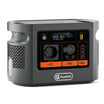
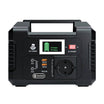
| E103 station | 12-30V DC input; 4A; 90W maximum | Local record does not fully specify connector dimensions and polarity for this pairing exercise |
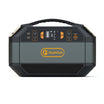
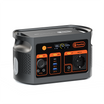
| E106B station | 12-30V solar/DC input; 10A; 200W maximum | Local record does not fully specify connector dimensions and polarity for this pairing exercise |
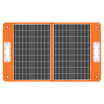
| TSP60 | 60W; 18V working output; about 3.34A; listed adapter tips | Voc and polarity are not supplied in the authoritative TSP18V60W record |
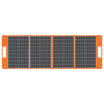
| TSP100 | 100W; 18V working output; 5.6A; listed adapter tips | Voc and polarity are not supplied in the authoritative TSP18V100W record |
Two useful screens that stop before a compatibility claim
TSP60 and E103
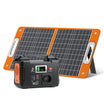
On the fields available, TSP60’s 18V working output sits inside E103’s 12-30V input window, its roughly 3.34A working current is below the station’s 4A figure, and 60W is below the 90W input ceiling. That is an encouraging paper screen, not a final pairing. The authoritative TSP60 record does not give Voc or polarity, and the E103 record does not fully resolve the delivered connector dimensions. Verify all three before connecting.
TSP100 and E106B
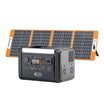
TSP100’s 18V working output sits inside E106B’s 12-30V range, its 5.6A figure is below the station’s 10A figure, and 100W is below the 200W input ceiling. Again, the missing Voc, polarity and exact delivered connector evidence prevent a blanket compatibility statement. A bundle listing or a tip that physically fits is not a substitute for the electrical record.
This stop rule protects buyers from a common mistake: completing four rows of a five-row comparison and treating the blank row as permission.
Why panel watts do not equal charging watts
The European Commission Joint Research Centre explains that photovoltaic peak power is defined at standard test conditions. Field production changes with solar radiation, temperature, system effects and time. Portable panels add more variation from angle, shade, dirt and placement. The station may also cap the accepted input below the panel nameplate.
Therefore, a 100W panel does not promise 100W into the battery, a daily energy amount or a full-charge time. Compatibility is an electrical safety and control question; yield is a weather and setup question. They should be evaluated separately.
When the label method fits—and when to stop
| Proceed to manufacturer confirmation when | Stop before connection when |
|---|---|
| Station limits, panel Voc/current/power and the connector record are all available. | Voc, polarity or exact connector evidence is missing. |
| The exact model and regional variant match every source. | A related model, bundle image or similar-looking cable is being used as proof. |
| The manual explicitly permits the arrangement and the delivered cable is correct. | A homemade adapter, reversed polarity or series/parallel wiring would be required. |
| Expected field variation is acceptable without a recharge-time promise. | The plan depends on nameplate output all day or on one weather forecast. |
After collecting all six fields, Review panel labels before comparing portable solar panels. Keep the written match beside the equipment so a later cable or panel swap does not inherit an old assumption.
FAQ
Is an 18V panel compatible with every 12-30V power station input?
No. The panel’s maximum open-circuit voltage, current, power, connector and polarity must also fit. Nominal working voltage alone is incomplete.
What is open-circuit voltage and why does it matter?
Open-circuit voltage, usually marked Voc, is the panel voltage with no load attached. It must remain within the station maker’s permitted input limit under the relevant conditions.
Can a 100W panel damage a station with a 90W input limit?
Headline watts alone cannot answer safely. The complete voltage, current, connector and polarity limits must be checked, and the station maker’s instructions should govern the pairing.
Do the current local records prove TSP60 with E103 or TSP100 with E106B?
No. Several working-voltage, current and power fields appear compatible on paper, but the local panel records do not provide Voc or polarity and the station records do not fully resolve connector dimensions.
Does a 100W panel deliver 100W all day?
No. Nameplate power is measured under defined test conditions. Sun angle, radiation, temperature, shade, dirt and station limits change field output.
Sources and editorial notes
FlashFish fields come from the authoritative local manual-derived records for E103, E106B, TSP18V60W and TSP18V100W, with fresh Europe Shopify status used only for current product presence. PV variability context comes from the European Commission JRC PVGIS manual. No connection was made, no panel was measured and no compatibility, yield or recharge-time result is claimed. Publication review must verify the exact delivered labels, Voc, polarity, connector and current manual versions.





Yorum yazın
Tüm yorumlar yayınlanmadan önce incelenir.
Bu site hCaptcha ile korunuyor. Ayrıca bu site için hCaptcha Gizlilik Politikası ve Hizmet Şartları geçerlidir.