









Short answer: these voltages describe different parts of a portable power station. The battery pack stores energy as DC at its own nominal voltage. Internal electronics can regulate a separate DC output, negotiate USB-C profiles and use an inverter to create 230V AC. A device must match the selected output path, not the hidden pack voltage.
Use PACK-PATH-PORT-LOAD: identify the battery pack only as the energy source, trace the intended conversion path, read that port's voltage/current/power limits, and then check the complete device load. Never treat one voltage number as universal.
One station can contain several electrical layers
| Layer | E106B example | What it tells you | What it does not tell you |
|---|---|---|---|
| Battery pack | 25.6V nominal, 15Ah, 384Wh | Nominal internal DC energy relationship | Outlet voltage or delivered runtime |
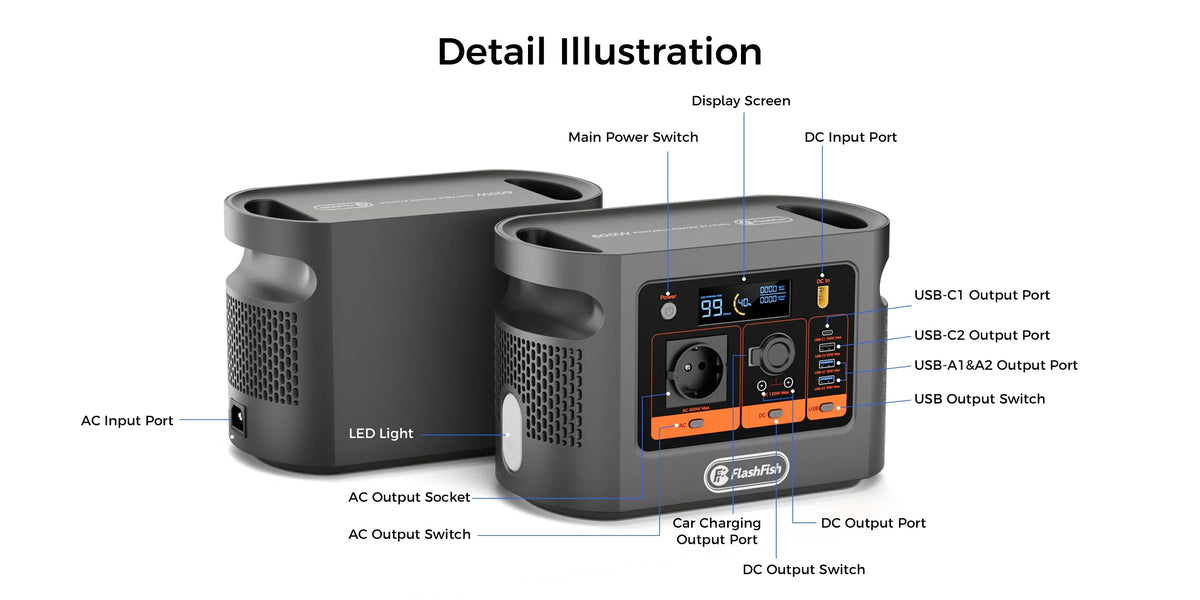
| Regulated DC group | 12V/10A/120W shared | Boundary for the specified DC outputs | Connector, polarity or every 12V device's fit |
| USB-C1 | Up to 100W PD, including documented profiles through 20V | Available negotiated source profiles | That every laptop or cable will request them |
| EU AC inverter | 230V/50Hz, 600W shared pure-sine maximum | Regional AC outlet format and total boundary | Appliance startup, runtime or universal compatibility |
Battery-pack voltage belongs inside the energy source
E106B's authoritative record lists a 25.6V nominal pack and 15Ah capacity. Multiplying the nominal figures gives 384Wh. Volts describe electrical potential, amperes describe current, watts describe power at a moment, and watt-hours describe energy over time. That nominal relationship is useful for understanding the pack; it is not a promise that 384Wh reaches every load after conversion and operating losses.
A regulated 12V output is its own path
The E106B DC group is documented as 12V/10A/120W shared. Its job is to present that output boundary to suitable accessories even though the internal battery's nominal voltage is 25.6V. Before connecting a device, check its required voltage, current, connector, polarity and startup demand. Do not open the station, bypass its protection, backfeed an outlet or build an improvised adapter from this explanation.
USB-C voltage is negotiated
USB-C describes a connector family; Power Delivery describes communication and power profiles. E106B USB-C1 documents profiles up to 20V/5A and 100W, while USB-C2 reaches 30W. The source, cable and device must agree on a supported profile. If they do not, the available result may be lower power or no useful charge.
An inverter creates regional AC
An inverter converts DC electricity to AC electricity. For the European E106B, the current evidence documents 230V at 50Hz and a shared 600W pure-sine maximum. That makes the outlet resemble the regional supply format, but it does not make every mains appliance suitable. The appliance label, startup behaviour, manufacturer instructions and total simultaneous load still control.
Three concrete voltage-path examples
- A hypothetical 12V/5A accessory: its 60W label is inside the E106B DC-group headline limit, but connection still depends on the exact plug, polarity, startup demand and shared use. It is an arithmetic example, not a compatibility result.
- A laptop requesting 20V/5A USB Power Delivery: that profile reaches 100W and matches the documented USB-C1 ceiling, but the laptop and a 5A-capable cable must negotiate it. USB-C2's 30W ceiling is a different path.
- A 230V/50Hz, 60W lamp: it uses the inverter-created AC outlet rather than the 25.6V pack or 12V DC group. Check the lamp and cable, then include its 60W in the shared AC load.
Compare portable power stations by complete output path after writing down the voltage, current, power, connector and protocol each device requires.
Common mistakes to avoid
- Comparing a battery's 25.6V nominal value directly with a 230V appliance label.
- Assuming every 12V socket has the same connector, polarity or current capacity.
- Assuming every USB-C cable carries 100W or every laptop accepts the same profile.
- Adding outlet power ratings as though they create extra total output.
- Dividing nominal watt-hours by device watts and presenting the result as measured runtime.
When the E106B example is useful
Use it to understand how one real station separates a LiFePO4 battery pack, a shared 12V DC group, two different USB-C ceilings and a European AC inverter. Do not transfer its numbers to another model. Read that model's authoritative manual and regional label from the beginning.
Frequently asked questions
Why is the battery voltage not 230V?
The battery stores energy as DC at its own pack voltage. The station's inverter converts that DC into regional 230V AC for the AC outlets; the outlet voltage does not need to match the internal pack voltage.
Is a 12V outlet connected straight to the battery?
Do not assume that. A portable station may regulate an output to 12V even when the battery pack has a different nominal voltage. Use the published output specification, not an imagined internal wire path.
Does 25.6V times 15Ah equal 384Wh?
For the E106B nominal figures, yes: 25.6V multiplied by 15Ah equals 384Wh. That arithmetic describes nominal stored energy, not the energy every outlet can deliver to a device after conversion losses.
Can I plug any 12V device into a 12V output?
No. Voltage is only one check. Confirm connector, polarity, maximum current, startup demand, output-group sharing and the device manufacturer's instructions.
Why can a 100W USB-C port use 20V?
USB Power Delivery can negotiate supported voltage and current profiles between the source, cable and device. A USB-C connector alone does not mean that every profile or power level is available.
Does a 600W AC rating mean 600Wh of energy?
No. Watts describe a rate of power; watt-hours describe an amount of energy. A 600W output limit and a 384Wh battery rating answer different questions and cannot be substituted for each other.
Conclusion
Battery-pack voltage, regulated DC, negotiated USB-C and inverted AC are separate layers. Follow PACK-PATH-PORT-LOAD, use the exact output specification and keep unknowns visible. Ask FlashFish Europe about an exact voltage path when the manual, regional label or port requirement is unclear.
Sources and evidence limits
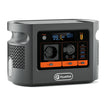
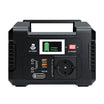
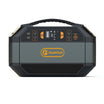
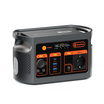
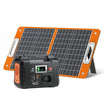
Checked 16 October 2026. E106B figures come from the authoritative local record and current Europe page. DOE supports the DC-to-AC principle; NIST supports unit terminology. No station was opened, rewired, instrumented or efficiency-tested, and none of the hypothetical devices was connected. The image is conceptual context, not a circuit diagram.



Leave a comment
This site is protected by hCaptcha and the hCaptcha Privacy Policy and Terms of Service apply.