






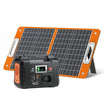

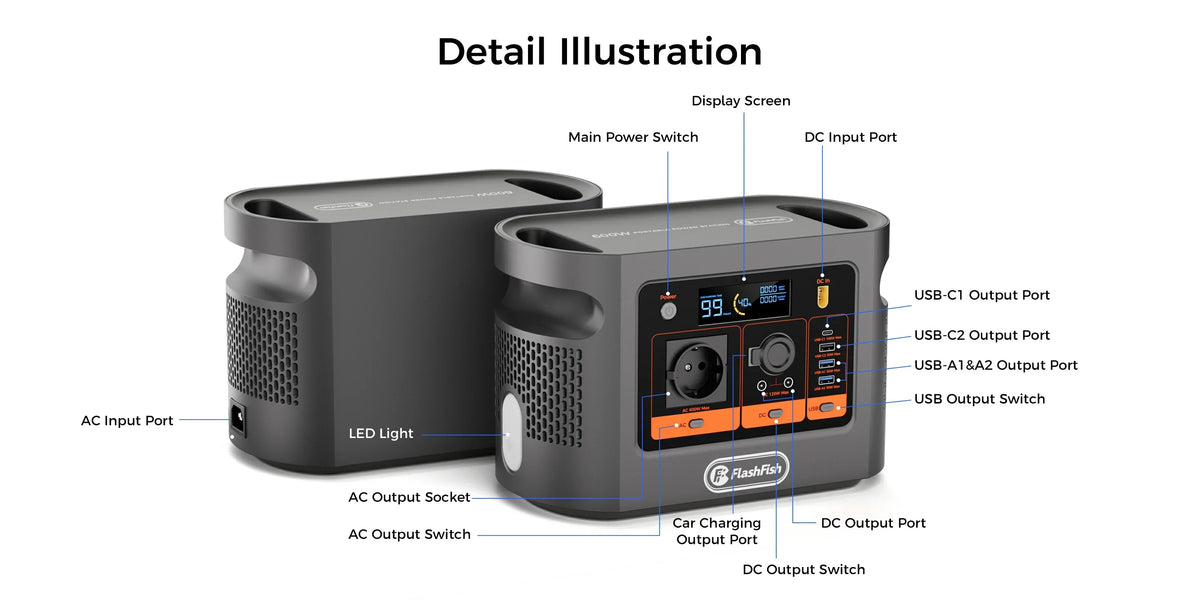
Short answer: power headroom and energy reserve answer different questions. Continuous-output headroom asks whether the station can support the load at a moment in time. Energy reserve asks whether enough energy remains for the whole task and what should be left unused. A plan passes only when both checks pass independently.
Keep watts and watt-hours in separate columns
| Check | Question | Evidence | Possible result |
|---|---|---|---|
| Continuous-output headroom | Does the simultaneous running load remain below a documented continuous-output rating with appropriate headroom? | Exact regional station rating plus every running load | Pass, fail or cannot compute |
| Startup evidence | Can the source support any material startup event? | Device manufacturer evidence or suitable supervised measurement | Pass, fail or unknown |
| Task energy and reserve | Does estimated or measured session energy fit after losses and an owner-chosen reserve? | Average watts or measured Wh, duration, efficiency assumption and reserve | Pass, fail or cannot compute |
A large nominal battery cannot repair a failed power check. Likewise, a low-watt load can pass the power check yet run longer than the available energy plan.
Use this two-gate worksheet
| Input | Your evidence | Do not substitute |
|---|---|---|
| Documented continuous AC output | _____ W | A shared maximum, peak figure or marketing category |
| Simultaneous running load | _____ W | One device while ignoring the rest |
| Startup evidence where material | Source or measured result: _____ | A generic multiplier copied from another device |
| Nominal battery capacity | _____ Wh | Usable delivered AC energy |
| Average task load or measured session energy | _____ W for _____ h, or _____ Wh | Maximum label watts multiplied indefinitely |
| Efficiency assumption | _____ % with source | An invisible default |
| Owner-chosen reserve | _____ % because _____ | A universal percentage |
For an estimate based on average load, use:
planning hours = nominal capacity Wh × efficiency × (1 − reserve fraction) ÷ average load W
The FlashFish runtime calculator exposes capacity, average load, efficiency and reserve as separate inputs and warns that output wattage and startup demand remain separate checks. Use the FlashFish runtime calculator with your own inputs, then label the result as an estimate rather than a measured duration.
Three hypothetical decision cards
Card 1: 400W steady load for 30 minutes with E106B
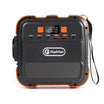
The exact-model E106B record provides 600W continuous AC output and 384Wh nominal capacity.
- Power gate: 600W minus 400W leaves 200W of nameplate continuous headroom before other loads. Confirm voltage, frequency, the exact load and any startup behaviour.
- Energy gate: the load-side arithmetic is 400W × 0.5h = 200Wh. That is not the required battery energy because conversion loss, standby draw, other loads and reserve still apply.
- Decision: the paper power screen can pass, but the task needs explicit efficiency, reserve and representative load evidence before an energy decision.
Card 2: 700W steady load for 10 minutes with E106B
- Power gate: fail. A 700W steady load is above the documented 600W continuous AC output before other devices are counted.
- Energy gate: 700W × 1/6h is about 116.7Wh at the load, but that smaller energy number cannot make the continuous-power mismatch acceptable.
- Decision: choose a lower-input task or a source with a documented suitable continuous rating; do not use short duration as a workaround.
Card 3: 300W steady load for two hours with E112B
The exact-model E112B record provides 1008Wh nominal capacity and defines 1200W as a shared maximum. Its continuous AC output field is not provided.
- Power gate: cannot compute from the reviewed record. Do not replace the missing continuous rating with the 1200W shared maximum.
- Energy gate: 300W × 2h = 600Wh at the load before losses and reserve. Nominal capacity alone does not prove delivery of that session.
- Decision: both the exact continuous-output evidence and a transparent energy plan are still required.
Startup evidence is a third line, not spare watt-hours
Some devices draw a brief burst when first energised. Fluke's inrush-current article distinguishes that momentary event from steady-state current and describes suitable instrument capture. It does not measure your appliance or either FlashFish model.
If startup can decide compatibility, use the exact device manufacturer's data or an appropriately supervised measurement. Do not copy a generic multiplier from another motor, compressor or power supply.
Common mistakes
- Using battery percentage as evidence that an over-rated load will start.
- Calling a maximum or peak number continuous output.
- Subtracting one device from the station rating while ignoring simultaneous loads.
- Treating nominal Wh as usable delivered AC energy.
- Hiding efficiency or reserve inside a calculator result.
- Using one short successful run as a general duration claim.
- Assigning every user the same reserve without explaining the consequence of depletion.
Frequently asked questions
Can a large battery capacity make an over-rated load fit?
No. Watt-hours describe energy; the load must independently fit documented continuous-output and startup boundaries.
Does spare continuous wattage prove a long runtime?
No. Duration still depends on average load, losses, reserve, cycling, temperature and other devices.
Can I use E112B's 1200W value as continuous output?
Not from the reviewed record. It defines 1200W as a shared maximum and leaves continuous AC output unprovided.
What reserve percentage should everyone use?
There is no universal percentage here. Choose and record a reserve for the actual consequence, uncertainty and next charging opportunity.
Do I need startup-current evidence for every load?
Steady electronic loads may have straightforward documented inputs, while motors, compressors and some power supplies can have a material startup event. Use exact evidence when startup can decide fit.
Sources and further reading
- FlashFish Europe E106B page and exact-model record — 384Wh nominal capacity and 600W continuous AC example.
- FlashFish Europe E112B page and exact-model record — 1008Wh nominal capacity, 1200W shared maximum and missing continuous-output field.
- FlashFish runtime calculator — transparent estimate inputs and output-versus-energy boundary.
- Fluke: measuring inrush current — startup-event context only.
Evidence checked 25 October 2026. No device, startup event, usable energy or runtime was measured.



Leave a comment
This site is protected by hCaptcha and the hCaptcha Privacy Policy and Terms of Service apply.