

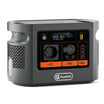
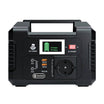

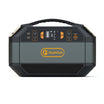
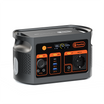







Short answer: treat FlashFish E106B as one more appliance on the campsite supply while it is charging. Its authoritative record lists AC input from 100-240V, 50/60Hz, up to 250W. That is a planning ceiling, not a constant draw or a promised recharge time. Check the pitch limit, count every simultaneous appliance, use proper campsite hook-up equipment and stagger loads when the allowance is tight.
A portable power station does not create extra pitch capacity while connected to the bollard. During charging, the campsite still supplies the station. After charging, use E106B as a standalone source only for directly connected compatible devices; do not improvise a connection into caravan, tent, home or campsite wiring.
Product facts that matter
| E106B fact | Documented value | Planning meaning |
|---|---|---|
| AC charging input | 100-240V, 50/60Hz, up to 250W | Count it in the pitch load budget; do not assume constant 250W. |
| Charging temperature | 0-40°C | Do not charge outside the documented range. |
| Nominal energy | 384Wh | Does not by itself produce a fixed charge time or delivered runtime. |
| AC output while used standalone | 600W shared continuous, pure sine wave | Separate output planning from the campsite input budget. |
Next step: check E106B input limits before planning your pitch load, then confirm the exact campsite allowance and rules.
Why the pitch limit comes first
The Camping and Caravanning Club electricity guide describes restricted campsite supplies and notes that mainland European hook-ups can be lower than typical UK provision. The number on the booking or bollard is the relevant ceiling; never assume every European pitch supplies the same current.
Use the campsite's stated rating and your appliance labels. A watt headline alone is not a complete electrical design, and this article does not supply a Europe-wide conversion rule. If the campsite does not clearly state its connector, voltage, current allowance or portable-station policy, ask before travel.
Build a simple load schedule
| Time block | Loads that may overlap | Decision |
|---|---|---|
| Arrival | E106B charging, fridge, lights and device chargers | Start with essential low loads and verify the station input on the display or suitable meter. |
| Meal period | Kettle, cooking appliance, fridge and station charging | Pause or reduce charging before a high-watt appliance if the combined plan is unclear. |
| Quiet period | E106B charging and low-demand essentials | Use a supervised low-overlap window, subject to campsite rules. |
| Wet conditions | Any exposed cable or connection | Stop if the setup cannot remain dry, protected and suitable for the conditions. |
Three examples for a limited hook-up
1. E106B charging by itself
The documented up-to-250W input is the main planned load, but actual input may change over the charge session. Confirm the proper regional cable, keep the station ventilated and dry, and observe the full cycle rather than assuming a fixed rate. A successful start does not prove the cable, connection or temperature remains acceptable for hours.
2. Charging overlaps with a high-watt kettle or heater
Heating appliances can take a large part of a restricted pitch allowance. The conservative workflow is to turn off or pause E106B charging, use the high-watt appliance only if the site and equipment allow it, then resume charging afterward. Do not keep resetting a tripped bollard or remove protective devices.
3. Charging is shifted to a low-overlap window
Plan a period when only essential low-demand equipment remains connected. This reduces simultaneous-load pressure, but it does not remove supervision, weather or site-rule requirements. If the station would be left unattended in a damp tent, choose another plan.
Hook-up equipment and placement checklist
- Use the campsite-approved connection system and a proper camping hook-up lead, not a household extension as a substitute.
- Keep RCD-protected equipment, sockets and connections off the ground and away from water.
- Fully uncoil the cable and keep it visible without creating a trip route.
- Use one appliance per appropriate socket and avoid daisy-chained adaptors.
- Keep E106B ventilated, within its charging-temperature range and accessible for monitoring.
- Stop on damage, heat, smell, water exposure or repeated protective trips.
The Club's tent electricity checklist recommends proprietary hook-up equipment, RCD protection, IP44-or-greater context, off-ground connections and supervised use. Follow the actual campsite and equipment instructions; these general boundaries do not certify a specific pitch.
What this setup must not do
- Do not connect E106B output into a pitch bollard, caravan inlet, home socket or tent distribution system through an improvised cable.
- Do not assume the two systems combine to create more current or uninterrupted backup.
- Do not use an indoor-only lead or exposed connector in damp conditions.
- Do not claim that a 250W ceiling proves a fixed recharge time.
- Do not add a kettle, heater or cooker without checking the combined pitch load and site rules.
When E106B fits
E106B fits this plan when the booked pitch has a clearly stated compatible supply, the campsite permits the equipment, proper hook-up gear is available, other loads can be scheduled, and the station can remain dry, ventilated and supervised. Its modest 250W maximum AC input can be easier to budget than an unknown high-power charger, but only the observed session and site limit settle the plan.
When it does not fit
Choose a different charging plan when the site allowance is unknown, essential appliances already consume the available budget, the connection would need an improvised adapter, conditions are damp, or the station must be left unattended. Compatible solar charging may be a separate option only after verifying panel voltage, current, connector and site placement; this article does not approve a panel or promise solar yield.
Frequently asked questions
Can I charge E106B from a campsite electric hook-up?
It can be considered when the hook-up supplies the correct regional voltage/frequency, the campsite allows the equipment, the proper hook-up system is used and the station's input plus every other load stays inside the pitch limit.
Does E106B always draw 250W while charging?
No. The authoritative record lists up to 250W AC input. Actual input can vary with charge state, temperature and control behaviour, so 250W is a planning ceiling rather than a constant measured value.
Can I run a kettle while charging E106B?
Only if the exact kettle and every simultaneous load fit the campsite's stated limit and the site's rules. High-watt heating appliances can consume most of a restricted pitch allowance, so staggering loads is usually the clearer plan.
Should E106B output be connected to the caravan or pitch wiring?
No improvised backfeed or male-to-male connection should be used. Treat E106B as an appliance while charging and as a standalone source for directly connected compatible devices.
Will 250W input fully recharge E106B in a fixed time?
This guide makes no fixed-time promise. An input ceiling is not the same as a complete charge curve, and actual charging varies with battery state, temperature and station controls.
Before travel: ask about the exact E106B regional charging cable and label, and ask the campsite to confirm its connector, allowance and rules.
Sources and evidence limits
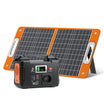
Checked 8 October 2026. E106B specifications come from the authoritative FlashFish manual-derived local record; the current Europe page and Admin snapshot establish an active public route. Camping and Caravanning Club pages provide bounded hook-up, combined-load and damp-condition guidance. FlashFish publishes this guide. No campsite, bollard, cable temperature, E106B charge curve or complete charging session was tested, and the image does not show an approved hook-up.



Leave a comment
This site is protected by hCaptcha and the hCaptcha Privacy Policy and Terms of Service apply.