

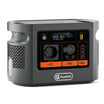
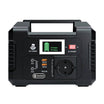

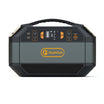
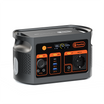




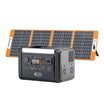

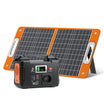


Short answer: start with E106B when the lighter 5.2kg station and documented 600W continuous AC envelope meet your kit. Consider E112B when 1008Wh of nominal energy, 1200W shared continuous AC or two AC sockets address a real need and you can manage its 11.2kg station mass. Neither is the universal winner.
The meaningful choice is not simply small battery versus big battery. Match output requirements first, plan session energy second, and then examine carrying, charging and missing evidence. Both models are linked to verified Europe product routes; this guide uses manual-derived records and is not an independent field review.
Compare equally defined fields
| Field | E106B | E112B | What it decides |
|---|---|---|---|
| Nominal stored energy | 384Wh | 1008Wh | Energy class, not delivered appliance watt-hours. |
| Continuous AC output | 600W shared, pure sine wave | 1200W shared, pure sine wave | Normal simultaneous AC-load ceiling. |
| AC sockets | 1 | 2 | Connection layout; socket count does not multiply power. |
| USB-C outputs | 100W PD and 30W PD | 100W PD and 30W PD | Same documented ceilings; actual negotiated profiles still need checking. |
| 12V output group | DC5521 pair plus car socket; shared 120W | DC5521 pair plus car socket; shared 120W | More stored energy does not raise this documented group ceiling. |
| AC charging ceiling | 250W | 960W | Input limit, not a measured charging curve. |
| DC charging window/ceiling | 12-30V, 10A, up to 200W | 10.5-60V, up to 600W; current not provided | Accessory electrical checks; voltage and watts alone do not prove a complete panel pairing. |
| Station-only mass | Approximately 5.2kg | Approximately 11.2kg | Carry route before cables, panels and devices. |
| Unit dimensions | 306 x 171 x 202mm | 415 x 203 x 242mm | Shelf and vehicle fit, allowing required ventilation. |
| AC regional evidence | 110V/230V and 50/60Hz by regional version | 230V for the EU group; output frequency not provided | Exact delivered label and manual required. |
The figures are matched local product records, not measurements from one shared test. E112B has about 2.63 times the nominal energy and about 2.15 times the station mass of E106B. Those arithmetic ratios describe listed ratings only. They do not establish runtime, efficiency, value for money or how either feels on stairs.
Lighter-kit check: Check E106B against the lighter-kit decision using your device labels, session energy and carrying route.
Choose by four decisions in order
1. Does the output path meet the actual device requirement?
List what will be connected at the same time. A nominally 900W AC load is above E106B's documented continuous limit and below E112B's, but that comparison is only a first screen. Voltage, frequency, starting behaviour, other loads and appliance instructions still matter. Neither record provides a usable peak figure to resolve an undocumented start demand.
For USB-C-first equipment, both records offer the same 100W and 30W ceilings. Confirm the device, cable and source profiles. Moving to a larger battery does not turn a 30W socket into a 100W socket, nor establish a laptop charging rate. USB-IF guidance explains the negotiated-power context.
2. How much energy does the session actually use?
Measure or defensibly estimate the complete workload, including pauses and enabled outputs. Nominal battery Wh is useful for comparing classes, but it is not all available at an appliance after losses, reserve and changing conditions. Use E112B's larger rating as a reason to investigate the required energy budget, not to promise an exact extension of E106B runtime.
3. What must you carry from the vehicle to the working place?
The station difference is approximately 6kg. Add the actual cables, adapters, devices and any panel to each proposed kit, rather than comparing a bare station with the other model's carton. Check the real route: parking distance, steps, grip, surface and how many separate trips the kit needs. Listed mass alone does not prove a unit is easy for every buyer to carry.
4. Can the planned charging opportunity support the setup?
The records give different AC and DC input ceilings. They do not establish full-charge times under your conditions or permission to combine inputs. For DC accessories, establish the precise connector, polarity, voltage/current limits and manufacturer approval. A panel watt figure below a headline input maximum is not a complete compatibility assessment.
Three buyer profiles
1. A short, carried-in laptop and camera session
With devices that fit the documented paths and an energy budget that does not require the larger class, E106B's lower station mass may be the more useful trade-off. The decision should change if measured session demand, required AC hardware or the available recharge opportunity disagrees with that assumption.
2. Two AC appliances used together at a temporary desk
E112B offers two built-in AC connection positions and a higher shared continuous ceiling. Count both demands together and check the regional supply before choosing. The comparison does not establish earth/RCD suitability for either appliance, and extra sockets do not supply 1200W each.
3. A vehicle-based kit with a longer energy requirement
If movement is limited and measured energy need justifies a larger battery class, E112B is worth evaluating. A larger rating adds little commercial value if the setup still fails a missing frequency, startup, protection or weather requirement. Resolve that exact requirement before accepting the heavier kit.
Unknown features must stay unknown
These records do not provide battery chemistry or peak output for either model. They also do not establish UPS/EPS transfer performance, an app or an ingress-protection rating. E112B's warranty and output-frequency fields are missing. Its AC input specification includes 50/60Hz, but input wording cannot be silently turned into output frequency.
Neither catalogue labels nor another FlashFish model fill these gaps. If a feature is essential, ask for exact supporting evidence or consider a model with it documented. We do not treat an unknown as either a proven benefit or a proven defect.
When neither option is established by this comparison
The table does not approve a life-critical setup, automatic whole-building supply, damp outdoor operation, sustained AC demand above 1200W or a device requiring unsupported startup evidence. It also supplies no measured noise, efficiency, reliability or review data. Those needs require their own evidence, not a stronger purchasing recommendation.
Frequently asked questions
Is E112B simply a longer-running E106B?
No. It also changes continuous AC from 600W to 1200W, outlet count, size, input ceilings and station mass. The nominal-energy ratio alone does not predict a real runtime ratio.
Do both E112B AC sockets supply 1200W each?
No. The authoritative record specifies a shared maximum AC output of 1200W across its two sockets. Count simultaneous appliance demand together.
Does E112B have faster USB-C charging for my laptop?
Both records list one 100W USB-C PD output and one 30W USB-C output. A higher battery capacity does not change that documented port ceiling or prove the same laptop will negotiate a particular rate.
Can I say either model has UPS or a particular battery chemistry?
Not from these records. Chemistry and UPS/EPS performance are not provided. The E112B output-frequency and warranty fields are also missing; input 50/60Hz wording is not an output-frequency specification.
Which should I choose for mostly USB devices?
Check the exact USB profiles, measured session energy and carry requirement first. E106B has the lower station mass; E112B has more nominal energy. Choose only after those facts address your actual kit.
Higher-energy check: Check current E112B details and availability when its output and energy class address your actual kit. For missing regional or feature evidence, send support your exact device requirements.
Sources and disclosure
Checked 7 October 2026. Specifications are from the authoritative E106B record and E112B EU manual record; the preserved E112B PDF checksum was verified. Fresh Europe Admin evidence confirms active product routes for E106B and E112B; availability can change. FlashFish publishes this neutral first-party comparison, rated evidence level C. No independent test, price ranking, customer quotation or runtime result is included.



Leave a comment
This site is protected by hCaptcha and the hCaptcha Privacy Policy and Terms of Service apply.