








50 Hz vs 60 Hz: Power Station Compatibility in Europe
Short answer: a 50Hz appliance should not be treated as interchangeable with a 60Hz appliance unless its label and manual explicitly allow both. Before connecting any device to a portable power station in Europe, match four separate items: frequency, voltage, plug and earth path, and continuous/startup power.
Key definition: electrical frequency is the number of alternating-current cycles per second. A 50Hz source completes 50 cycles per second; a 60Hz source completes 60. Frequency is separate from voltage, socket shape, waveform and wattage, so passing one check does not pass the others.
The European Commission's referenced EU-market test guidance specifies 230V at 50Hz for the relevant equipment. IEC 61293 separately identifies voltage, current, frequency and power as supply ratings used to help people select electrical equipment safely. Together, those sources support a simple buyer rule: read every relevant rating instead of assuming that a familiar-looking socket proves compatibility.
The FOUR compatibility check
| Check | Read on the appliance | Read on the power station | Decision |
|---|---|---|---|
| F — Frequency | 50Hz, 60Hz or 50/60Hz | Exact AC output frequency for the regional version | The source frequency must fall within the appliance's accepted range. |
| O — Output voltage | Input voltage or voltage range | AC output voltage | Do not use an adaptor to hide a voltage mismatch. |
| U — Usable plug path | Plug, earth class and manufacturer restrictions | Socket type and documented protective arrangement | A plug must fit without an improvised or unapproved chain of adaptors. |
| R — Rated power | Watts or amps plus startup behavior | Continuous output and documented peak behavior | All simultaneous loads must remain within the applicable limits. |
Why frequency can change appliance behavior
Some modern switch-mode power supplies accept a broad input such as 100–240V, 50/60Hz. Others are designed for one voltage and one frequency. Motors, clocks, pumps, compressors and equipment that use the mains cycle for timing can behave differently when frequency changes. The safe conclusion is not that every motor will fail; it is that a frequency-sensitive appliance needs manufacturer confirmation before use.
Pure sine wave does not remove this check. Waveform describes the shape of the AC signal; frequency describes how often it repeats. Likewise, a travel adaptor normally changes only the physical plug. It does not promise voltage transformation or 50/60Hz conversion.
Three practical label examples
1. A laptop adaptor marked 100–240V, 50/60Hz
This label passes the frequency and voltage-range checks for a 230V/50Hz source, but the plug path, earth class, adaptor condition and input watts still need review. If the adaptor or station manual adds a restriction, that restriction controls.
2. A motor appliance marked 230V, 60Hz only
A 230V figure alone is not enough. The label does not declare 50Hz acceptance, so a European 230V/50Hz source is not a defensible pairing without written manufacturer confirmation. Do not use a travel adaptor as a frequency converter.
3. An imported appliance marked 120V, 60Hz
This fails both the usual European voltage and frequency checks. A plug adaptor does not resolve either mismatch. Choose a region-correct appliance or obtain a manufacturer-approved electrical solution rather than improvising a transformer/converter chain.
Common mistakes
- Checking the plug shape but not the electrical label.
- Reading 230V and overlooking a 60Hz-only marking.
- Assuming pure sine wave means universal appliance compatibility.
- Using the model name without confirming the regional version.
- Comparing only the largest load and ignoring simultaneous devices.
- Using an unverified transformer or frequency converter as a routine accessory.
A buyer checklist before first use
- Photograph the power station output label and the appliance input label.
- Write down voltage, frequency, watts/amps, plug, earth class and startup information.
- Check the exact regional manual for both products; do not substitute a manual from another market.
- Confirm every required value is present and compatible.
- Inspect plugs and cables and use only approved, undamaged accessories.
- If any rating is missing, stop and ask the manufacturer rather than testing by trial and error.
Where FlashFish fits — and where it does not
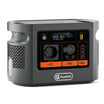
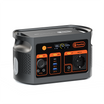
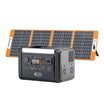
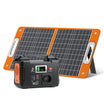
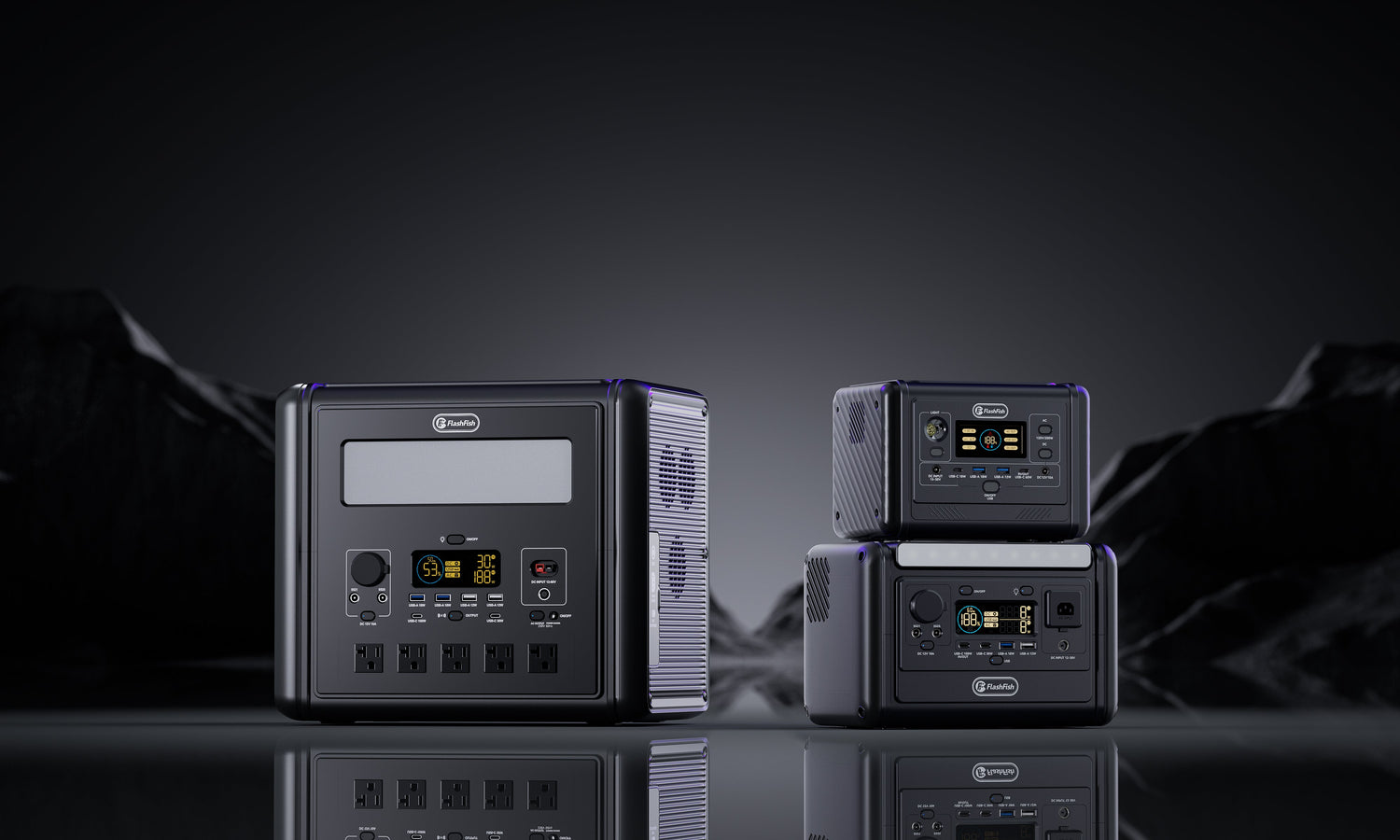
FlashFish can fit when a current Europe-market station has the correct regional output and enough documented headroom for the exact appliance. Start with the FlashFish portable power station collection, then verify the selected product page, physical unit label and supplied manual.
FlashFish does not fit when the buyer needs to assume that a U.S. manual applies to an EU unit, when an appliance is 60Hz-only, when voltage or grounding is incompatible, or when safe use would require an unapproved adaptor or converter. The model name alone is never enough to override the rating label.
Safety boundary
This guide is a label-reading method, not installation advice. Do not open a power station or appliance, alter protective conductors, create a neutral-earth bond, build a frequency converter or connect the station to household wiring. Stop if the equipment, cable or plug is damaged, overheats, smells abnormal or behaves differently from its manual.
FAQ
Is Europe 50 Hz or 60 Hz?
The referenced European Commission test guidance uses 230V at 50Hz, and 50Hz is the normal EU-market assumption. Still check the destination country, the exact power station output label and the appliance label rather than relying on a continent-wide shortcut.
Can a 50/60 Hz appliance run from a 50 Hz power station?
Potentially, if the appliance label genuinely accepts 50/60Hz and its voltage, plug, grounding, continuous watts and startup behavior also fit the station. A dual-frequency label solves only the frequency question.
Will a travel adaptor convert 60 Hz to 50 Hz?
No. A basic travel adaptor changes the physical plug interface; it normally does not convert voltage or frequency. Use only equipment whose documented electrical ratings match the source, or obtain manufacturer-approved conversion guidance.
Does pure sine wave mean frequency does not matter?
No. Waveform and frequency are different characteristics. A pure sine wave label does not automatically make a 60Hz-only appliance suitable for a 50Hz output.
What should I check before connecting an imported appliance?
Check the appliance input voltage, frequency, watts or amps, plug and earth requirements, startup behavior and manual restrictions. Then compare each item with the exact power station version and stop if any required value is missing or incompatible.
Sources and further reading
- European Commission: 230V/50Hz EU-market test context.
- IEC 61293:2019 public summary — equipment supply-rating markings.
- European Commission: Low Voltage Directive — electrical-equipment safety scope.
- FlashFish Europe buying guide — current regional shopping context; exact product label and manual still control.
Editorial viewpoint: compatibility is a four-column evidence problem, not a plug-shape guess. If one column is blank, the professional answer is “not verified yet.”
Human review required before publication: electrical terminology, regional scope, author/reviewer credentials, link accuracy, image crop and rendered FAQ/schema parity.



Hinterlasse einen Kommentar
Diese Website ist durch hCaptcha geschützt und es gelten die allgemeinen Geschäftsbedingungen und Datenschutzbestimmungen von hCaptcha.