






FlashFish Europe support center
FlashFish FAQ
Find practical answers about FlashFish portable power stations, solar panels, FlashFish SR5000, orders, shipping, returns and warranty support. If your case depends on an order, destination country or product condition, contact FlashFish support before taking action.
Contact us
Quick answer
What this FlashFish FAQ covers
This FAQ helps FlashFish Europe customers choose a product category, understand safe power matching, plan solar charging, maintain portable power stations, check basic FlashFish SR5000 facts, and find the right support route for orders or after-sales questions.
Product specifications on this page are based on the local FlashFish product database. Where a field is not provided by the database, the FAQ says so instead of estimating it.
FlashFish product, charging, order and support FAQ
Answers below are visible on this page and are emitted by the same native FAQ section as the FAQ structured data.
What types of products does FlashFish sell in Europe?
FlashFish Europe focuses on portable power stations, portable solar panels, solar generator kits and home energy storage products. The product database includes portable power station, solar panel and home energy storage categories.
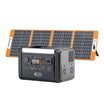
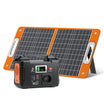
Useful starting points: portable power stations, portable solar panels and solar generator kits.
How do I choose the right FlashFish power station capacity?
Start with two numbers: watt-hours (Wh) and output watts (W). Wh indicates stored energy. W indicates how much power the product can supply at one time. Choose a model with enough Wh for the expected runtime and enough continuous output for the device you want to power.
For example, the product database lists FlashFish E200 at 151Wh and 200W AC output, FlashFish T300PRO at 230Wh and 300W AC output, and FlashFish T2000 at 1536Wh and 2000W AC output.
What is the difference between W and Wh?
Watts (W) describe power at a moment in time. Watt-hours (Wh) describe stored energy. A higher Wh value usually means more available energy, while a higher W rating means the unit can support higher-power devices. Actual runtime depends on device load, operating mode and conversion loss.
Can a FlashFish power station run any appliance?
No. Check the appliance's rated power and starting surge, then compare it with the FlashFish model's continuous and peak AC output. Do not exceed the product's output rating, and check the user manual before connecting sensitive, medical, heating or motor-driven devices.
Which FlashFish products use LiFePO4 batteries?
The local product database lists LiFePO4 chemistry for models including FlashFish SR5000, SR2000, T2000, T1200S, T300PRO and T200. It lists FlashFish E200 as lithium-ion. Always check the exact product page and manual for the model you are buying.
How can I estimate runtime?
A simple estimate is: battery watt-hours divided by the device's watt draw, then reduced for conversion loss and real operating conditions. Example: a 100W device cannot be estimated accurately from the AC output rating alone; you need the model's Wh capacity and the device's actual draw.
What is pure sine wave output, and which models list it?
Pure sine wave output is generally preferred for sensitive AC devices. The product database lists pure sine wave output for FlashFish T200, T300PRO, T1200S and T2000. FlashFish E200 is listed with modified sine wave output.
How can I recharge a FlashFish portable power station?
Recharge options depend on the model. Common routes include AC wall charging, vehicle charging and solar/DC input. The product database lists maximum solar/DC input examples such as 600W for FlashFish T2000, 400W for FlashFish T1200S, 120W for FlashFish T300PRO and 60W for FlashFish T200. Check the product page and manual before connecting panels or adapters.
Can I use a FlashFish power station indoors?
FlashFish portable power stations are battery products, not fuel generators. Use them according to the manual, keep ventilation openings clear, avoid moisture and heat sources, and do not open, modify or repair the product yourself. For medical or safety-critical equipment, follow the equipment manufacturer's guidance and use a properly rated backup solution.
How should I store a portable power station?
Store the product in a dry, clean place away from heat, direct moisture and physical damage. Follow the charging, storage temperature and maintenance instructions in the manual for the exact model. If the product has been dropped, exposed to liquid or shows swelling, odor or damage, stop using it and contact support.
How do I calibrate the battery display on a FlashFish portable power station?
If the battery percentage appears inaccurate, first check the manual for the exact model. A practical calibration route is to charge the unit fully with the approved charger, let it rest, use it under a moderate load, and then recharge it fully again. Do not force deep discharge, overload the unit, open the product, or continue using it if it shows warning icons, abnormal heat, swelling, odor or liquid exposure.
Some FlashFish manuals include model-specific charging and storage notes. For example, the product database says FlashFish A101 should be charged before first use and before storage, and recharged when remaining electricity is below 10%. It also says FlashFish E200 should be charged every 3 months or at least every 6 months during storage.
What should I check first if a portable power station is not charging or not outputting power?
Start with simple checks: confirm the power station is turned on, the output port is enabled, the connected device is within the rated output, the cable and adapter are seated correctly, and the charger or solar panel is within the model's allowed input range. Remove the load and allow the unit to cool if it may have triggered temperature, overload, over-current or short-circuit protection.
The product database lists protection functions such as over-temperature, low-temperature, over-voltage, low-voltage, overload, short-circuit and over-current for several FlashFish portable power models. If the issue remains after basic checks, stop using the product and contact FlashFish support with the model, order number, photos or video, and the conditions that triggered the issue.
What daily maintenance helps protect a FlashFish portable power station?
Keep the unit dry, clean and ventilated. Avoid covering vents, using the product near heat sources, placing it in direct rain or moisture, or connecting loads above the rated output. Use approved chargers and cables, inspect ports before use, and store the product with periodic recharging according to the manual. Do not disassemble, modify or repair the battery product yourself.
How do I choose a compatible solar panel?
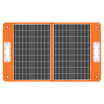
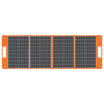
Match the solar panel's connector, voltage, current and wattage with the power station's allowed solar/DC input. Do not exceed the input range in the manual. The product database includes FlashFish foldable monocrystalline solar panels with 18V DC output, including 60W, 100W and 200W classes.
Why is solar charging lower than the rated panel wattage?
Solar panel output changes with sunlight intensity, panel angle, shade, temperature, cable loss and the power station's input limit. Rated wattage is measured under standard test conditions, so real-world charging is often lower.
How can I improve portable solar panel output?
Place the panel in direct sunlight, adjust the angle toward the sun, keep the surface clean, avoid shade across any part of the panel, and use the correct cable and connector for the power station. The product database notes that FlashFish solar panel conversion depends on sunlight angle, temperature, weather and charging time. It also notes that the solar panel cannot store power; it converts sunlight to electricity.
Can I connect multiple solar panels?
Only connect multiple panels if the combined voltage, current and wattage remain within the FlashFish product's specified input range and the connector setup is supported. If you are unsure, contact FlashFish support before connecting panels in series or parallel.
What is the difference between connecting solar panels in series and in parallel?
A series connection usually increases voltage while current stays closer to a single panel's current. It can be useful when the power station needs a higher input voltage and all panels receive similar sunlight. The risk is that shade or mismatch on one panel can reduce the whole string's output, and the total voltage must never exceed the power station's input limit.
A parallel connection usually increases current while voltage stays closer to a single panel's voltage. It can be useful when panels may receive uneven sunlight or when the power station input voltage limit is low. The risk is that total current can exceed the input rating if the setup is not matched correctly.
When should I use series or parallel solar panel wiring?
Use series only when the combined voltage remains inside the exact FlashFish input range and the panels are the same or closely matched, facing the same direction and receiving similar sunlight. Use parallel when keeping voltage lower is important or when panel sunlight may be uneven, while still staying within the current and wattage limits of the power station.
FlashFish products have different input ranges. The product database lists examples such as FlashFish T200 at 15-30V, 60W solar input; FlashFish T300PRO at 12-30V, 120W solar input; FlashFish T1200S at 12-50V, 400W solar input; FlashFish T2000 at 12-80V, 600W solar input; and FlashFish SR5000 PV input at 10-100Vdc with 1000W x 2. Always check the exact model manual before using series or parallel wiring.
How should I care for FlashFish portable solar panels?
Do not bend the panel, immerse it in water, or use it to charge an automotive battery directly. The product database says FlashFish portable solar panels should not be cleaned with water directly; wipe gently with a wet cloth or microfiber cloth as specified. Store the panel folded and dry when not in use, and check the cable and connector before charging.
Can I use a power station while it is charging?
Pass-through or backup behavior depends on the model and the connected load. Check the product manual for the exact model and avoid using loads that exceed the rated output or create unsafe heat, moisture or ventilation conditions.
What is FlashFish SR5000?
FlashFish SR5000 is a home energy storage product. The product database lists it as a 5120Wh LiFePO4 unit with 230V AC output, 2400W rated off-grid AC output and 3600W maximum output for 10 seconds. The listed size is 520 x 181 x 715mm and the listed weight is 59kg.
Can ordinary users install FlashFish SR5000 themselves?
Yes. FlashFish SR5000 information on the Europe site should describe it as suitable for ordinary users to install themselves when following the official instructions. Users should still follow the product manual, use the correct accessories and comply with local electrical and safety requirements. If the installation situation is unclear, contact FlashFish support or a qualified professional before connecting equipment.
What solar input does FlashFish SR5000 support?
The product database lists FlashFish SR5000 solar input as 1000W x 2. Do not connect solar input outside the product's specified voltage, current or wattage limits. Check the exact manual before connecting panels.
What battery cycle information is provided for FlashFish SR5000?
The product database lists LiFePO4 chemistry, a minimum cycle-life value of 6000 and a 60-month warranty value for FlashFish SR5000. Cycle-life and warranty conditions are separate; check the warranty page and the terms that apply to the exact order.
Is FlashFish SR5000 suitable for every whole-home backup setup?
No single FAQ answer can confirm suitability for every home. FlashFish SR5000 should be matched to the actual load, connection method, local requirements and user manual. The product database confirms 2400W rated off-grid AC output, so high-power or whole-home loads must be checked before use.
How do I check my order status?
After payment, FlashFish sends order updates to the email address used at checkout. You can also use your customer account where available. If the tracking information is missing or unclear, contact FlashFish support with your order number.
Can I change my shipping address after ordering?
Contact FlashFish support as soon as possible. If the order has not shipped, support may be able to review the change. If the package has already shipped, the address may not be changeable while it is in transit.
How do I know whether FlashFish ships to my country?
Available delivery countries, carrier options and shipping costs can depend on the product, destination and battery-shipping restrictions. Check the checkout page first. For islands, remote areas or unclear destinations, contact support before placing the order.
Shipping information page: Shipping & Delivery.
Which payment methods are available?
Available payment methods are shown at checkout and may vary by country, currency and payment-provider availability. Use the checkout page as the source of truth for the current order.
Can I get an invoice?
If you need an invoice, keep your order confirmation and contact FlashFish support with your order number, billing details and any information required for the invoice request.
When should I contact FlashFish support?
Contact support before returning any product, before troubleshooting damaged battery products, and whenever the question depends on your order, product condition or destination. Email info@flashfishtech.com or use the contact page.
Can I request a return after receiving a product?
Customers may request a return within 30 calendar days after receiving the product. Contact FlashFish support before sending anything back. Battery products may require specific packaging, labels or carrier handling.
Who pays return shipping for defective and unconditional returns?
For a confirmed defective return, return shipping is covered by FlashFish. For an unconditional return, return shipping is paid by the customer. Support must confirm the case type before return shipping is arranged.
How long does refund handling take?
Refund handling is normally completed within 7 business days after FlashFish confirms the eligible cancellation or completes the required return inspection. The bank or payment provider may need additional time to post the funds.
Where can I confirm warranty coverage?
Warranty coverage depends on the exact product, purchase channel and support review. Many product database records list 12 months, while the user-confirmed SR5000 record lists 60 months. Check the warranty support page and retain the terms that apply to the exact order.
What should I do if a product arrives damaged?
Keep the product, accessories, packaging and shipping label. Take clear photos or video and contact FlashFish support before using the product further or sending it back.
Where can I check certificates, plugs, policy exceptions or compliance details?
Use the product page, official manual and FlashFish support as the source of truth. If a certification, plug type, country exception or compliance detail is not provided in the product database or official store content, this FAQ does not estimate it.
Need more help?
Contact FlashFish support
Email: info@flashfishtech.com
Contact page: https://eu.flashfishtech.com/pages/contact
Include your order number, product model, photos or video where relevant, and the country or region for delivery questions.
Last reviewed: 28 July 2026.