

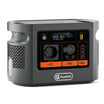
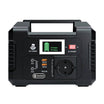

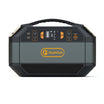
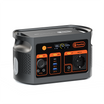







Short answer: A portable station can use battery energy while its AC inverter is enabled even if no appliance is plugged in. The loss matters most when the intended devices draw little power over many hours. It is not a universal percentage or a FlashFish E106B number: the authoritative local E106B record does not state its no-load watts. Plan from the exact unit and actual trip pattern.
The missing row in a trip energy budget
A simple “device watts × hours” worksheet counts useful loads but can omit power consumed to keep an inverter ready. Victron publishes zero-load consumption for specific SUN inverter models, including 4.2W for 12/250 and 5.2W for 24/250. Its operation manual also describes an ECO search mode that reduces no-load use by periodically checking for a load. Those are Victron figures and functions, not E106B specifications.
| State | What it means | Planning implication |
|---|---|---|
| Station stored, outputs off | Battery rests without active AC output | Consider long-term self-discharge separately. |
| AC enabled, socket empty | Inverter can consume energy without useful output | Measure or find the exact model-specific no-load figure. |
| Small appliance on AC | Useful appliance demand plus conversion and station overhead | Measure a representative combined session. |
| Verified direct USB/DC path | AC inverter may remain off if the device can use that path | Check protocol, voltage, current and cable first. |
As arithmetic only, 4.2W sustained for eight hours equals 33.6Wh. That example uses Victron’s named 12/250 inverter. It is not a prediction of E106B loss or of how long any FlashFish battery will last. Battery state displays may be too coarse to infer a small watt figure from one short observation.
The OFF-LOAD measurement method
- O — Observe the exact station, temperature and starting state of charge. Note whether AC, USB and DC are enabled.
- F — Fix a reasonable observation interval and use the same starting conditions for a control with AC disabled.
- F — Focus on only the setting being compared. Remove unintended adapters or chargers that have their own standby demand.
- LOAD — Log ending display state, any station energy reading, connected load and interval. Treat a coarse percent display as a broad planning clue, not a laboratory watt measurement.
A plug-in AC meter on an empty outlet reads useful external AC output, which may be zero; it does not directly measure internal battery-to-inverter consumption. Do not open the battery or improvise probes to obtain a number. For buying decisions, request the maker’s model-specific no-load data or use a controlled, safe observation of the complete station.
Three trip patterns
Phone charging in the evening
If a verified USB output supplies the phone, leaving AC enabled for hours may add an avoidable planning burden. Confirm that the phone and cable negotiate the intended USB mode.
AC-only camera battery charger
AC may be necessary. Count the charger’s own draw and the period AC remains on after charging, then switch the inverter off according to the station manual.
Low-draw overnight electronics
Standby overhead can be material relative to a small load. Keep a measured reserve; do not use an unverified ECO/search mode, because another inverter’s wake threshold may miss a very light appliance.
Where E106B fits in this decision
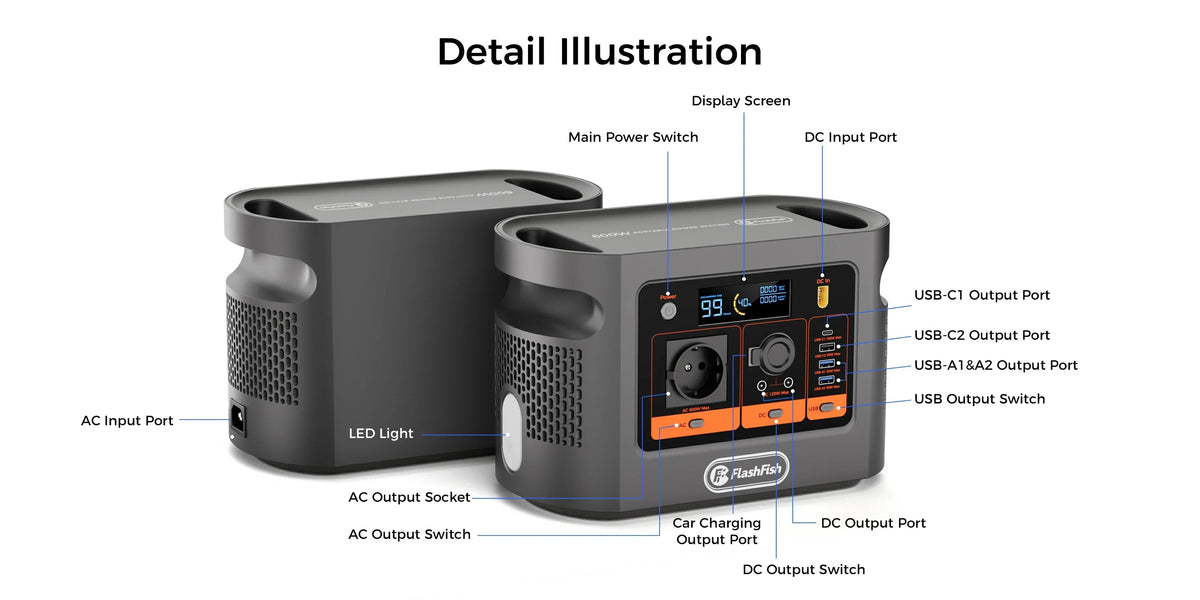
E106B documents AC, USB-C and 12V output paths, so a buyer can compare possible connection routes. The local record has no standby-watt or ECO-mode value. It fits this planning method only after the exact device input and station output are verified. It is a poor evidence fit for a fixed overnight duration claim until the actual configuration has been measured.
Common mistakes
- Copying a no-load figure from another brand or model.
- Equating an empty AC socket meter reading with battery consumption.
- Subtracting a fixed inverter percentage from every battery capacity.
- Confusing AC standby while enabled with stored-battery self-discharge.
- Assuming ECO search mode will recognise every low-draw device.
FAQ
Does an AC outlet use energy with nothing plugged in?
An enabled inverter can consume power at no external load. The amount depends on the exact station and mode. The local E106B record does not give a standby-watt figure.
Can I use a Victron inverter number for E106B?
No. Victron publishes model-specific zero-load figures for its own inverters; those numbers illustrate the mechanism and must not be copied to E106B.
Will ECO mode always save energy?
Some inverters use a search mode at light or absent load, but wake thresholds can fail to recognise a small device. Use only a mode documented for the exact station and test the load.
Is AC standby the same as battery self-discharge?
No. AC standby requires the inverter to be enabled; self-discharge describes stored-battery loss with outputs off. The two need separate measurements.
How should I plan a low-power trip?
Prefer a verified direct USB or DC path when suitable, switch unused outputs off according to the manual, and measure a representative session rather than subtracting a borrowed standby number.
Conclusion
For a camping worksheet, add an “AC enabled with little or no useful load” line and test that state on the exact station. Turn off unused outputs as the manual directs and use a verified direct path where appropriate. Use the Europe buying guide after measuring your load to compare the remaining port and energy requirements.
Sources and limits
The Victron operating manual establishes the no-load mechanism; its SUN inverter specifications give model-specific examples. The FlashFish manual-derived E106B record gives no standby number. No station was physically tested for this article, and no runtime or efficiency claim is made.



Hinterlasse einen Kommentar
Diese Website ist durch hCaptcha geschützt und es gelten die allgemeinen Geschäftsbedingungen und Datenschutzbestimmungen von hCaptcha.