








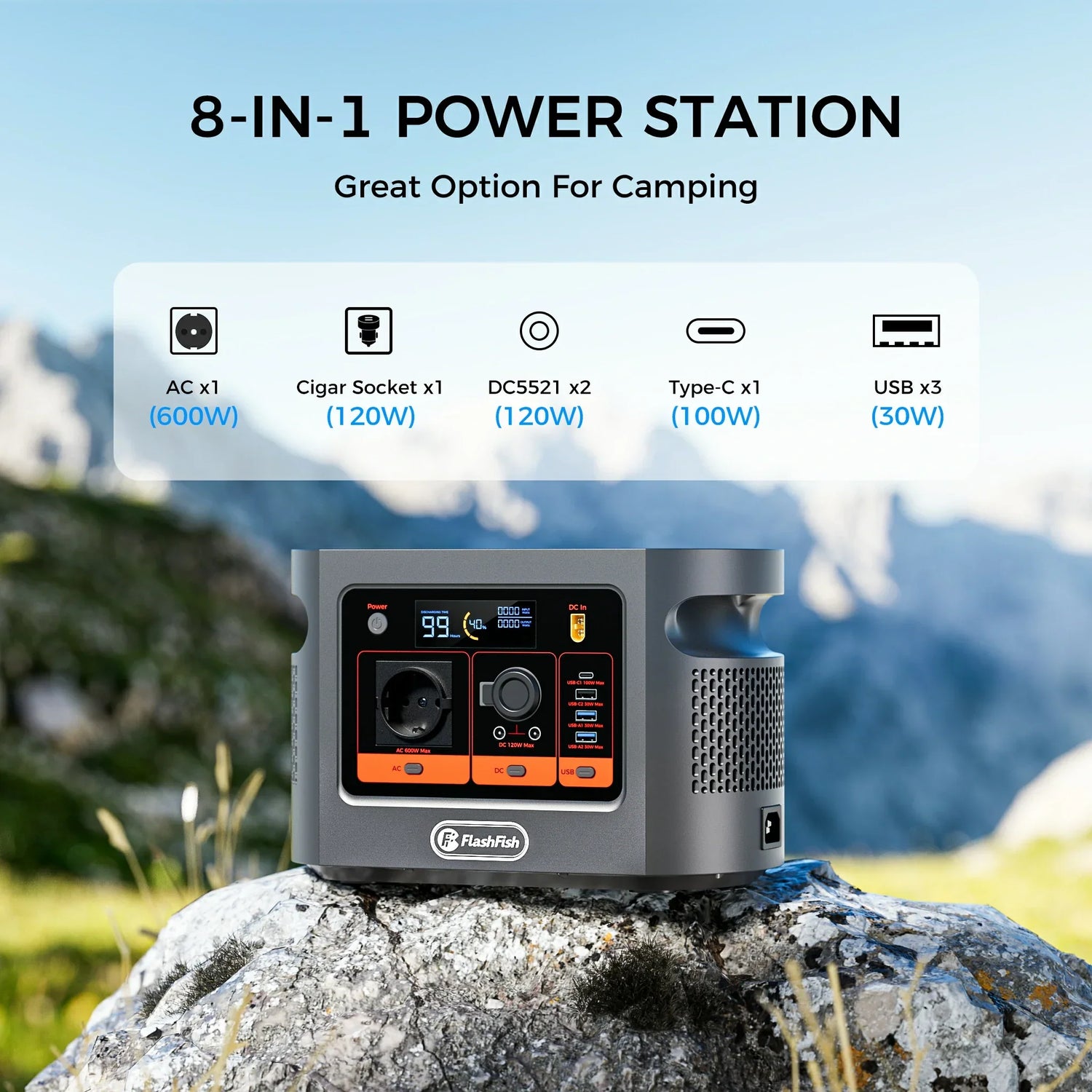
Short answer: continuous output is the power a station is designed to supply during normal operation. Peak output is a higher, short-duration ceiling intended for brief startup demand. Size everyday use from continuous watts; treat peak watts only as extra startup headroom when both the appliance manual and power-station documentation support the load.
Why the two numbers are easy to misread
A portable power station may be labelled “1,200W / 2,400W peak.” That does not mean it can run a 2,400W appliance continuously. The first number is the main operating limit. The second describes a brief condition, and manufacturers may use different test methods or time windows.
The safest comparison starts with the appliance input label, not a list of example devices. Add every load that will operate at the same time and keep the normal total within the station's continuous rating.
Continuous and peak output compared
| Rating | What it means | How to use it | Common mistake |
|---|---|---|---|
| Continuous output | Normal sustained AC power limit | Compare it with total running watts | Ignoring a second device connected at the same time |
| Peak output | Brief higher output for startup demand | Use only as documented startup headroom | Treating it as a second continuous rating |
| Battery capacity | Stored energy measured in Wh | Use for duration estimates after checking output | Assuming more Wh means more available watts |
Running watts, startup watts and energy are different
Running watts
This is the power a device draws after it is operating normally. Some devices vary their draw, so a label or manual may show a maximum input rather than a constant measurement.
Startup demand
Motors, compressors and some power supplies can draw more power when starting. The size and duration of that increase depend on the device. Do not infer it from the device category alone.
Watt-hours
Watt-hours describe energy, not instantaneous power. A 768Wh battery may have more stored energy than a compact model, but the inverter's continuous rating still controls which AC loads it can support.
A label-first checking method
- Find the input watts on every appliance or charger.
- If only volts and amps are shown, use the manufacturer manual or calculate volts × amps as an upper-bound label check.
- Add the watts of devices that may run together.
- Keep that normal total within the station's continuous AC output.
- For a motor or compressor, check the appliance documentation for startup demand.
- Confirm the station documentation covers that startup demand; do not rely on peak watts alone.
- Only then estimate duration from Wh, average watts and a conservative loss allowance.
Practical examples without guessing
| Load pattern | Main comparison | What remains unknown |
|---|---|---|
| Router plus laptop charger | Add both input labels and compare with continuous output | Changing laptop load and conversion losses |
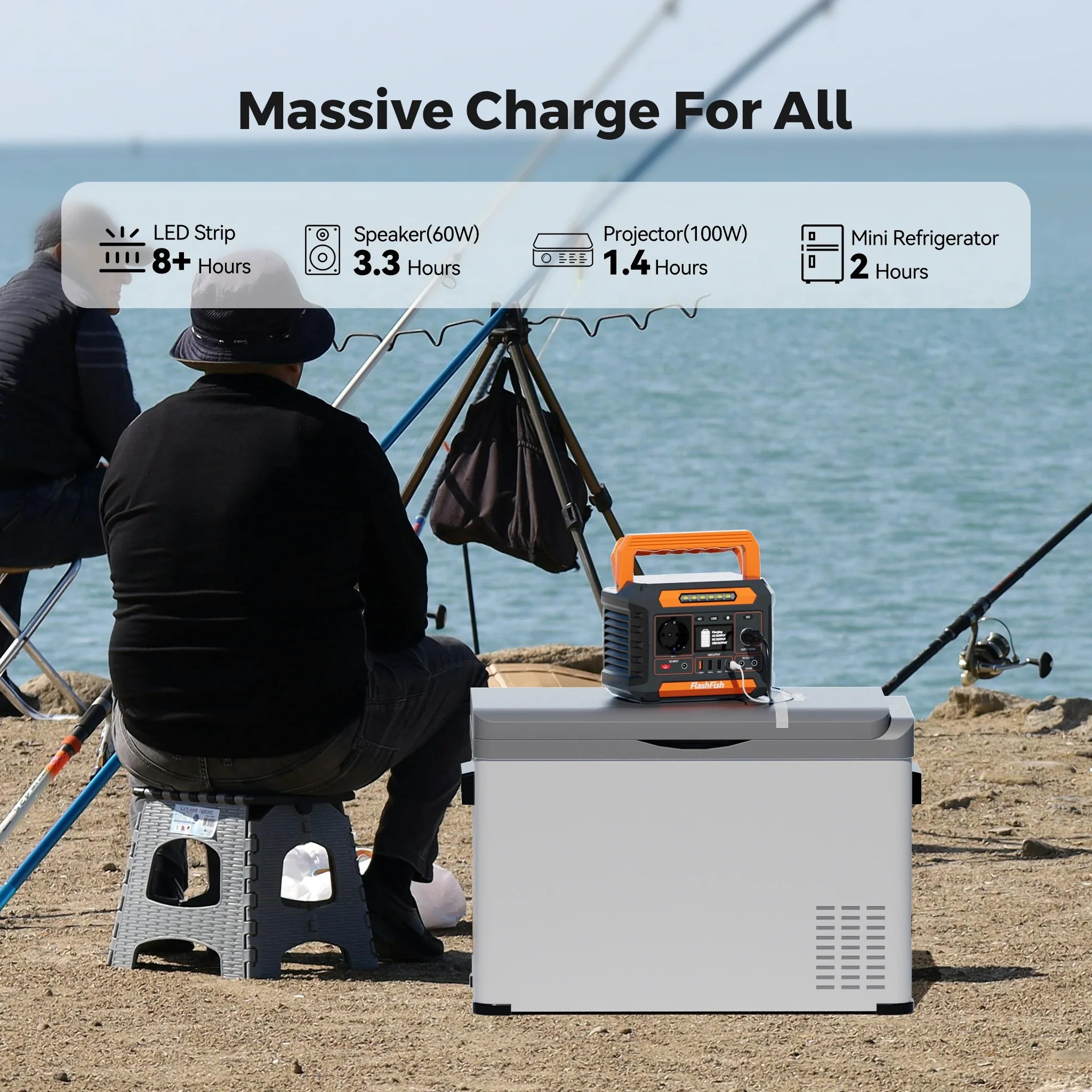
| Portable fridge or cool box | Running input plus documented compressor startup | Duty cycle, temperature and actual startup behaviour |
| Two tool-battery chargers | Add both charger input ratings | How each charger changes draw during charging |
How FlashFish examples illustrate the ratings
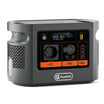
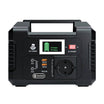
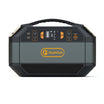
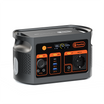
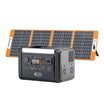
The local FlashFish product database lists the T1200S at 1,200W continuous and 2,400W peak, and the T2000 at 2,000W continuous and 4,000W peak. These pairs show the difference clearly: normal load planning uses 1,200W or 2,000W, not the larger peak number.
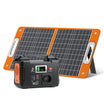
The database lists E103 at 300W continuous AC output but does not provide its peak-output value. This guide therefore does not fill that blank from memory or infer it from another page.
Common mistakes
- Choosing from the peak number printed most prominently.
- Checking one appliance while forgetting chargers, lights or a monitor.
- Using battery Wh as though it were inverter W.
- Assuming every appliance in a category has the same startup demand.
- Using damaged, overloaded or daisy-chained extension leads.
Safety checklist
- Follow both the appliance manual and station manual.
- Keep plugs, cables and ventilation openings in good condition and unobstructed.
- Stay within every rating in the connection path, including adaptors and extensions.
- Stop if a plug or cable becomes unusually hot, damaged or discoloured.
Frequently asked questions
Can I run a device equal to the peak rating?
Not as a normal plan. Compare sustained operation with continuous output and use peak only for documented brief startup demand.
Does twice the peak output mean a station is more powerful?
Not by itself. Compare continuous output, peak conditions, capacity, ports, weight and the actual load profile.
What if an appliance label shows only volts and amps?
Check its manual first. Volts × amps can provide a label-based upper-bound check, but power factor and operating behaviour may require manufacturer information.
Does a larger battery solve an output-limit problem?
No. More Wh may extend operation, but it does not raise the inverter's continuous output.
Why is no E103 peak value shown here?
The primary local product database does not provide that value. Missing product facts are left unstated rather than inferred.
Sources and evidence notes
- FlashFish product-source bundle, accessed 3 July 2026, for model ratings and evidence gaps.
- Electrical Safety First: extension leads, cable reels and block adaptors, accessed 3 July 2026, for connected-load and cable precautions.




Hinterlasse einen Kommentar
Diese Website ist durch hCaptcha geschützt und es gelten die allgemeinen Geschäftsbedingungen und Datenschutzbestimmungen von hCaptcha.