

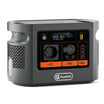
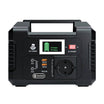

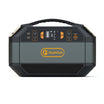
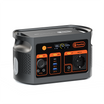


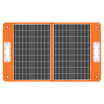
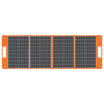


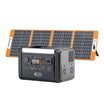

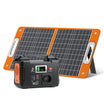


Short answer: sometimes, but watt-hours are only the first gate. UK CAA passenger guidance says batteries under 100Wh are common passenger-device sizes, 100-160Wh require airline approval, and batteries over 160Wh are prohibited in passenger baggage. FlashFish A101 is documented at 97.68Wh, so it clears the under-100Wh paper threshold; the operating airline still decides whether it accepts the product and under what packing and onboard-use rules.
Use BOARD before the airport
- B - Battery evidence. Read Wh from the exact product label and manual. Do not substitute mAh without the correct nominal voltage.
- O - Operating airline. Check the airline that operates each segment, not only the ticket seller. Codeshare partners can apply different rules.
- A - Appropriate baggage. Treat a product whose main purpose is supplying power as a power-bank/spare-battery question and obtain the airline's written instruction. EASA and UK CAA guidance direct power banks/spare batteries to carry-on baggage, not checked baggage.
- R - Risk condition. Do not travel with a swollen, damaged, recalled, leaking, hot or unreadable battery. Protect switches and terminals against activation and short circuit.
- D - Documentation and day-of-travel check. Carry the readable Wh label, model/manual evidence and the airline response. Recheck rules shortly before departure.
The watt-hour screen
| Battery rating | General passenger guidance | What the traveller must still do |
|---|---|---|
| Up to 100Wh | Within the common passenger-device band in UK CAA guidance | Confirm airline/product classification, quantity, bag and onboard-use rules |
| Over 100Wh to 160Wh | Requires airline approval | Obtain approval before travel and follow operator quantity/packing limits |
| Over 160Wh | Prohibited in passenger baggage under UK CAA guidance | Use an authorised dangerous-goods transport route if available |
The threshold is not a permission slip. Airlines can impose stricter conditions, and cabin-bag size or weight rules apply separately. A product can be under 100Wh yet still be refused because of classification, condition, packing, local rules or operator policy.
Exactly three travel examples
Example 1: FlashFish A101 at 97.68Wh
The authoritative local record places A101 below 100Wh, so it passes the first UK CAA capacity screen. Ask the operating airline whether it accepts this portable power station as carry-on, how it wants the terminals and switch protected, and whether use or charging onboard is prohibited. Do not rely on the product handle or a marketing badge.
Example 2: a 120Wh power bank
This sits in the 100-160Wh band, where UK CAA guidance requires airline approval; the traveller should obtain approval before the journey and follow the operator's limits. Being below 160Wh is not automatic permission.
Example 3: FlashFish E103 at 179.2Wh
E103 exceeds 160Wh, so it falls outside passenger baggage under UK CAA guidance. A car, train or authorised dangerous-goods transport route is a more realistic planning path; this article does not suggest taking it to the airport for an exception.
A carry-on documentation checklist
- Photograph and inspect the exact Wh/model label before travel; keep the manual page available offline.
- Confirm the operating airline for every segment and save its written answer or current policy page.
- Keep the station in carry-on only when instructed; never move a power bank or spare battery to checked baggage because cabin staff ask for gate-checking without first declaring it.
- Prevent accidental activation and protect exposed terminals from short circuit using the airline-approved method.
- Do not charge the station or use it to power another device onboard when airline or EASA guidance prohibits that use.
- Stop if the case, battery, switch, port or label is damaged, swollen, hot, leaking or unreadable.
Why mAh and product names are not enough
Passenger limits are expressed in watt-hours because Wh combines voltage and charge. Two products with the same mAh can have different Wh when their nominal voltage differs. Use the manufacturer's exact Wh rating rather than guessing from a marketplace title. Likewise, 'mini,' 'travel' or 'flight approved' is not a regulatory category. The operator needs the actual product and battery evidence.
When A101 fits - and when it does not
| A101 may fit the travel plan when | It does not fit the available evidence when |
|---|---|
| The delivered label clearly states 97.68Wh and matches the manual | The label is missing, damaged or conflicts with the document |
| The exact operating airline confirms carriage and packing conditions | The traveller relies only on a product-page claim or another airline's policy |
| The unit is undamaged, protected against activation and carried as instructed | The battery is damaged, recalled, swollen, hot or placed in checked baggage |
| The user accepts that onboard use/charging can be prohibited | The trip requires the station to power critical equipment during the flight |
Check the A101 label after confirming your airline's rules. Product selection comes after the operator decision, not before it.
Frequently asked questions
Is every power station under 100Wh allowed on a plane?
No. Under 100Wh is a general threshold screen. The operating airline, product classification, quantity, condition, packing and itinerary still decide.
Can A101 go in checked baggage?
Do not plan that. EASA and UK CAA guidance direct power banks and spare batteries to carry-on baggage. Ask the airline how it classifies A101 and follow its written instruction.
Does 97.68Wh mean A101 is airline approved?
No. It means the local product record is below the general 100Wh threshold. No airline, airport or regulator approved A101 for this draft.
Can I use A101 to charge a laptop during the flight?
Do not assume so. EASA guidance says power banks should not be recharged or used to provide power onboard; the airline's current cabin rules control.
What if my ticket is sold by one airline but operated by another?
Check the operating carrier for every segment and obtain a clear answer for the exact product. Codeshare rules can differ from the ticketing airline's summary.
Sources and evidence limits
- UK CAA Pack Right guidance - passenger Wh bands, carry-on treatment, airline approval and over-160Wh boundary.
- EASA dangerous goods guidance - carry-on, short-circuit and onboard-use boundaries.
- KLM hand-baggage restrictions - one current operator example, not a universal policy.
- FlashFish A101 Europe page and the manual-derived local record - exact model and 97.68Wh capacity.
Rules can change and the operating airline makes the carriage decision for the itinerary.
Conclusion
A101 is below 100Wh on paper, which makes it a candidate for an airline check rather than an automatically accepted travel product. Confirm the operator, carry-on treatment, terminal protection and onboard-use rules before travelling. Ask FlashFish Europe for exact A101 battery documentation if the delivered label and product records do not match.





Hinterlasse einen Kommentar
Diese Website ist durch hCaptcha geschützt und es gelten die allgemeinen Geschäftsbedingungen und Datenschutzbestimmungen von hCaptcha.