

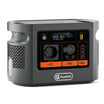
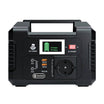

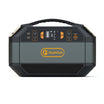
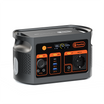






Short answer: a pure sine wave label does not, by itself, prove zero distortion, a particular total harmonic distortion percentage or compatibility with every sensitive device. A defensible claim needs the exact parameter, calculation method, instrument, operating load, conditions and the powered device's requirements.
What a THD percentage is trying to summarise
An ideal AC voltage waveform contains one fundamental frequency. Real waveforms can also contain harmonic components at multiples of that fundamental. Total harmonic distortion summarises the harmonic content relative to a chosen reference. It compresses a spectrum into one percentage, so the method and context matter.
Fluke's power-quality material explains harmonic distortion and THD in electrical systems. Schneider also distinguishes calculation conventions. The practical lesson is not to copy one percentage into another context: first ask whether it is voltage THD or current THD, what denominator is used and which harmonics were included.
The PROOF evidence table
| PROOF field | Question to ask | Weak evidence |
|---|---|---|
| Parameter | THDv, THDi or another metric? | A bare 'THD' percentage |
| Requirement | What does the exact powered device require? | 'Sensitive electronics' as a category |
| Operating load | Which load type and percentage of rated output? | No-load result only |
| Observed measurement | Which appropriately rated analyser, setup and date? | Marketing artwork without a report |
| Framework | Calculation convention, bandwidth, harmonic order, voltage, frequency, battery state and temperature? | Two percentages compared without matched methods |
Pure sine wave is a category claim, not a test certificate
Pure sine wave usually communicates that an inverter is intended to approximate the sinusoidal AC waveform used by conventional mains supplies, rather than a stepped modified waveform. It is useful classification language. It still does not disclose a numeric THDv result, a maximum across the load range or a complete harmonic spectrum.
A model page can truthfully use the category while leaving the percentage unreported. The local FlashFish product records checked for this article describe pure-sine output for selected models but contain no model-specific numeric THD field. That absence is an unknown, not evidence of either good or poor performance.
THDv and THDi answer different questions
THDv concerns distortion in the supplied voltage waveform. THDi concerns the harmonic content of current drawn by a load. A nonlinear charger can draw distorted current even from a relatively clean voltage source. Therefore, a current-distortion result from one device cannot be relabelled as the station's voltage THD.
Calculation conventions can also use different references. Schneider's THD-versus-thd note is a useful warning: compare results only when the parameter and denominator are aligned.
Three claim checks
- 'Pure sine wave, therefore zero THD': reject the conclusion. The label is not a zero-distortion measurement.
- 'THD below X%, therefore every laptop and audio device works': reject the universal compatibility step. Voltage, frequency, transient power, grounding or isolation design and the device supply still matter.
- 'Model A has lower THD than Model B': accept only when the exact regional units, loads, instruments, calculation conventions and conditions are matched and disclosed.
Why load condition changes the evidence
An inverter may behave differently at no load, light resistive load, high load or with a nonlinear switching supply. Battery state and temperature can also be relevant. A single attractive percentage without the operating point cannot support a whole-range claim.
Likewise, one oscilloscope picture is not automatically a quantified THD result. A visual trace can reveal obvious shape differences, but numeric harmonic analysis requires a defined measurement system and method.
A buyer's evidence request
- Ask whether the reported value is output-voltage THD and whether it is a maximum or one observed point.
- Request the regional output voltage and frequency plus the load type and load percentage.
- Request the instrument class, bandwidth or harmonic order, calculation convention, date and environmental conditions.
- Check the powered device's own voltage, frequency, power, transient and supply instructions.
- Keep compatibility as unverified unless a documented requirement or matched test closes it.
Do not improvise probes on exposed mains conductors. Where a numeric result is important, use a qualified reviewer and appropriately rated power-quality equipment under a controlled test plan.
What a fair comparison can say
| Supported statement | Unsupported shortcut |
|---|---|
| 'The manufacturer labels this regional output pure sine wave' | 'Therefore THD is zero' |
| 'A report measured THDv under these disclosed conditions' | 'This is the value at every load' |
| 'Two units were tested with a matched method' | 'Two marketing percentages are directly comparable' |
| 'The device maker documents these supply limits' | 'All sensitive electronics are compatible' |
Common mistakes
- Treating pure sine wave as a numeric THD certificate.
- Mixing voltage and current distortion.
- Comparing percentages calculated with different denominators or bandwidths.
- Using a no-load result to claim performance across the full range.
- Turning one power-quality metric into universal device compatibility.
Frequently asked questions
What does THD mean for a portable power station?
Total harmonic distortion summarises harmonic components relative to the fundamental waveform. A useful result must name the parameter, calculation convention, instrument method, operating load and conditions.
Does pure sine wave mean zero THD?
No. Pure sine wave is a waveform-category claim, not a numeric test report. It does not by itself state zero distortion, a maximum percentage or behaviour at every load.
Are THDv and THDi the same?
No. THDv describes voltage distortion; THDi describes current distortion. They answer different questions and should not be compared or substituted without the exact measurement context.
Can one no-load THD number rank power stations?
Not fairly. Results can change with load level, load type, battery state, temperature, instrument bandwidth and calculation method. A useful comparison needs matched conditions.
Does a low THD percentage prove device compatibility?
No. It is one input. Compatibility also depends on voltage, frequency, continuous and transient power, grounding or isolation design, the device's own supply and manufacturer instructions.
Conclusion: ask for a measured claim, not a reassuring label
A pure sine wave label is a useful waveform category, but it does not close a THD or compatibility decision. Apply PROOF and preserve unknowns. Use the Europe buying guide to compare documented power-station fields before building a test shortlist.
Sources and evidence limits
- Fluke harmonics explainer and Fluke electrical glossary for harmonic and THD concepts.
- Schneider Electric THD versus thd FAQ for calculation-convention distinctions.
- FlashFish Europe portable power station collection and the local product database for the bounded no-numeric-THD-field statement.
Evidence checked 13 September 2026. No station was measured, no numeric model threshold is asserted and no sensitive-device compatibility result is claimed.




Hinterlasse einen Kommentar
Diese Website ist durch hCaptcha geschützt und es gelten die allgemeinen Geschäftsbedingungen und Datenschutzbestimmungen von hCaptcha.