








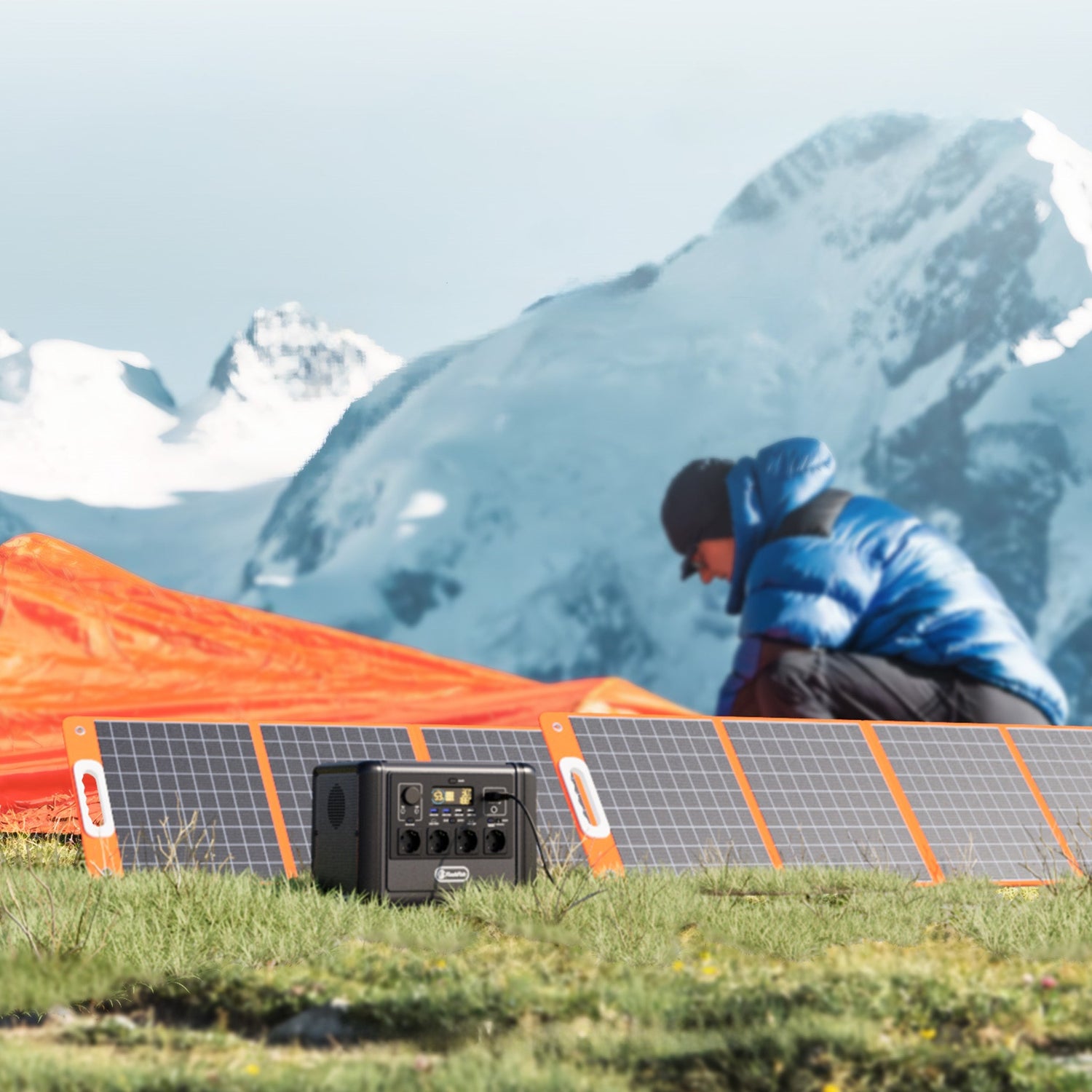
Short answer: a small solar generator makes sense when your goal is to keep low-power essentials moving: phones, cameras, headlamps, LED lights, small USB devices, and occasional laptop charging. It is the wrong tool when you need heavy heating, cooking, compressor loads, high daily watt-hours, or dependable charging in poor sun.
Why this matters before buying a compact kit
"Small solar generator" usually means a compact portable power station paired with a portable solar panel. The name can sound bigger than the reality. The useful question is not whether the kit has solar in the title, but whether the battery capacity, AC output, USB output, solar input and daily sunlight fit the devices you actually bring.
For Europe camping, the right decision is often a tradeoff between weight, weather, campsite electricity access and device discipline. A small setup can be excellent when you pack around modest electronics. It becomes frustrating when it is expected to act like a campsite hook-up, a fuel generator or a fixed home battery.
A simple decision framework
| Question | Small solar generator fits when | Choose another plan when |
|---|---|---|
| What must run? | Phones, cameras, small lights, power banks and a modest laptop plan | Heating, cooking, pumps, compressors or several AC appliances are required |
| How much energy is needed daily? | You can list each device and keep the total within a compact battery budget | The plan depends on vague "all-day" power or unknown appliance labels |
| How predictable is sunlight? | The solar panel is a top-up and you can leave with enough stored charge | Solar must refill everything every day regardless of weather or shade |
| How far will you carry it? | Weight and pack size matter more than running larger appliances | You are near a vehicle or pitch and can carry a larger power station |
| What is the fallback? | You can reduce loads, use campsite mains if available, or charge from the wall before leaving | Failure would leave safety-critical or trip-critical equipment without a backup |
Practical example: two nights with phones, camera and lights
A good small-solar plan starts with a written device list. Two phones, a camera battery and a small LED light are a realistic compact-kit use case because the loads are low and flexible. A cool box, kettle, heater or coffee machine changes the class of the problem because the power draw is much higher and may involve AC or startup demand.
Use this formula before choosing a kit: daily energy need = device watts x hours used. Add a margin for charging losses, standby use, temperature, cloudy weather and battery ageing. If the result is already close to the battery rating, a small kit is probably too tight.
What solar can and cannot solve
Portable solar panels are useful because they extend a trip and reduce dependence on campsite sockets. They do not remove the need for planning. The European Commission JRC PVGIS manual explains that photovoltaic output depends on solar irradiance, temperature, mounting, orientation and system losses. In plain terms: a panel rating is not the same as the power you will see every hour in a real campsite.
That is why a compact panel should be treated as a top-up unless you have tested the setup in similar conditions. Angle the panel, avoid shade, keep connectors dry and clean, and plan around the battery's stored energy first.
Common mistakes
- Buying by panel wattage alone and ignoring the station's input limit.
- Assuming a 60W panel will produce 60W continuously outdoors.
- Charging every device at once without checking shared output limits.
- Using a compact AC outlet for devices that are better charged by USB or DC.
- Forgetting that campsite mains electricity has its own safety and cable checks.
- Letting the battery arrive empty instead of wall-charging before the trip.
FlashFish product context
| FlashFish option | Product-source facts | Where it fits | Where it does not fit |
|---|---|---|---|
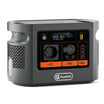
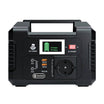
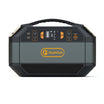
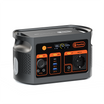
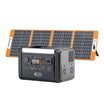
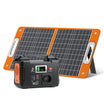
| E200 | 151Wh, 200W modified sine AC output, 400W peak, 40W max solar/DC charging, 1.85kg | Very light device charging, cameras, phones and small lights where modified sine AC is acceptable or not needed | High-watt appliances, long AC-motor loads, sensitive AC devices that require pure sine output |
| E103 | 179.2Wh, 300W pure sine AC output, 90W max DC charging input, 60W max USB-C, 3.0kg | Small laptop and device-charging trips where 300W AC and 60W USB-C are enough | Claims about battery chemistry or peak output; the product database does not provide those values |
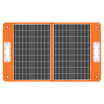
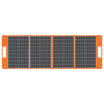
| TSP60 | 60W foldable monocrystalline panel, 18V DC output, USB outputs, 1.9kg; output varies with sun, angle, temperature and weather | Portable top-up for compact camping setups after connector and input checks | Fixed recharge-time plans, poor-weather certainty or universal compatibility claims |
When FlashFish fits
- You want a lightweight setup for low-power camping electronics.
- You can read each device label and keep the energy budget modest.
- You treat the solar panel as a top-up rather than the only source of power.
- You want clear product limits instead of a bigger-is-always-better recommendation.
When it does not fit
- Your trip depends on heating, cooking, pumping, compressor cooling or several AC appliances.
- You need predictable daily refilling in shade, rain or short winter daylight.
- You cannot verify the cable, connector or station input match.
- Your equipment is safety-critical and needs a provider-approved continuity plan.
Frequently asked questions
Is a small solar generator enough for camping?
It can be enough for low-power devices such as phones, cameras and lights. It is usually not enough for heating, cooking or unknown compressor loads.
Should I buy by Wh or by solar panel watts?
Start with Wh because the battery is what powers your devices when the sun is weak. Then check the panel and station input limits.
Can a portable panel recharge everything in one day?
Do not assume that. Solar output depends on sun, angle, temperature, shade and losses. Use solar as a top-up unless you have tested your setup.
Is E200 or E103 better for small camping power?
Choose by load, not by model name. E200 is lighter and lower capacity, while E103 has a higher AC rating and USB-C output. E103 chemistry and peak output should not be claimed from the current product database.
Can I connect any solar panel to any power station?
No. Check voltage, connector, polarity and input limits first. If any value is unclear, do not improvise the connection.
Sources and evidence notes
- FlashFish product-source bundle, accessed 8 July 2026, supports manual-derived FlashFish product facts for model capacity, output, input, weight, chemistry where provided and usage boundaries.
- 2026-07-07 Shopify discovery cache, accessed 8 July 2026, supports flashFish.EU store identity, ACTIVE product status, inventory context and non-empty Europe online-store URLs.
- European Commission JRC PVGIS 5 user manual, accessed 8 July 2026, supports solar output varies with irradiance, temperature, orientation, mounting and system losses.
- The Camping and Caravanning Club: Expert Guide to Campsite Electricity, accessed 8 July 2026, supports campsite electricity is a nominal 230V supply and safe use still requires cable and equipment checks.
Soft next step: compare your device list with the FlashFish portable solar panels and compact power stations before choosing the smallest kit that fits.




Hinterlasse einen Kommentar
Diese Website ist durch hCaptcha geschützt und es gelten die allgemeinen Geschäftsbedingungen und Datenschutzbestimmungen von hCaptcha.