

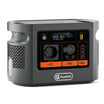
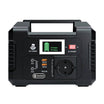

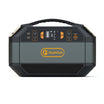
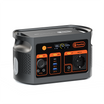




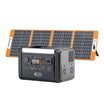

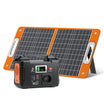

Short answer: choose one T1200S when the camp needs a single load domain above 600W or one simpler charging and monitoring point. Consider two separate E106B units when the loads can be split into two groups, each stays below 600W, and location or partial redundancy matters more. Two E106B units do not combine into one 1200W outlet.
The numbers look equal until you draw the wiring boundary
| Decision field | One T1200S | Two separate E106B units | What the row does not prove |
|---|---|---|---|
| Nominal energy | 768Wh | 384Wh each; 768Wh arithmetic total | Equal delivered energy or duration |
| Continuous AC domain | One 1200W station ceiling | Two separate 600W station ceilings | A combined 1200W outlet or parallel operation |
| USB-C headline | Up to 100W | Up to 100W on each unit | Every device profile or cable match |
| Listed mass | About 12.45kg | About 5.2kg each; 10.4kg total before accessories | Total packed weight after duplicated chargers and leads |
| Failure domain | One shared station | Two separate stations and battery states | Automatic continuity for a critical load |
The most important row is the AC domain. Two E106B units can each carry a different group below 600W. They must not be treated as halves of a home-made parallel system. One appliance stays connected to one verified output path.
Complete the SPLIT card
| SPLIT check | Question | T1200S signal | Two-E106B signal |
|---|---|---|---|
| Simultaneous loads | Which devices run at the same time? | One combined group may fit below 1200W | Two groups must each fit below 600W |
| Power domains | Does any single appliance exceed 600W or have uncertain startup? | May justify the higher single-domain ceiling after verification | A non-fit if one load must exceed one unit's ceiling |
| Locations and leads | Are devices in one base camp or two separated spaces? | Simpler central monitoring but may require longer controlled cable routes | Can reduce cross-camp cabling when each unit stays with its load group |
| Independent needs | Should one group remain available if another battery is empty? | All loads share one battery state | Separation can isolate depletion, but not all failures |
| Top-up logistics | How many chargers, sockets, solar paths and checks can the group manage? | One charging workflow | Two battery states and duplicated accessories to plan |
Compare the current FlashFish portable power-station range after completing your SPLIT card. Check current product state and regional labels only after the architecture is clear.
Three shared-camp examples
- One central kitchen or tool load above 600W: two E106B units cannot merge their AC outputs for that device. T1200S may be the relevant screen if the exact appliance, startup behaviour, complete simultaneous load and campsite conditions all fit its delivered rating.
- Two tents with phones, lights and separate low-power chargers: one E106B per location can avoid a long cross-camp lead and keeps each group within its own energy budget. The group must still control moisture, access, charging and overnight supervision.
- One shared communications group plus leisure loads: separate units can reserve one battery for the checked communications group while the other serves leisure devices. This is load separation, not assured continuity; keep an independent communications plan.
Why nominal 768Wh is not the whole comparison
The arithmetic energy total is exact: two 384Wh nameplates equal 768Wh. The operating result is not exact. Two inverters and control systems can create different overhead from one station, loads may be unevenly divided, one unit may reach its cutoff first, and temperature or battery condition may differ.
Do not pool the percentages mentally. If one E106B shows 20% and the other 80%, the group does not have one electrically shared 50% pack. Record watt-hours by load group and keep a reserve in each unit according to the consequence of that group stopping.
Carry weight can favour separation without making it simpler
The database lists T1200S at about 12.45kg and E106B at about 5.2kg. Two E106B units therefore total about 10.4kg before accessories. That can let two adults split the carry, but duplicated AC chargers, DC leads, bags and checklists narrow the difference.
One T1200S concentrates weight in one item and may be easier to manage from a vehicle or central awning. Two E106B units can be moved independently, but each must be protected, monitored and returned with its correct accessories. Portability is a workflow, not only kilograms.
Control cables and campsite boundaries
Electrical Safety First advises adding simultaneous loads, fully unwinding rated cable reels, avoiding daisy-chaining and stopping when plugs or cables show heat, damage, smoke or burning smells. Camping and Caravanning Club guidance adds damp and site-equipment boundaries. Apply those principles to each station separately.
Do not route a lead from one station into another station's AC input as an improvised sharing system. Do not connect their AC outputs together. If charging one unit while the other supplies loads is part of the plan, use only the supported charging route for each unit and keep the responsibilities separate.
When each architecture fits
| One T1200S tends to fit when | Two E106B units tend to fit when | Neither conclusion is ready when |
|---|---|---|
| One verified load domain needs more than 600W but no more than the delivered station rating | All loads can be divided into two groups below 600W each | Startup or regional compatibility is unknown |
| One base station and one charging workflow are preferred | Two locations need short local cable routes | Cables or placement cross wet or public areas |
| Shared energy management is acceptable | Independent battery states help protect a priority group | No group-level reserve or fallback exists |
| Concentrated 12.45kg carry is practical | Two people can split roughly 5.2kg units plus accessories | Accessory weight and charging capacity were ignored |
Common mistakes
- Adding two 600W ratings and assigning 1200W to one appliance.
- Calling equal nominal watt-hours equal delivered duration.
- Ignoring that duplicated stations need duplicated charging, labelling and monitoring.
- Running long or daisy-chained leads to make a central plan reach every tent.
- Treating two units as complete redundancy when both depend on the same charger, weather window or operator.
Frequently asked questions
Do two E106B units equal one 1200W power station?
No. Two units provide two separate 600W AC domains. They can serve separate load groups, but their outputs do not become one 1200W outlet and should not be connected together unless explicit manufacturer documentation says so.
Do two E106B units store the same nominal energy as one T1200S?
On the listed figures, 384Wh plus 384Wh equals the T1200S nominal 768Wh. That does not make delivered energy or duration identical because each unit, conversion path, load and reserve can differ.
Which option is lighter to carry?
The database lists T1200S at about 12.45kg and E106B at about 5.2kg each, so two E106B units total about 10.4kg before duplicated chargers and cables. Pack distribution may matter more than the arithmetic total.
Is two-unit redundancy always better?
No. Separation can preserve one load group if the other unit is depleted or unavailable, but it also doubles charging, monitoring and cable-management tasks. A shared critical load still needs its own fallback.
Which choice is better for one appliance above 600W?
A pair of E106B units cannot combine to run one appliance above either unit's 600W ceiling. T1200S may clear the continuous-output screen up to 1200W, but startup behaviour, regional compatibility and measured energy still need checking.
Conclusion: choose the power architecture before the product count
Use SPLIT to decide whether the camp needs one higher-power domain or two lower-power domains. View current T1200S details if one 1200W load domain is the deciding need. If separation wins, verify each E106B load group independently rather than treating the pair as a combined station.
Sources and evidence boundaries
- FlashFish Europe buying guide and local product database for bounded cross-model facts.
- T1200S Europe page for the current product route.
- E106B Europe page for the current product route.
- Camping and Caravanning Club for campsite electricity context.
- Electrical Safety First for load and extension-device boundaries.
Evidence checked 9 September 2026. No matched discharge, charging, parallel, weather or reliability test was performed.



Hinterlasse einen Kommentar
Diese Website ist durch hCaptcha geschützt und es gelten die allgemeinen Geschäftsbedingungen und Datenschutzbestimmungen von hCaptcha.