









Short answer: avoid using a parked car as routine storage for a portable power station. Cabin temperature can rise quickly, direct sun can heat the case beyond the outdoor forecast, and a cracked window is not a controlled cooling method. Take the station with you when practical; otherwise minimise the stop, keep it powered off and shaded, and never treat that as permission to exceed the model's storage range.
This is a source-led safety guide, not a hot-car experiment. No FlashFish station was left in a vehicle, heated or charged in a parked car for this article.
Why the outdoor forecast is not the cabin temperature
A closed vehicle is a changing microclimate. The U.S. CDC says interior temperature can rise almost 20°F (about 11°C) in the first ten minutes, even with a window cracked. That statement is published for pet safety, but it demonstrates why the dashboard weather forecast is not a battery-storage measurement.
Direct sun adds local heating. A black case on a seat, shelf or boot floor can be warmer than shaded cabin air. The U.S. Fire Administration explicitly says not to keep lithium-ion batteries in hot cars or direct sunlight. Health Canada gives the same general direction and recommends room-temperature, dry storage.
Use the four-part PARK checklist
P: power down and disconnect
Before a stop, turn off AC and DC outputs, disconnect loads, stop charging and let the station return to normal temperature. Do not leave a cooler, heater, charger or solar cable running unattended in a parked vehicle. A powered device generates its own heat and may keep drawing when you are not there to respond.
- Remove AC plugs, USB leads and vehicle-charging cables.
- Do not place clothing, bedding or bags over ventilation openings.
- Secure the station against movement before driving again.
- Keep metal objects and liquids away from ports.
A: keep it away from sun and heat traps
The best road-trip action is to carry the station into a room-temperature, dry location. If a very short stop cannot be avoided, park in shade, keep the unit low and out of direct sun, and shorten the exposure. These measures reduce heat; they do not make the car temperature-controlled.
| Location | Main issue | Better action |
|---|---|---|
| Dashboard or parcel shelf | Direct solar heating and visibility | Remove the station from the vehicle |
| Seat under a blanket | Trapped heat and blocked vents | Store uncovered in a dry indoor area |
| Closed boot | No temperature feedback; possible luggage impact | Carry indoors or use only for unavoidable, brief transport stops |
| Parked car while charging | Battery and charger heat without supervision | Charge in a visible, ventilated place permitted by the manual |
R: read the model's charge, discharge and storage limits
Charge temperature, discharge temperature and storage temperature are different. A station may permit discharge below the minimum charge temperature, for example. Always use the exact regional manual and the unit label; do not copy a temperature from a similar model.
A published maximum is not a target and not a car-storage approval. Without measuring the station and its surroundings, you do not know whether a parked cabin, case surface or battery pack stayed inside the documented range.
K: know when to stop use
After heat exposure, do not immediately connect a charger or large load. Move the station to a dry, room-temperature place away from combustible materials, let it stabilise and inspect it. USFA lists odor, excessive heat, shape change, leaking and unusual noises as warning signs.
Do not use or charge the station if it is swollen, cracked, leaking, hissing, unusually hot, discoloured or smells abnormal. Keep people away and contact the manufacturer or local emergency services as appropriate. Do not open or repair the battery enclosure yourself.
What the current FlashFish records establish
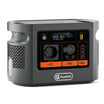
The authoritative local database lists the T1200S charge range as 0–40°C and its discharge/storage range as -20–40°C. It records the unit at 12.45kg, so removing it from the car should be planned rather than improvised. The T2000 is larger at 19.2kg and deserves an even clearer handling and storage plan.
These are model records, not hot-car test results. They do not establish how long either station can remain in a particular car, sun angle or European climate. The featured image shows carrying a T1200S outdoors; it is not evidence of car storage, heat tolerance or a field test.
A road-trip routine that avoids the hot-car problem
- Check the destination and identify an indoor, dry storage location before departure.
- Pack the station where it cannot slide, tip or be struck by luggage while driving.
- Stop outputs and charging before parking.
- Carry the station indoors when practical; use a trolley or second person for heavier models.
- Before reuse, inspect the case, ports, smell, sound and displayed temperature/status.
- Charge only after the station is inside the documented range and no abnormal sign is present.
When a portable station fits a road trip
- You can secure it during driving and move it to a dry, temperature-controlled location at stops.
- You know the exact model's charge, discharge and storage ranges.
- You can supervise charging in a ventilated location permitted by the manual.
- You have a stop-use plan for heat, damage, odor, swelling, leaking or unusual noise.
When it does not fit
- The plan depends on leaving the station in a closed car for hours while weather changes.
- The unit will sit in direct sun, under luggage or beside combustible items.
- You cannot confirm the model temperature limits or inspect the station before reuse.
- The station is already damaged or shows an abnormal sign after heat exposure.
Frequently asked questions
Is a parked car safe storage for a portable power station?
It is a poor routine location because temperature can change quickly and direct sun can heat the unit beyond the forecast.
Does cracking a car window keep the battery cool enough?
Do not rely on it. CDC says a cracked window is not enough to prevent rapid parked-car heating.
Can I charge a power station inside a parked car?
Do not use an unattended parked car as a charging location. Follow the model manual and charge where temperature, ventilation and supervision are controlled.
What should I check after the station became very hot?
Let it stabilise in a dry, room-temperature place and inspect for odor, unusual heat, swelling, leaking, discoloration or odd noises before contacting the manufacturer.
What are the T1200S temperature limits?
The checked local record lists 0–40°C for charging and -20–40°C for discharge/storage. Verify the current regional manual before use.
Sources and evidence boundary
- U.S. Fire Administration battery fire safety — hot-car, direct-sun and warning-sign guidance.
- Health Canada lithium-ion battery safety — room-temperature, dry-storage guidance.
- CDC parked-car heat guidance — rapid cabin-temperature change and cracked-window limitation.
- FlashFish product-source bundle and Europe store records — model temperature and handling facts.
Human review must confirm current regional manual values and emergency wording before publication.





Hinterlasse einen Kommentar
Diese Website ist durch hCaptcha geschützt und es gelten die allgemeinen Geschäftsbedingungen und Datenschutzbestimmungen von hCaptcha.