

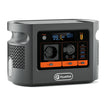
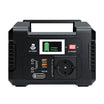

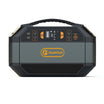
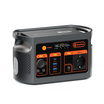


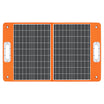
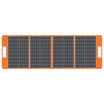


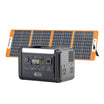

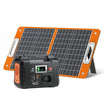


Short answer: choose by device path, not by a single headline number. FlashFish E200 declares more nominal energy: 151Wh versus 128Wh. BLUETTI Elite 10 Mini declares direct 100W USB-C, LiFePO4 cycle evidence and a 100W solar-input ceiling. E200 may fit a USB-A-led kit and compatible small AC loads; Elite 10 Mini may fit a USB-C-led kit. Neither is a universal winner.
Use ENERGY-AC-PATH-CARRY-FEATURE: define the kit, screen its AC behaviour, map every charging path, compare station-only carry mass and then value only the features you will actually use. FlashFish publishes this comparison and has a commercial interest in E200.
Quick declared-specification comparison
| Decision field | FlashFish E200 | BLUETTI Elite 10 Mini |
|---|---|---|
| Nominal energy | 151Wh | 128Wh |
| Rated AC output | 200W; 400W declared peak | 200W; 300W declared surge; 400W power-lifting mode |
| AC evidence | Modified sine wave | Use the current BLUETTI instructions for waveform and device-specific limits |
| Battery evidence | Lithium-ion 18650; more than 800 cycles, with retained-capacity threshold not supplied | LiFePO4; 3,000+ cycles to 80% declared |
| USB path | USB-A outputs; no documented USB-C output | One 100W USB-C, one 15W USB-C and two 15W USB-A outputs declared |
| DC path | 12V, 10A, 120W declared | 12V DC5521, 60W declared |
| Solar/input ceiling | 11-24V, 40W maximum in the authoritative local record | 100W solar input declared |
| Station-only mass | Approximately 1.85kg | Approximately 1.8kg |
| Warranty evidence | 12 months in the local record | 3 years on the reviewed official page |
These are manufacturer declarations, not one laboratory's side-by-side measurements. Power lifting is not interchangeable with rated AC output, a peak figure does not approve a device, and cycle claims must retain their stated threshold.
The decision table for a compact kit
| Your priority | Evidence-led direction | Remaining check |
|---|---|---|
| More declared nominal energy | E200: 151Wh versus 128Wh | Do not infer delivered runtime; test the real load and conversion path |
| Direct high-power USB-C | Elite 10 Mini: 100W USB-C declared | Confirm the laptop, cable and required PD profile |
| Small AC device | Either needs device-specific screening | E200 modified-sine suitability; BLUETTI waveform and mode limits in current instructions |
| Solar recovery | Elite 10 Mini declares the higher input ceiling | Panel voltage/current, connector, weather and actual solar conditions |
| Carry | Declared station masses are close | Add every cable, charger, adaptor and panel you will carry |
Check the current FlashFish E200 Europe page if its documented paths match the kit. If they do not, do not force the purchase around the station.
Where FlashFish E200 may fit
- Your kit is built around USB-A charging and small, verified DC or AC loads.
- The extra 23Wh of declared nominal energy matters more than direct USB-C.
- The exact AC device accepts modified-sine power and does not rely on an uncertain startup event.
- A 40W maximum input ceiling is acceptable for your recovery plan.
Where Elite 10 Mini may fit better
- Your laptop or camera kit benefits from a declared 100W USB-C output.
- LiFePO4 chemistry and a declared 3,000+ cycles to 80% are priorities.
- A higher declared solar-input ceiling is useful for the verified panel and conditions.
- The longer manufacturer warranty is important after checking regional terms.
Three device-kit examples
- Phone, camera batteries and USB-A lamp: E200's documented USB-A paths may be the simpler fit, provided every cable and charging protocol is checked. The BLUETTI still works as a comparison, but its 100W USB-C may add little value to this kit.
- 100W USB-C laptop and phone: Elite 10 Mini has the documented direct USB-C path. E200 has no documented USB-C output, so an improvised adaptor should not be assumed equivalent.
- Small AC motor or compressor: neither earns an automatic yes from a sub-200W running label. E200's modified-sine limitation and the device's startup event are material; verify the exact instructions or choose a different plan.
Do not compare unlike numbers
Nominal watt-hours are not delivered watt-hours. Rated output is not surge or power lifting. A solar panel's nameplate watts are not the station's input ceiling. A cycle figure without a retained-capacity threshold is not directly equivalent to one stated as cycles to 80%.
The same rule applies to warranty: compare the current regional terms, coverage and claim process rather than counting years alone. This article records declared fields but does not test service quality.
When neither model fits
- The appliance requires more than 200W continuous AC or has an unresolved startup event.
- The use is safety-critical, medical, food-storage or uninterrupted-power dependent.
- You need a verified pure-sine path and have not confirmed the exact product evidence.
- Your trip energy, charging window or environmental conditions have not been measured.
Frequently asked questions
Is FlashFish E200 a real alternative to BLUETTI Elite 10 Mini?
It can be for a kit that values 151Wh nominal energy, USB-A outputs and compatible small AC loads. Elite 10 Mini may fit better when direct 100W USB-C, LiFePO4 cycle evidence or a higher declared solar-input ceiling matters. Verify the exact device rather than choosing by brand alone.
Which model has more battery energy?
The declared nominal figures reviewed are 151Wh for E200 and 128Wh for Elite 10 Mini. Nominal energy is not measured delivered energy or runtime, so it should not be converted into a promised usage time.
Can either station run any device below 200W?
No universal claim is justified. Connector, AC waveform, startup behaviour, power-lifting behaviour and the device manufacturer's requirements still matter. E200 uses modified-sine AC and its local record advises against long-term AC-motor loads.
Which is better for a USB-C laptop?
Elite 10 Mini's official page declares a 100W USB-C port. E200 has USB-A outputs and no documented USB-C output, so a laptop needing direct USB-C Power Delivery points toward the BLUETTI unless a separately verified charging path is used.
Why does this comparison omit price and runtime?
Prices and stock change by market and date, while runtime depends on the exact load and conversion path. Without a same-condition test and dated checkout evidence, including those values would create false precision.
Conclusion
E200's case is more declared nominal energy and a familiar USB-A-led path; Elite 10 Mini's case is direct 100W USB-C, LiFePO4 cycle evidence and a higher declared solar-input ceiling. Define the kit first. For an unresolved E200 path, ask FlashFish Europe about the exact device before buying.
Sources and evidence limits
Checked 19 October 2026. E200 facts come from the authoritative local FlashFish record and current Europe route; Elite 10 Mini facts come from its current European manufacturer page. FlashFish publishes this article and sells E200. No side-by-side physical test, price comparison, delivered-energy test, charging-time test, noise test, reliability dataset or current-availability conclusion is claimed. Ask FlashFish Europe about the exact device when its E200 path remains unresolved.



Hinterlasse einen Kommentar
Diese Website ist durch hCaptcha geschützt und es gelten die allgemeinen Geschäftsbedingungen und Datenschutzbestimmungen von hCaptcha.