

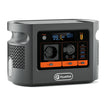
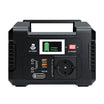

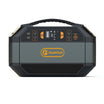
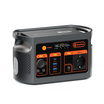


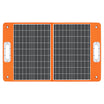
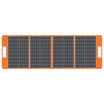


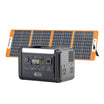

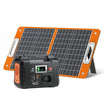

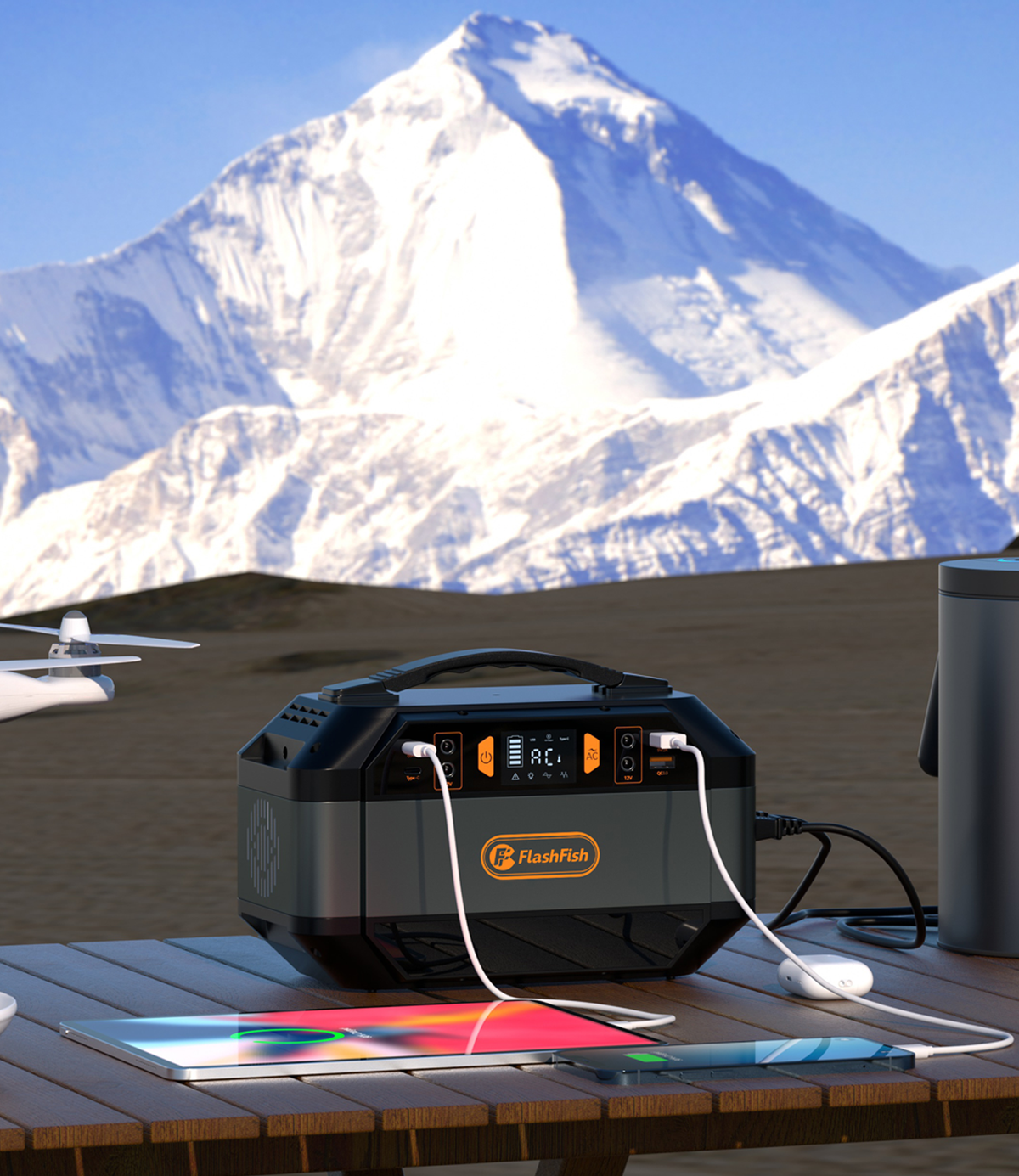
Short answer: P56 is the lighter 330W-class choice on the authoritative local record, while E106B gives materially more AC and USB-C headroom. But the P56 evidence is not publication-clean: the local record uses 299Wh and 4.3kg, while the current Europe page says 288.6Wh and 3.4kg; its spec block also shows 60Hz where the Europe support record identifies a 230V/50Hz manual. Do not choose P56 on those disputed fields until FlashFish reconciles them.
Use CARRY-PORT-LOAD-RESERVE: compare the complete carried kit, verify the exact charging path for every device, test the declared load rather than a generic camping list, and preserve energy for priority devices. The better station is the smallest one whose evidence and ports actually pass that process.
Decision table
| Decision factor | P56 | E106B | Buyer meaning |
|---|---|---|---|
| Current Europe route | ACTIVE and in stock | ACTIVE with sellable EU-plug variant | Both can be considered today |
| Nominal energy | 299Wh local decision; 288.6Wh EU manual/page conflict | 384Wh | Do not base the P56 decision on an unresolved 10.4Wh difference |
| Continuous AC | 330W pure sine; 600W peak documented | 600W pure sine; peak unavailable | E106B offers more documented continuous headroom |
| Station mass | 4.3kg local authority; public page says 3.4kg | 5.2kg | Weigh or verify the delivered P56 before planning the carry |
| USB-C | Two 18W Quick Charge ports; PD not documented | 100W USB-C1 PD and 30W USB-C2 PD | E106B is the clearer direct laptop-charging path |
Compare the currently sellable P56 and E106B paths only after writing down the exact devices and cables.
Carry: compare the complete kit
The local product source uses 4.3kg for P56 and 5.2kg for E106B, so the station-only difference is 0.9kg. That difference matters on foot, but it is not the whole load. Add chargers, power leads, a dry bag, lights, laptop, camera batteries and any solar panel. The public P56 page's 3.4kg value conflicts with the authority and must not be used as settled fact.
Ports: choose the real charging path
P56's local record lists two USB-C Quick Charge outputs up to 18W. It does not identify them as USB Power Delivery. E106B has one USB-C PD output up to 100W and another up to 30W. A USB-C connector alone is not enough: the device, station and cable must share a supported profile. Otherwise use the device's approved AC charger only when the complete AC load fits.
Load: continuous output decides normal fit
P56 documents 330W continuous AC and 600W peak. E106B documents 600W continuous AC and leaves peak unspecified. Compare normal device demand with continuous output first; do not use P56 peak as though it were continuous, and do not invent an E106B surge figure.
Three light-camping examples
- Phones and low-power lights: P56 may be the easier carry if every charging path is verified. A smaller station may still be enough; do not buy unused AC headroom.
- A laptop that accepts 100W USB-C PD: E106B USB-C1 is the documented direct path to investigate. P56's 18W Quick Charge wording does not establish laptop PD compatibility.
- A declared 250W AC device plus chargers: both ratings can pass an initial continuous-power screen, but E106B leaves more paper headroom. Starting behaviour, total simultaneous load, energy use and manufacturer permission still require evidence.
When P56 may fit
- The complete kit benefits materially from the lower local-record mass.
- Loads stay comfortably within 330W continuous AC.
- Phones and small devices use verified USB or approved AC charging paths.
- The buyer accepts that P56 specification conflicts need reconciliation before publication and purchase reliance.
When E106B may fit
- The kit needs a documented 100W USB-C PD path or more continuous AC headroom.
- The extra station mass is acceptable after the full pack is weighed.
- 384Wh nominal energy supports the plan without being converted into a promised runtime.
- The exact regional labels, cables and device requirements pass.
When neither is the right fit
- The trip needs high-watt heating, medical-device assurance, whole-camp power or fixed runtime.
- The setup cannot remain dry or depends on household leads in damp conditions.
- The device manual rejects the intended source or the charging protocol is unknown.
- The complete carry is too heavy or the unresolved P56 fields are material to the decision.
Frequently asked questions
Is P56 lighter than E106B?
The authoritative local record uses 4.3kg for P56 and 5.2kg for E106B, a 0.9kg station-only difference. The current P56 page says 3.4kg, so verify the exact delivered unit before using weight as the decision.
Which model is better for a 100W USB-C laptop?
E106B is the documented fit to investigate because USB-C1 supports up to 100W Power Delivery. P56's local record lists 18W USB-C Quick Charge, not 100W PD. The laptop and cable profiles still must match.
Does E106B last longer because it has more watt-hours?
It has a higher documented nominal-energy figure, but no fixed runtime follows. Actual duration changes with load, conversion, duty cycle, temperature, starting charge and reserve.
Can either station be used in rain at camp?
This comparison makes no water-resistance claim for either product. Keep stations and all plugs dry, follow the exact manual and stop when the location cannot maintain a dry setup.
Why does the P56 capacity differ across sources?
The local authority currently uses a user-confirmed 299Wh decision, while the EU manual and public page use 288.6Wh or 288Wh. The draft discloses the conflict and requires human reconciliation before publication.
Conclusion
Choose P56 when lower carried mass and modest verified loads matter most; choose E106B when the trip genuinely needs 600W continuous AC or 100W USB-C PD. Do not turn either choice into a runtime promise, and do not hide the P56 record conflict. Ask FlashFish Europe to reconcile the P56 label before purchase if those disputed fields affect your decision.
Sources and evidence limits
Checked 15 October 2026. Product facts use the authoritative local P56 and E106B records, with live Europe pages and the support directory used for current routes and the visible P56 discrepancy. Camping guidance supplies only general load and dry-use boundaries. No unit was weighed, no device was connected and no side-by-side runtime, charging, noise, weather or durability test was performed.

Hinterlasse einen Kommentar
Diese Website ist durch hCaptcha geschützt und es gelten die allgemeinen Geschäftsbedingungen und Datenschutzbestimmungen von hCaptcha.