

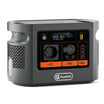
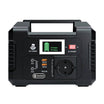

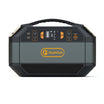
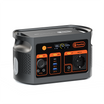





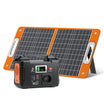

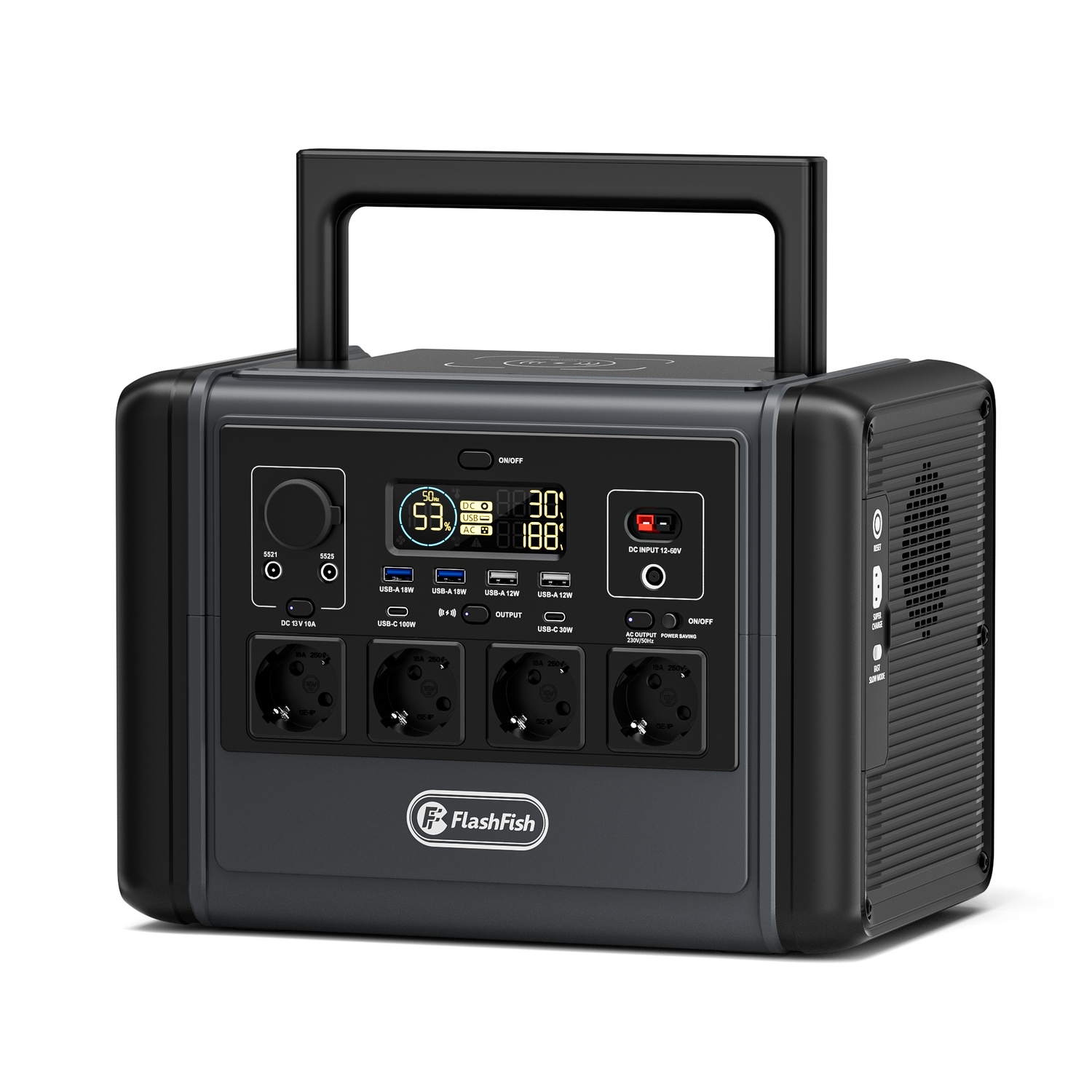
Short answer: FlashFish T1200S is the better fit for campers who want a price-sensitive 768Wh LiFePO4 power station for lights, laptops, phones, camera batteries, small fans and moderate campsite loads. EcoFlow DELTA 2 sits in a larger 1024Wh / 1800W class, so it can make sense when higher AC headroom and a broader ecosystem matter more than keeping the kit compact and budget-led.
The practical decision is not "Which brand wins?" It is "Which load class matches the trip?" A camping power station should be chosen from the labels on the devices you actually bring, the number of people sharing the battery, how far you carry it, and whether solar top-up is realistic at the pitch.
Decision framework for European camping trips
| Buyer question | FlashFish T1200S fit | EcoFlow DELTA 2 fit | What to check first |
|---|---|---|---|
| Phones, tablets, camera batteries and LED lights | Strong fit. T1200S has 768Wh capacity and USB-C up to 100W. | Also fits, with more capacity overhead. | Count charging cycles and USB-C wattage needs. |
| Laptop work, small fans and low-watt campsite devices | Good fit when each device stays inside the 1200W AC output limit. | Good fit with more AC headroom. | Read the device label and avoid running everything at once. |
| Cool box or compressor-style appliance | Possible only after checking startup watts and continuous watts; do not assume fixed runtime. | More output headroom, but the same label-check rule applies. | Check compressor surge, thermostat cycling and food-safety needs. |
| Kettle, heater, hair dryer or cooking load | Usually a poor camping-battery use case because these loads drain batteries quickly and can exceed limits. | May handle some short high loads, but it is still not an efficient battery use case. | Prefer campsite facilities or gas where allowed and safe. |
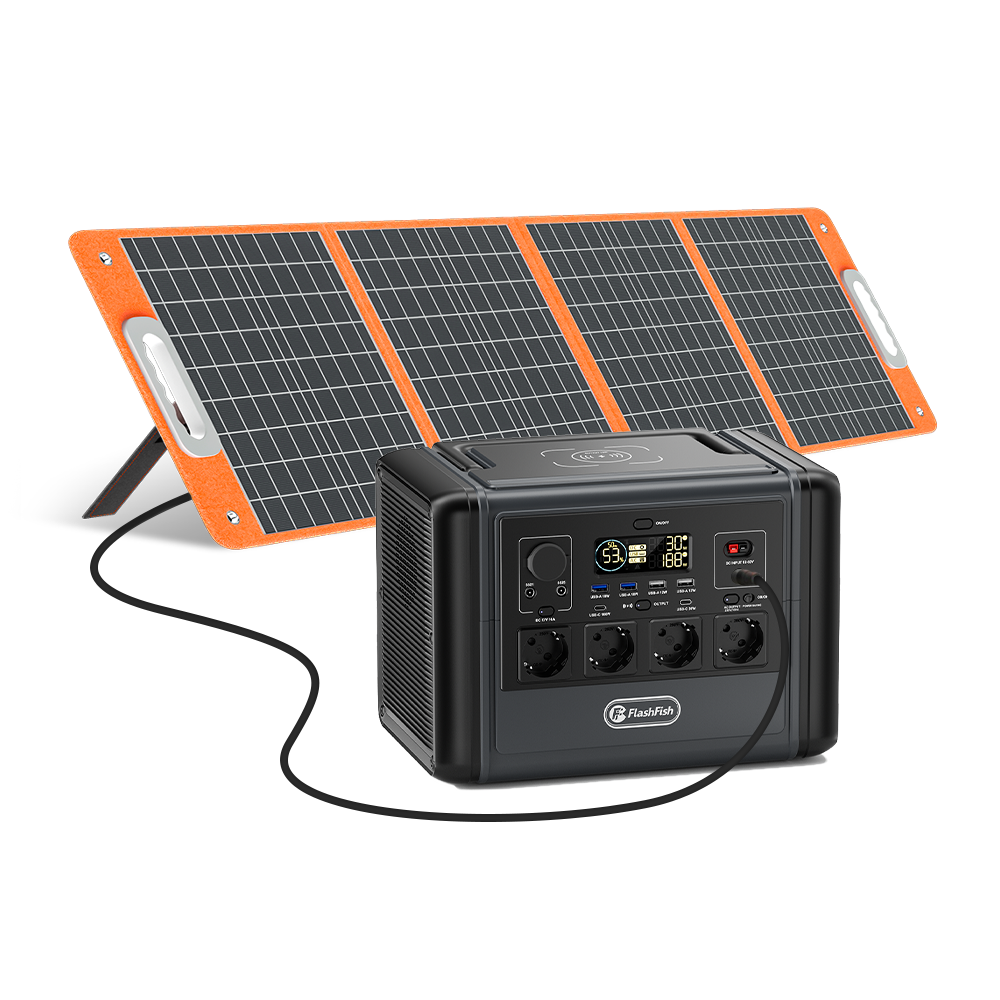
| Solar top-up at camp | Manual-derived data supports up to 400W solar input for T1200S. | Use EcoFlow's current product page for DELTA 2 solar limits. | Expect weather, shade, panel angle and season to reduce output. |
Where FlashFish T1200S has the cleaner fit
- Budget-led camping: If the main loads are devices, lights, camera batteries, laptop charging and a small fan, T1200S keeps the buying decision focused on useful capacity instead of paying for a larger class you may not use.
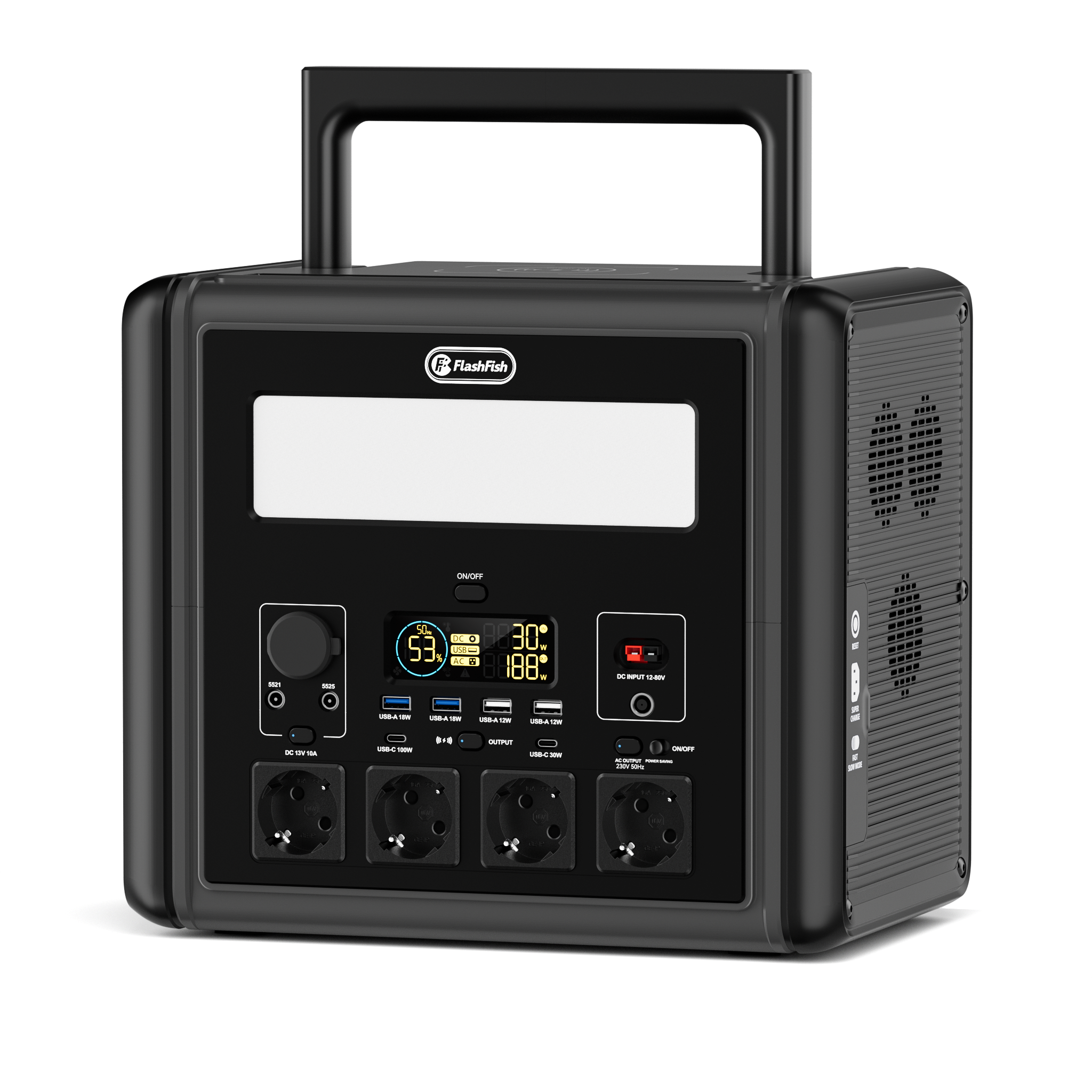
- Moderate AC loads: The local product bundle lists T1200S at 768Wh capacity, 1200W continuous AC output and 2400W peak output. That is enough for many camping electronics, but it is not a blank cheque for heaters, kettles or compressors.
- USB-C-first packing: A 100W USB-C output helps for modern laptops and tablets without needing to run everything through AC adapters.
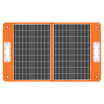
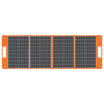
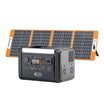
- Solar pairing: T1200S can sit with a FlashFish TSP100 portable solar panel or a larger compatible solar setup, but the article should not promise a fixed recharge time because campsite sun is variable.
Where EcoFlow DELTA 2 may fit better
- More AC headroom: EcoFlow's DELTA 2 page positions the model around 1024Wh capacity and 1800W AC output, which can suit shoppers who know they need a higher output class.
- Ecosystem preference: If a buyer already owns EcoFlow accessories or wants that app and accessory ecosystem, staying in that ecosystem may be simpler.
- Higher-load uncertainty: When the load list includes appliances close to 1200W, the larger class can leave more margin, although the user still needs to check appliance labels.
Simple load-check worksheet
- Write down every device, its watts, and whether it starts with a surge.
- Add the devices that may run at the same time. Keep that total below the continuous output of the station.
- For runtime planning, divide usable watt-hours by the device watts, then reduce the result for inverter loss, temperature, battery age and cycling loads.
- For solar, treat panel wattage as a best-case input. Shade, panel angle, cloud cover and season can reduce real output substantially.
- For campsites, follow the site rules for cables, damp ground, hook-up points and appliance placement.
When FlashFish fits and when it does not
| FlashFish T1200S fits when... | FlashFish T1200S does not fit when... |
|---|---|
| You want a mid-capacity camping station for personal electronics, laptops, lighting, camera gear and moderate AC loads. | You need to run heaters, kettles, cooking appliances or unknown compressor loads without checking the label first. |
| You value a LiFePO4 battery, 100W USB-C and a practical solar-pairing path. | You need the largest ecosystem, expansion path or output class regardless of price and weight. |
| You can plan loads from watt labels and accept weather-dependent solar input. | You expect guaranteed runtime, campsite legal advice or whole-vehicle electrical backup from one blog article. |
FAQ
Is T1200S a direct EcoFlow DELTA 2 replacement?
No. It is better described as a value alternative for selected camping loads. DELTA 2 is a larger output and capacity class, while T1200S focuses on a 768Wh LiFePO4 setup with 1200W AC output.
Can T1200S run a camping cool box?
Only after checking the cool box label, startup behavior and food-safety needs. Compressor loads can behave differently from simple phone or laptop charging, so this draft avoids fixed runtime promises.
Should I choose the bigger station just in case?
Not automatically. A larger station can add headroom, but it also changes price, weight and packing space. A written load list is the better starting point.
Sources checked
- FlashFish product specifications for T1200S manual-derived specs.
- FlashFish Europe T1200S product page and FlashFish Europe product listing cache for active status and Europe URL.
- EcoFlow Europe DELTA 2 product page for competitor positioning and public specs.
- Camping and Caravanning Club campsite electricity guide for campsite power context.
- European Commission JRC PVGIS for solar-output variability context.



Hinterlasse einen Kommentar
Diese Website ist durch hCaptcha geschützt und es gelten die allgemeinen Geschäftsbedingungen und Datenschutzbestimmungen von hCaptcha.