


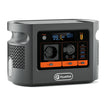
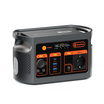


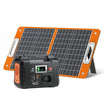

Short answer: choose the E106B + TSP100 basket when a smaller station plus an included, documented solar-recovery path fits the plan. Choose E112B*1 when the larger 1008Wh nominal store and its known output paths matter more than having a panel in today's basket. Neither choice can be called a two-day runtime winner until you enter the actual devices, hours and measured losses.
Method and limits. FlashFish Miles compared the current Europe configurations, dated storefront prices and exact-model records. No station, panel, load set, weather, charging session, usable-energy value, carry sample or checkout was tested. Prices were observed on the EU English storefront on 4 November 2026 and can change.
1. Start with the exact baskets
| Basket checked 4 Nov 2026 | Displayed price | Known energy and carry components | Recovery hardware in this basket |
|---|---|---|---|
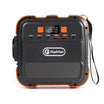
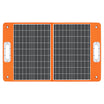
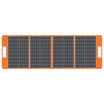
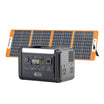
| E106B + TSP100 | €298.99 EUR; tax included; shipping calculated at checkout | E106B: 384Wh nominal and about 5.2kg; TSP100: about 2.8kg; known component mass 8.0kg before cables or bags | Included TSP100 panel rated 100W, 18V and 5.6A; E106B solar/DC input is 12–30V, 10A and 200W maximum |
| E112B*1 | €389.99 EUR; tax included; shipping calculated at checkout | E112B: 1008Wh nominal and about 11.2kg | No panel in the selected E112B*1 basket; the station has a documented 10.5–60V DC input up to 600W |
Compare the current E106B + TSP100 kit using the same country, currency and configuration you intend to buy.
2. Keep price conclusions dated
The two displayed prices create a €91.00 storefront gap on the check date, but they are not final delivered totals. A later promotion, country storefront, shipping rule, tax treatment or configuration change can alter the result. Record the page, selected variant, currency, date and checkout-stage total before treating price as a deciding fact.
3. Build a two-day energy worksheet
| Load | Input you provide | Day 1 | Day 2 | Evidence needed |
|---|---|---|---|---|
| Laptop | Measured Wh per session or maker-supported power × planned hours | ___ Wh | ___ Wh | Exact charger profile and task pattern |
| Network device | Measured Wh or label power × planned hours | ___ Wh | ___ Wh | Voltage, plug, polarity and startup behaviour |
| Lighting or camera charging | Measured Wh per cycle or supported estimate | ___ Wh | ___ Wh | Actual charger and number of cycles |
| Contingency | Your project allowance, kept separate from device demand | ___ Wh | ___ Wh | Reason for the allowance |
Add the two days only after each row is defensible. Do not compare that total directly with nominal 384Wh or 1008Wh as if every stored watt-hour were available at every output.
4. Decide whether recovery is part of the plan
The E106B basket includes a documented TSP100 route; that is a meaningful option when the team has an open, supervised charging window. It is not a promise of 100Wh per sunny hour. The European Commission's PVGIS service shows that solar resource changes by location and season, while a portable setup also depends on shade, panel angle, temperature, cable losses and station input behaviour.
The E112B*1 basket begins with more nominal energy but no panel in the selected configuration. If recovery matters, price and verify a separate supported panel path instead of crediting the station-only basket with hardware it does not include.
5. Check the output path before comparing capacity
| Question | E106B evidence | E112B evidence |
|---|---|---|
| AC path | 600W continuous pure-sine AC; peak remains unknown | 1200W shared maximum pure-sine AC; independent continuous and peak ratings remain unknown |
| USB-C | USB-C1 up to 100W; USB-C2 up to 30W | USB-C1 up to 100W; USB-C2 up to 30W |
| 12V DC group | 12V/10A, 120W shared maximum | 12V/10A, 120W shared maximum |
| Decision | Confirm the exact device voltage, profile, connector, polarity, startup demand and simultaneous-use rules before assigning it to a port. | |
6. Compare what you actually carry
For the kit, 5.2kg plus 2.8kg is a component subtotal, not a packed-kit claim. Add the actual cables, adapters, weather protection and bag you will take. E112B is about 11.2kg before its cable and any separately purchased solar equipment. If stairs, public transport or one-person lifts matter, rehearse the complete packed route rather than ranking catalogue masses alone.
7. Use three stop conditions
- Energy stop: the two-day worksheet exceeds your measured usable energy and supported recovery evidence.
- Port stop: any device input, connector, polarity, startup demand or shared-group rule is unknown.
- Logistics stop: the complete packed load, charging location or weather plan has not been rehearsed by the responsible team.
Common mistakes
- Calling 384Wh or 1008Wh a fixed usable-energy figure.
- Turning a 100W panel rating into a daily-yield promise.
- Calling E112B's 1200W shared maximum a confirmed continuous rating.
- Comparing a kit price with a station-only price without naming both configurations.
- Adding station and panel mass but forgetting cables, protection and carry cases.
FAQ
Is E112B automatically the better two-day choice because it has 1008Wh?
No. Its larger nominal energy is useful evidence, but the decision also depends on the user's measured loads, usable energy, required outputs, recovery access, carry limits and fallback plan.
Does the TSP100 add 100Wh every sunny hour?
No. 100W is a panel rating. Delivered energy varies with sunlight, angle, temperature, shading, input limits and conversion losses.
Can I call E112B a 1200W continuous station?
No. The authoritative record identifies 1200W as a shared maximum and does not confirm an independent continuous rating.
Are €298.99 and €389.99 final delivered prices?
No. They are dated EU storefront displays for the named configurations; checkout, shipping, promotions, tax treatment and future prices can differ.
Can I compare carry weight by adding the E106B and TSP100 masses?
You can record 5.2kg plus 2.8kg as known component mass, but that is not the complete packed kit weight because cables, cases and other items are not included.
Decision and next step
The defensible choice is the basket that covers the measured two-day worksheet through documented output paths and a realistic recovery plan. The smaller kit offers current solar hardware; E112B*1 offers more nominal stored energy. Check the current E112B station-only option, refresh both baskets in the same storefront context and keep a fallback for any unmeasured load or lost charging window.
Sources and further reading
Sources and prices checked 4 November 2026. Recheck the intended country storefront, exact variant, device manuals and complete packed setup before buying or deploying.





Dejar un comentario
Este sitio está protegido por hCaptcha y se aplican la Política de privacidad de hCaptcha y los Términos del servicio.