








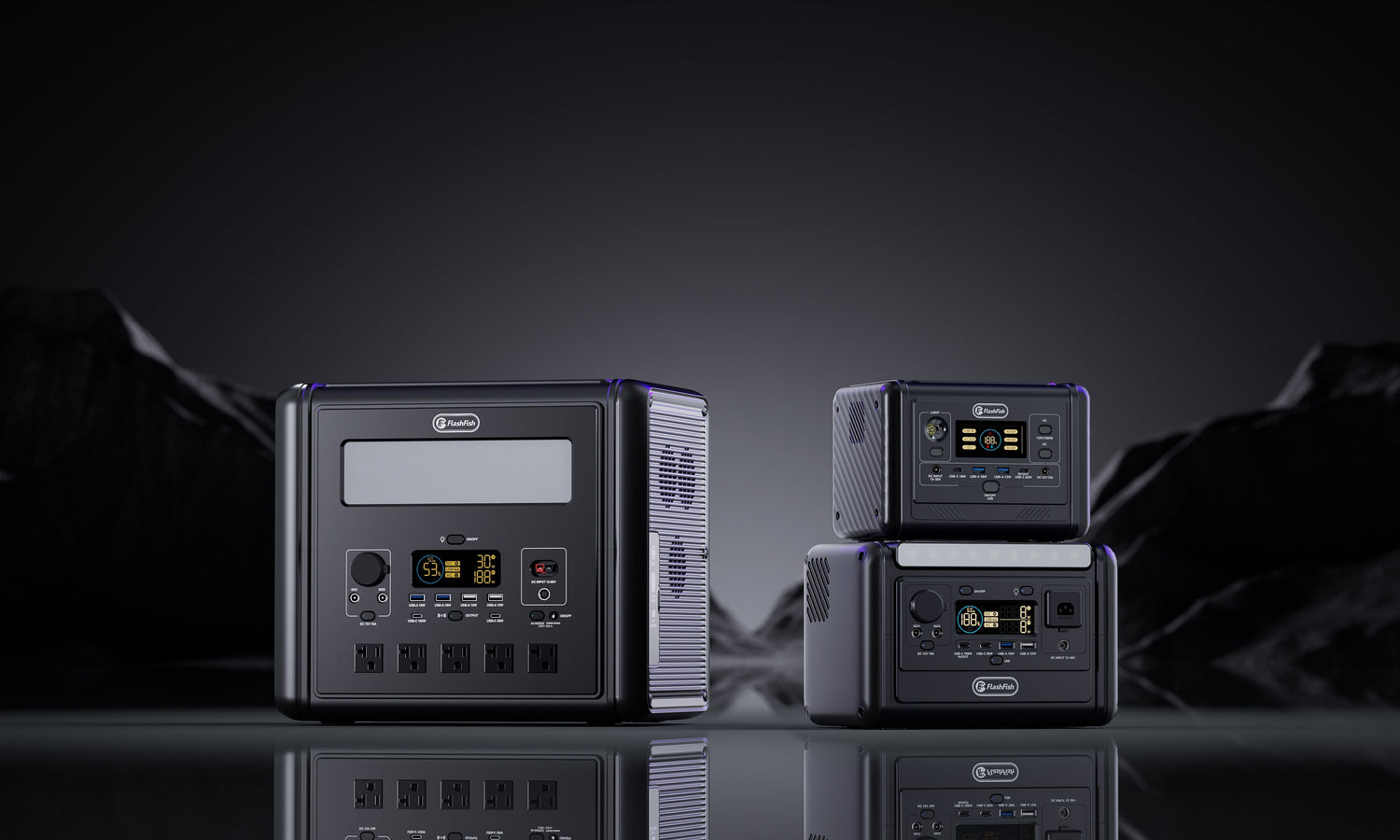
Short answer: choose a camping power station by passing three gates in order: carryability, load compatibility and recharge opportunity. For a light phone-and-lamp kit, a compact unit may be enough. For multiple laptops, a powered cool box or selected higher-watt loads, move up only after checking actual device labels. Bigger is not automatically better if the station is too heavy to use or too slow to recharge on your trip.
This Europe-focused guide compares four active FlashFish size classes using verified product facts. It does not give fixed runtime promises. Your device list, ambient conditions, conversion losses and usage pattern determine the result.
The four-gate CAMP ladder
- Carry gate: can one person realistically move the station from home to vehicle, pitch and charging point?
- Appliance gate: do continuous AC output, waveform and ports fit the devices that must run together?
- Margin gate: does the battery offer a sensible reserve after expected losses and changing device demand?
- Power-recovery gate: can the station be recharged through the available wall, vehicle or solar opportunity?
A model advances only if it passes every relevant gate. This prevents two common failures: buying too small for the load or buying so large that the station stays in the car because it is inconvenient to carry.
FlashFish camping size ladder
| Size step | Model facts from the local product source | Potential camping role | Main limitation |
|---|---|---|---|
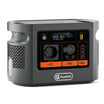
| Ultralight compact | E200: 151Wh, 200W modified-sine AC, 400W peak, 40W max solar/DC input, 1.85kg. | Phones, camera batteries, lights and other verified low-power accessories when modified-sine output is suitable. | Small output and energy class; 40W input limits recovery speed. |
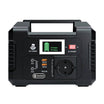
| Compact pure sine | E103: 179.2Wh, 300W pure-sine AC, 60W USB-C, 100W AC input, up to 90W DC input, 3kg. | Low-load camping and remote-work kits that benefit from pure-sine AC and 60W USB-C. | Still a compact energy reserve; the local database does not provide chemistry or peak AC output. |
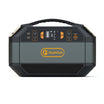
| Mid-size selected loads | T1200S: 768Wh LFP, 1200W pure-sine AC, 2400W peak, 100W USB-C, up to 400W solar/DC input, 12.45kg. | Multi-device group camps or selected larger loads that pass the label and startup checks. | Much less convenient to carry than compact stations. |
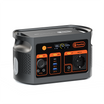
| Larger portable reserve | T2000: 1536Wh LFP, 2000W pure-sine AC, 4000W peak, 100W USB-C, up to 600W solar/DC input, 19.2kg. | Vehicle-based trips with a planned group load list and realistic high-capacity recharge access. | Heavy for routine carrying and unnecessary for a simple phone-and-light kit. |
The table describes fit, not a universal ranking. E200 may be the better tool for a low-watt walking distance from the car; T2000 may be the better tool for a vehicle-based group load. Each solves a different constraint.
Build the device list before choosing the rung
| Trip pattern | Questions to answer | Likely ladder starting point |
|---|---|---|
| Phone, camera, lights | Are all loads USB/DC, or is AC required? How far must the station be carried? | E200 or E103, depending on waveform, ports and load labels. |
| Laptop-based remote work | What does the adapter label show? Can USB-C replace AC? How many work sessions occur before recharge? | E103 if the verified kit fits; T1200S when more reserve or output is justified. |
| Cool box or refrigeration | What are steady and startup watts? How often does the compressor cycle? What ambient temperature is expected? | Calculate from the exact appliance; do not select from the appliance category alone. |
| Group electronics and selected AC loads | Which loads overlap? Is solar or wall recovery genuinely available? | T1200S or T2000 if the combined plan passes every gate. |
| Heating or cooking appliance | What is the nameplate wattage and duty cycle? Is a non-electric campsite method more practical? | Do not assume a portable station is appropriate; high-draw heat loads consume energy quickly. |
Why we do not publish fixed camping runtimes
A runtime such as “X hours for a fridge” hides too many variables: the appliance model, thermostat cycle, room temperature, ventilation, startup current, cable losses and battery reserve. Even a laptop adapter's maximum label wattage may differ from its average draw. A more defensible approach is to estimate from the exact equipment, reduce the theoretical result for losses and uncertainty, and test the real kit before travel.
For solar recovery, weather and geography matter as much as panel wattage. PVGIS provides location-based solar planning inputs, but it still depends on assumptions. A campsite shaded by trees can perform very differently from an open field under the same regional forecast.
A practical packing worksheet
- List every device, its connector and label watts.
- Mark must-have loads and optional comfort loads.
- Identify which devices run at the same time.
- Compare the highest steady combination with continuous output.
- Check startup behaviour for compressors, pumps or motors.
- Estimate energy use with a reserve; do not plan to drain the full rated Wh.
- Write down the real recharge window: wall power before departure, vehicle charging if supported, or unshaded solar time.
- Carry the proposed weight around the route you will actually use.
- Test cables, ports and essential devices at home before the trip.
When FlashFish fits
- E200 fits the smallest verified load list when low weight is the priority and modified-sine AC is suitable.
- E103 fits compact camping or remote work when 300W pure-sine AC, 60W USB-C and 179.2Wh meet the real device plan.
- T1200S fits a broader group plan that needs more output, energy reserve and solar input while remaining vehicle-portable.
- T2000 fits vehicle-based use where 1536Wh and 2000W are justified by selected loads and the user accepts 19.2kg.
Buy from the Europe portable power station collection only after matching those facts to your kit.
When FlashFish may not fit
It may not fit if the load is safety-critical, the appliance demand is unknown, the station would be exposed to rain or damp beyond its permitted conditions, or the trip lacks a workable recharge plan. A campsite electrical hook-up with suitable protected equipment may be more appropriate for some pitches. A non-electric solution may be more efficient for heat-heavy tasks.
Europe campsite safety checklist
- Follow campsite rules and the product manuals.
- Keep the station, plugs and connections dry and ventilated.
- Use outdoor-appropriate connection equipment where the campsite requires it.
- Inspect extension leads, avoid overloading them and fully unwind cable reels when required by their instructions.
- Keep trip hazards away from tents, paths and vehicle movement.
- Do not improvise a connection to campsite electrical infrastructure.
Frequently asked questions
What size power station is best for weekend camping?
There is no single best size. Use the three-gate ladder: carryability, exact appliance compatibility, energy margin and recharge access. A compact unit can be better for a phone-and-light kit; a group load may justify a larger model.
Is 200W enough for camping?
It can be enough for selected low-power devices whose labels and startup behaviour fit. It is not a general cooking, heating or high-draw appliance rating.
Should I choose more watt-hours or more output watts?
You need both to fit. Watt-hours influence the energy window; continuous watts determine the steady load class. Ports, waveform, input and weight also matter.
Can I use a portable power station inside a tent?
Follow the manufacturer and campsite instructions, keep equipment dry and ventilated, and avoid placing electrical equipment where condensation, rain or trip hazards create risk.
How much solar panel power do I need?
Start with the station's supported input voltage, current and watt limits, then use location, season and shading assumptions. Panel nameplate output is not a promise of campsite delivery.
Why is T2000 not automatically the best camping choice?
Its larger capacity and output come with a 19.2kg product weight. If the load list is small or the station must be carried far, a compact model may be more usable.
Sources and further reading
- Camping and Caravanning Club: using electricity in your tent — campsite equipment and damp-condition precautions.
- Electrical Safety First: extension leads and cable reels — cable, reel and overload precautions.
- European Commission JRC: PVGIS user manual — solar planning variability.
- U.S. Department of Energy: solar energy and storage basics — power versus energy capacity context.
- FlashFish product-source bundle and current Europe product pages for E200, E103, T1200S and T2000 facts, accessed 15 July 2026.
Decision rule: stop at the lightest ladder rung that powers the verified simultaneous load, leaves an energy reserve and can recover through the charging opportunities your trip actually provides.
Human review note: confirm current model pages, product-manual boundaries and visible image text before publication. Test essential trip equipment before relying on it away from home.



Dejar un comentario
Este sitio está protegido por hCaptcha y se aplican la Política de privacidad de hCaptcha y los Términos del servicio.