

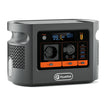
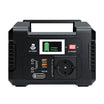

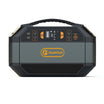
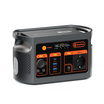


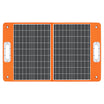
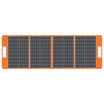


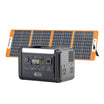

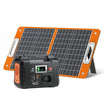

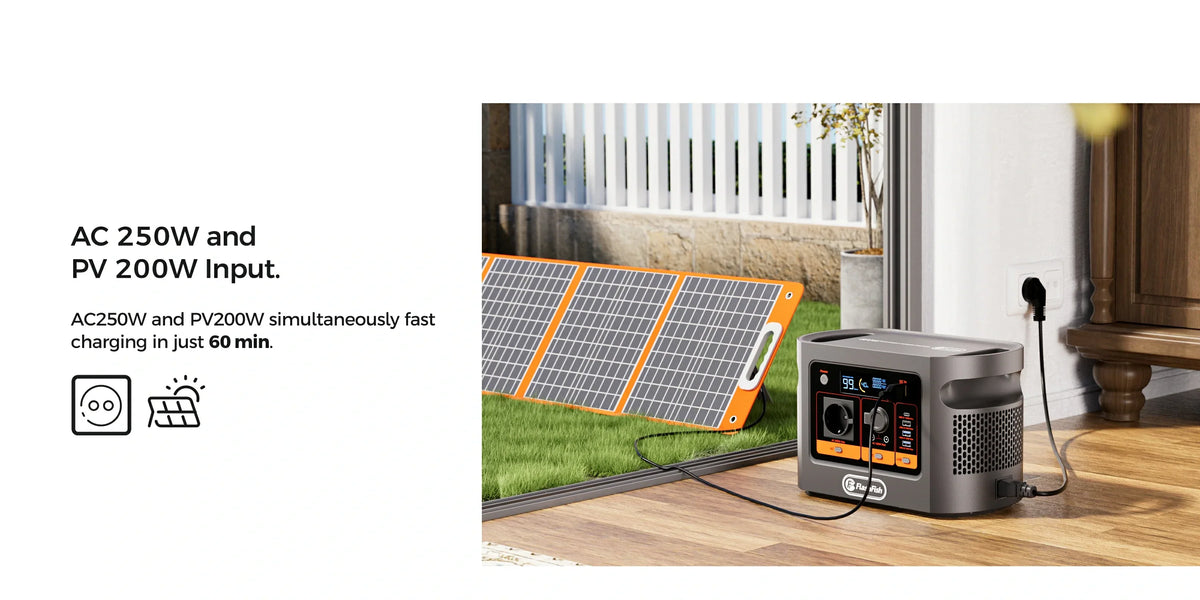
Short answer: E106B is the stronger paper fit when the camping kit needs more than 300W continuous AC headroom or values 384Wh nominal energy and two documented USB-C PD outputs. RIVER 3 is the stronger paper fit when lower station mass and its documented app, UPS and battery-pack IP54 features matter more. EcoFlow's 600W X-Boost is not the same as 600W continuous output, and neither specification sheet proves runtime.
Use HEADROOM-CARRY-FEATURE: screen the exact device list against continuous output, decide how much weight you will carry, then pay attention only to features you will actually use. That makes the comparison about a declared trip rather than a brand slogan.
E106B vs RIVER 3: equally defined evidence
| Decision factor | FlashFish E106B | EcoFlow RIVER 3 | Buyer meaning |
|---|---|---|---|
| Nominal energy | 384Wh | 245Wh | Capacity label, not delivered runtime |
| Rated continuous AC | 600W pure sine wave | 300W rated | Use this line for ordinary continuous-load screening |
| Boost/peak evidence | Not provided by the authoritative local record | 600W surge/X-Boost | Do not fill the E106B gap or call X-Boost continuous |
| Station mass | 5.2kg | 3.55kg | RIVER 3 is 1.65kg lighter before cables |
| USB-C | 100W PD plus 30W PD | One port up to 100W | Verify device and cable profiles |
| Documented platform features | No app, UPS timing or IP rating in the authoritative record | App control; model-specific UPS and IP54 battery-pack claims | Count only features the exact trip needs |
FlashFish product check: review the current E106B ports and regional output after writing down the exact camping load list.
HEADROOM: compare rated output before boost labels
E106B documents 600W continuous pure-sine AC. EcoFlow documents 300W rated AC for RIVER 3 and separately markets 600W surge/X-Boost. X-Boost can change how certain appliances are driven; it is not a substitute for the ordinary 300W rating. For either station, record each appliance's regional input label, starting behaviour and every simultaneous load. An unfamiliar motor, compressor or heating device needs its own evidence rather than a category-level promise.
CARRY: 1.65kg can matter more than 139Wh
E106B has 139Wh more nominal energy but weighs 1.65kg more. A car camper may accept that trade. A rail camper with a tent, water and food may not. Weigh the station, adapters, solar panel if any and the complete camp kit together. Do not compare product mass in isolation or assume extra nominal Wh always earns its place in the bag.
FEATURE: use a need-to-feature map
| Trip need | Evidence to seek | Current paper fit |
|---|---|---|
| Two direct USB-C devices | Exact PD profiles and simultaneous-port evidence | E106B documents 100W and 30W USB-C ports; still verify sharing |
| Remote monitoring or control | Current app support and offline behaviour | RIVER 3 documents app control; E106B record does not |
| Fast automatic transfer | Required interruption tolerance and exact UPS specification | RIVER 3 documents model-specific UPS timing; E106B has no such authoritative field |
| Damp campsite | Complete-product ingress rating and a dry setup | EcoFlow limits the cited IP54 claim to the battery pack; no claim makes wet use acceptable |
Three concrete camping decisions
- Phone, 100W USB-C laptop and LED light: both stations have a documented 100W USB-C path, but E106B adds a separate 30W USB-C port and more nominal energy. RIVER 3 saves 1.65kg. Confirm the laptop profile and measure the session before deciding.
- One verified 450W AC appliance: the load is above RIVER 3's 300W rated output, even though EcoFlow lists 600W X-Boost. E106B is the cleaner continuous-output candidate on paper, subject to the exact appliance label, start behaviour and supervised test.
- Connectivity-sensitive device: if the trip genuinely needs the competitor's documented app or UPS behaviour, RIVER 3 has the stronger published feature case. E106B should not be presented as an equivalent when its authoritative record does not provide those fields.
When FlashFish E106B fits
- The declared load needs more than 300W but stays comfortably inside a verified 600W continuous envelope.
- The trip values 384Wh nominal energy and can justify the 5.2kg station mass.
- Two direct USB-C paths—up to 100W and 30W—solve real, verified device needs.
- The buyer does not require undocumented E106B app, UPS-timing or ingress-protection features.
When E106B does not fit
- Every kilogram matters and the measured kit stays inside RIVER 3's 300W rated envelope.
- The workflow requires the competitor's documented app, UPS or battery-pack IP feature.
- The campsite cannot keep the station, sockets and connections dry.
- The decision depends on an invented runtime, recharge time, price winner or reliability claim.
Frequently asked questions
Is EcoFlow RIVER 3 rated at 600W continuously?
No. EcoFlow lists 300W rated AC output and separately lists 600W surge/X-Boost. This comparison uses 300W as the continuous rated figure and does not treat X-Boost as ordinary 600W continuous power.
Does E106B have more nominal energy?
Yes. The authoritative E106B record lists 384Wh, while EcoFlow lists 245Wh for RIVER 3. Nominal Wh still does not equal delivered runtime for a particular device.
Which station is lighter?
EcoFlow lists RIVER 3 at 3.55kg, compared with 5.2kg for E106B. The 1.65kg difference matters only after the complete camp kit is weighed.
Can both charge a 100W USB-C laptop?
Both manufacturers document a USB-C output up to 100W, but the laptop and cable must support a matching Power Delivery profile. A 100W label is not universal compatibility.
Which one will run my camping kit longer?
This article makes no runtime promise. Build and measure the exact load list, charging path, use pattern and reserve; nominal capacity alone is insufficient.
For a bounded compatibility question: ask FlashFish Europe to review your camping load list and keep the competitor's current manual beside it.
Sources and evidence limits
Checked 14 October 2026. E106B facts come from the authoritative local record and current Europe route. RIVER 3 facts come from EcoFlow's current Europe product and series pages. Camping and electrical-safety sources define dry-placement and load-management boundaries. FlashFish publishes this comparison. No side-by-side test, runtime, recharge time, noise result, price winner, reliability result or independent review conclusion is claimed; the image shows only E106B.



Laat een reactie achter
Deze site wordt beschermd door hCaptcha en het privacybeleid en de servicevoorwaarden van hCaptcha zijn van toepassing.