

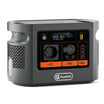
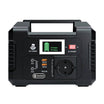

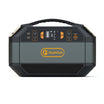
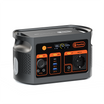






Short answer: input watts describe how quickly a portable power station can accept charging power; output watts describe how much power it can deliver to connected devices. Watt-hours describe the energy stored in the battery. They are three different numbers, and a sound buying decision checks all three.
This guide is for Europe buyers comparing small solar generators and portable power stations for camping, travel, remote work or selected home electronics. It uses product-specific FlashFish examples, but the method works across brands. It does not promise exact charge times or runtimes because conversion losses, charging behaviour, temperature, device demand and solar conditions vary.
The reservoir model: capacity, inlet and outlet
A useful mental model is a reservoir. Battery capacity in watt-hours is the stored volume. Charging input in watts is the inlet. Device output in watts is the outlet. A 300W outlet does not require a 300W inlet at that moment: the battery supplies the difference from stored energy. Likewise, a large battery with a small inlet may power a suitable load but take longer to recover.
| Number | What it answers | What it cannot answer alone |
|---|---|---|
| Battery capacity, Wh | How much energy is stored before losses and reserve margin. | Whether the inverter can start or run a particular appliance. |
| Charging input, W | The maximum supported rate at which the station can accept power through a specified input. | A fixed wall or solar charge time. |
| Continuous output, W | The steady AC load class the inverter is designed to supply. | Exact runtime or universal compatibility with every device below that number. |
| Peak output, W | Short startup headroom when the manufacturer provides it. | A steady operating limit. |
Why output watts can be higher than input watts
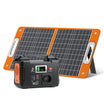
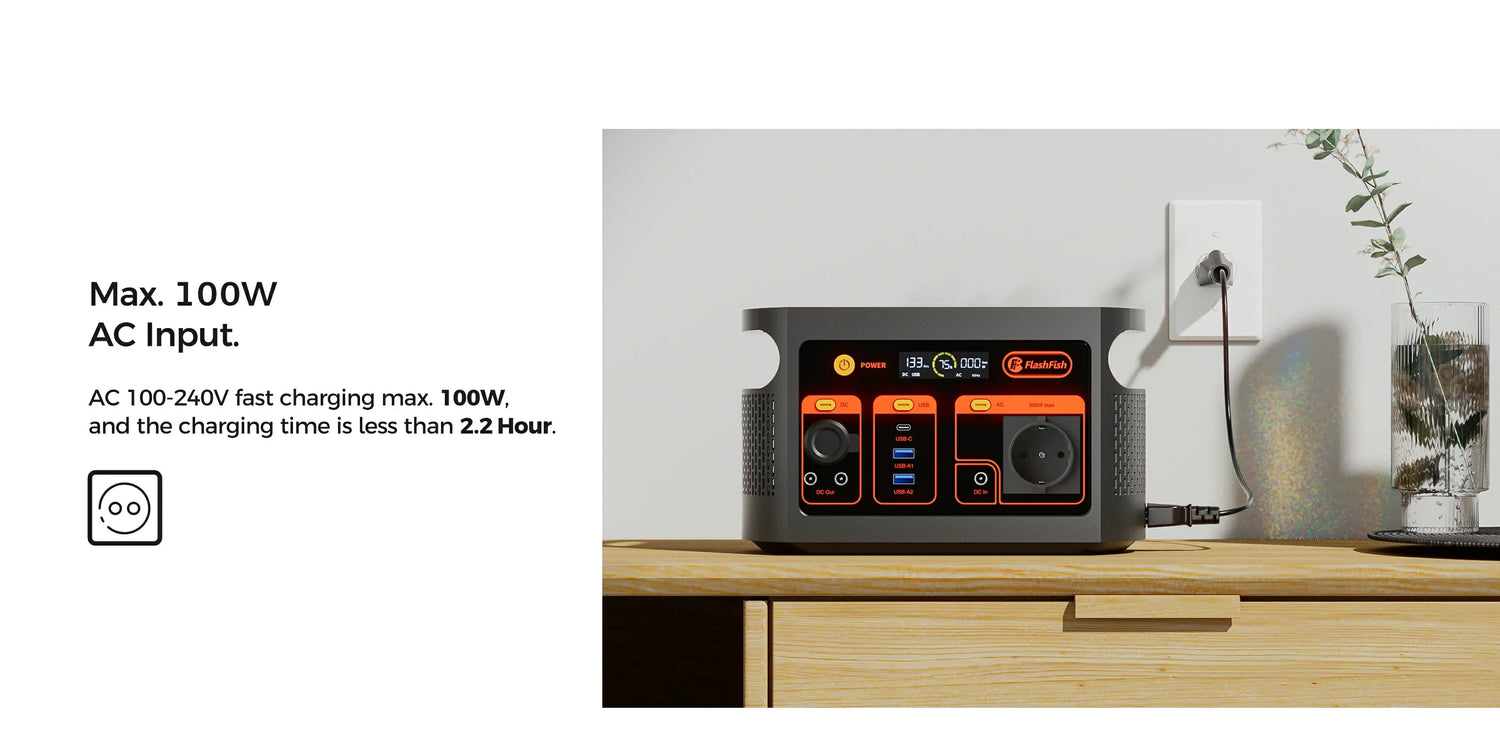
The station charges its battery first and later releases stored energy through its outputs. For example, the local FlashFish product database lists the E103 with 100W AC charging input, up to 90W DC charging input and 300W continuous pure-sine AC output. That is not a contradiction. The 300W figure is the inverter's steady output class; the input figures describe separate supported charging paths.
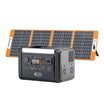
The same distinction becomes more visible in larger models. The T1200S is listed at 768Wh, 1200W continuous AC output, 700W AC input and up to 400W solar/DC input. The T2000 is listed at 1536Wh, 2000W continuous AC output, 1500W AC input and up to 600W solar/DC input. None of those numbers should be substituted for another.
Product-specific examples
| FlashFish model | Stored energy | Continuous AC output | Charging input facts used here | Practical reading |
|---|---|---|---|---|
| E103 | 179.2Wh | 300W pure sine | 100W AC; up to 90W DC | Compact selected-load station. Output headroom is not the same as a large energy reserve. |
| T1200S | 768Wh | 1200W pure sine | 700W AC; up to 400W solar/DC | A larger reserve and outlet class with a faster supported charging path than compact units. |
| T2000 | 1536Wh | 2000W pure sine | 1500W AC; up to 600W solar/DC | Suited to a broader selected-load plan, with greater weight and less casual portability. |
Evidence boundary: these are specification comparisons, not hands-on test results. The local product database does not provide E103 battery chemistry or peak AC output in its product summary, so this article does not state either value.
Why Wh divided by input W is not an exact charge time
Dividing battery watt-hours by input watts can produce a rough lower-bound planning number, but it is not a dependable completion time. Charging systems lose energy, may reduce power near full charge, and may accept less than the stated maximum because of source limits, temperature or power management. If devices run while the battery is charging, part of the incoming energy may go to those loads instead of increasing the battery state of charge.
Solar adds weather, season, shade, panel angle and cable conditions. The European Commission's JRC PVGIS documentation is useful precisely because solar potential is location- and assumption-dependent. Treat a panel's rated output and a station's solar input limit as design constraints, not an hourly forecast.
Why Wh divided by output W is not an exact runtime
A simple capacity-to-load calculation is useful for comparing options, but actual AC runtime is lower than an ideal calculation because the inverter and internal electronics consume energy. Many appliances also cycle, vary their demand or draw more power at startup. A refrigerator label, laptop adapter and kettle can each need a different interpretation.
For buying decisions, use the device label, identify steady and startup demand, add a reserve margin, and regard any result as a planning range. When the application is safety-critical or the device behaviour is unclear, obtain device-manufacturer or qualified electrical guidance.
The INPUT decision framework
- I — Identify every load. Record watts from each device or adapter and note which loads may run together.
- N — Note steady and startup demand. Compare steady demand with continuous output; never treat peak output as the normal limit.
- P — Pick the required ports and waveform. Check AC, USB-C and DC connections, plus pure-sine requirements for sensitive electronics.
- U — Understand recovery. Compare AC and solar/DC input limits with where and how often you can recharge.
- T — Test the assumptions. Leave energy and power margin, confirm cables and review every blank or uncertain specification before purchase.
Common mistakes to avoid
- Reading a 300W output label as if it meant 300Wh of stored energy.
- Assuming a 100W input means the battery always receives 100W from empty to full.
- Adding the maximum ratings of every port and assuming they can all be delivered simultaneously.
- Using peak output as the steady load target.
- Assuming solar panel nameplate output will be available through cloud, shade or winter sun.
- Ignoring the difference between a wall charging input and a DC or solar input.
When FlashFish fits
FlashFish fits when the required device list, steady watts, connection type, expected energy use and realistic recharge opportunity all fall inside a verified model's specifications. E103 can fit a compact low-load plan; T1200S or T2000 can fit broader selected-load plans when the buyer accepts the additional weight and cost class. The Europe portable power station collection helps compare those size classes.
When FlashFish may not fit
Do not choose a model when the appliance demand is unknown, the required output exceeds its continuous rating, the charging opportunity is too limited for the planned use, or a fixed electrical installation is actually required. A portable station is also the wrong substitute for professional design of building circuits, medical equipment power or other safety-critical systems.
Electrical and campsite safety
Keep connectors dry, inspect cables before use, and follow the station and device manuals. Electrical Safety First advises against overloading extension leads and highlights the risks of coiled cable reels under load. The Camping and Caravanning Club also recommends campsite-appropriate equipment and careful use around damp outdoor conditions. Those sources provide general precautions; they do not certify a particular FlashFish setup.
Frequently asked questions
Is charging input the same as appliance output?
No. Charging input is power entering the station through a supported charging path. Appliance output is power leaving through AC, USB or DC ports.
Can a 100W input power a 300W output?
The battery can supply a suitable 300W-class load even when the charging input rating is lower because energy has already been stored. That does not mean a 100W charger can indefinitely replace a 300W load.
Does more output wattage mean longer runtime?
No. Output wattage is a power limit; battery watt-hours describe stored energy. Runtime also depends on load behaviour, conversion loss and reserve margin.
Can I calculate solar charge time from panel watts?
Only as a rough planning exercise. Station input limits, sunlight, shade, angle, temperature, cable losses and charge taper all affect the result.
Should I compare continuous or peak output?
Use continuous output for normal planning. Peak output, when provided, is short startup headroom rather than the normal operating target.
What should I check first when comparing power stations?
Start with the exact device list and its steady and startup demands. Then compare output, stored energy, ports, charging input, weight and evidence gaps.
Sources and further reading
- U.S. Department of Energy: solar energy and storage basics — power capacity, energy capacity and conversion context.
- European Commission JRC: PVGIS user manual — location- and assumption-dependent solar planning.
- Electrical Safety First: extension leads and cable reels — general cable and overload precautions.
- Camping and Caravanning Club: using electricity in a tent — campsite electrical precautions.
- FlashFish product-source bundle and current Europe product pages for model-specific facts, accessed 15 July 2026.
Decision rule: choose the smallest verified station whose continuous output, stored energy, ports and recharge path all fit the same device plan with margin. If one of those checks fails, move to another model or another power approach.
Human review note: recheck source manuals, current Europe product pages and image copy before publishing. This educational guide is not an electrical installation specification.





Laisser un commentaire
Ce site est protégé par hCaptcha, et la Politique de confidentialité et les Conditions de service de hCaptcha s’appliquent.