








Round-Trip Efficiency in Portable Power Stations Explained
Short answer: round-trip efficiency compares the energy a storage system returns with the energy needed to bring it back to the same starting state of charge. You cannot calculate a defensible model result from rated watt-hours alone; you need measured input, measured output and clearly defined conditions.
Key definition: Regulation (EU) 2023/1542 defines energy round-trip efficiency as the ratio of net energy delivered during a discharge test to the energy required to restore the initial state of charge by a standard charge. The phrase initial state matters: charging from an unknown percentage and stopping at a different endpoint does not close the energy loop.
The buyer problem is simple. A 1,000Wh label describes a rated energy class under stated reference conditions; it is not a promise that 1,000Wh will reach an AC appliance, nor that 1,000Wh from the wall will refill the station. Charging electronics, the battery, controls, temperature management, DC conversion, the inverter and idle time can all change the measured path.
Six numbers that should not be treated as interchangeable
| Number | What it describes | What it cannot prove alone |
|---|---|---|
| Rated capacity (Wh) | The model's stated energy capacity under reference conditions | Energy delivered to every AC or DC load |
| Wall input energy (Wh) | Energy measured entering the charger during a defined refill | How much remains stored after losses |
| Battery discharge energy | Energy leaving the battery-side boundary in a test | Energy available at an AC socket after inverter loss |
| AC delivered energy | Energy measured at the AC outlet for a defined load | Performance of USB-C or regulated DC outputs |
| Inverter efficiency | One-way DC-to-AC conversion performance | Full charging-and-discharging efficiency |
| Round-trip efficiency | Output divided by the energy required to restore the starting state | A fixed result for every load, temperature or operating mode |
The LEDGER method for reading an efficiency claim
| Step | Question | Evidence to record |
|---|---|---|
| L — Line input | Where was charging energy measured? | Wall meter, DC source meter or another named boundary |
| E — Electronics and auxiliaries | Which controls, fans, displays or heaters were included? | System boundary and whether standby loads count |
| D — Delivered battery energy | Was the battery returned to the same state? | Starting and ending state of charge plus settling method |
| G — Gateway conversion | Was output AC, USB-C or regulated DC? | Port, converter and load type |
| E — End-use load | What power level and duty cycle were used? | Watts, duration, cycling and simultaneous loads |
| R — Repeatable conditions | Could another tester reproduce the result? | Temperature, firmware, charge/discharge rate, test date and endpoint |
The mathematical form is simple: measured energy out divided by measured recharge energy in, multiplied by 100. The hard part is making the two measurements describe the same cycle boundary. If the battery begins or ends at a different state of charge, the result mixes efficiency with a change in stored energy.
Three practical examples
1. A weekend laptop and camera kit
Charging through USB-C and running a mains charger through the AC inverter follow different conversion paths. A station may show the same battery percentage change while the energy delivered to the devices differs. Compare like with like: the same ports, loads, starting state, endpoint and temperature.
2. A low-watt router during an outage
A long low-power session can make fixed inverter and control overhead a larger share of the total energy. That does not prove that every larger load is more efficient or safer; it explains why a one-size efficiency factor is weak evidence for a small continuous load.
3. Two stations with the same rated Wh
Equal rated capacity does not establish equal delivered AC energy, recharge energy, idle overhead or operating limits. A fair comparison needs the same load profile and measurement boundary. Catalogue Wh remains useful for size class, but it is not a substitute for a repeatable test.
Common mistakes
- Calling inverter efficiency the round-trip result.
- Dividing appliance watts into rated Wh and presenting the answer as measured runtime.
- Using a generic lithium-battery percentage for a named power station.
- Ignoring energy used after the load stops but before the AC output is switched off.
- Comparing an AC result for one model with a USB-C result for another.
- Changing temperature, firmware, load or state-of-charge endpoints between tests.
A buyer checklist
- Ask whether the published number is rated capacity, usable output, inverter efficiency or round-trip efficiency.
- Find the input and output measurement points.
- Confirm the battery started and ended at the same state of charge.
- Record the output path, load watts, duration, temperature and operating mode.
- Look for auxiliary loads and automatic shutdown behavior in the test boundary.
- Use the result only for comparable conditions; keep a reserve for real use.
Where FlashFish fits—and where it does not
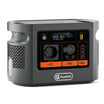
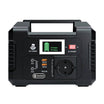
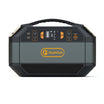
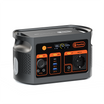
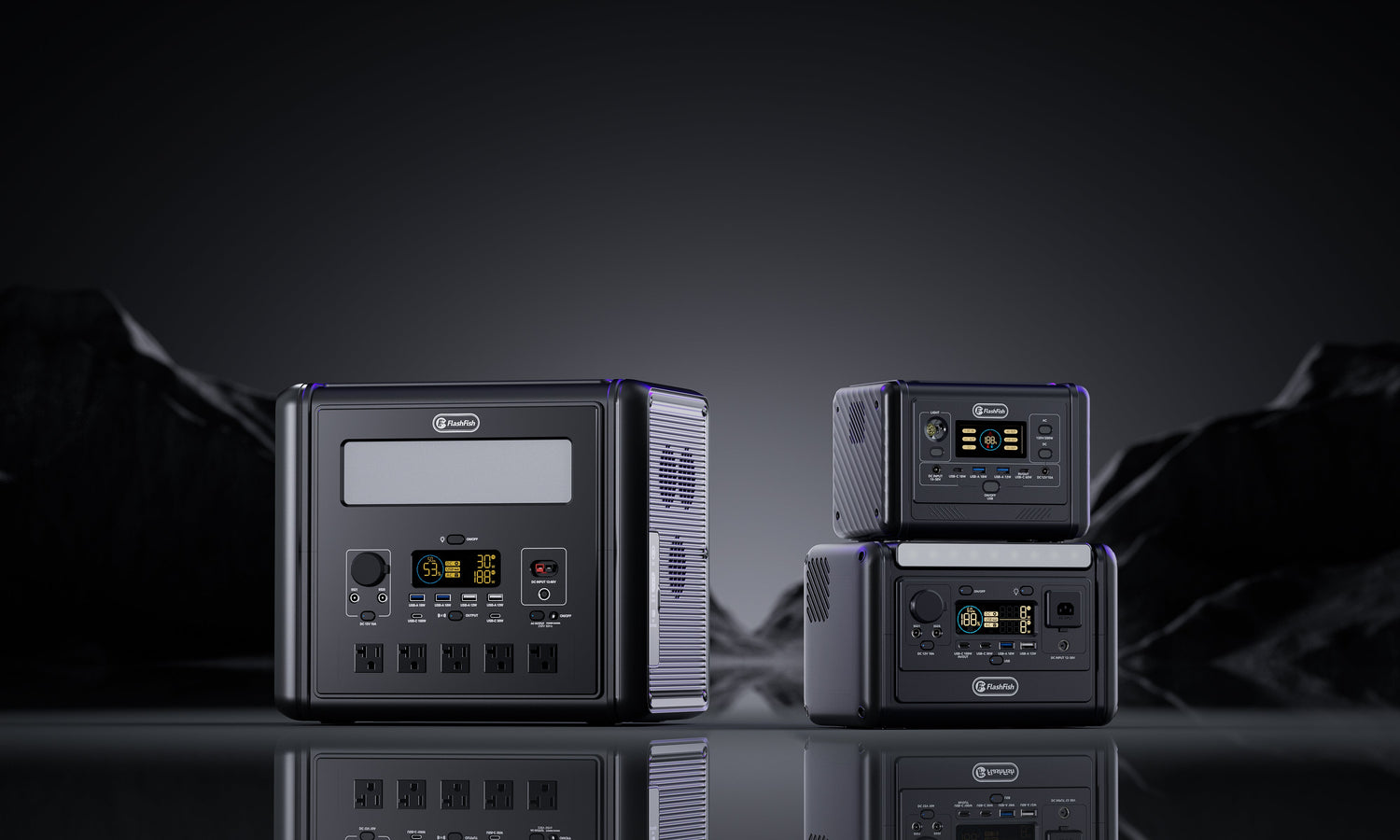
FlashFish can fit when the selected station's verified capacity, continuous output, ports, regional voltage and carry weight match the buyer's job. Use the FlashFish portable power station collection to identify the relevant size class, then compare the exact product and manual.
FlashFish does not fit when the decision depends on a model-specific round-trip percentage that has not been published or independently measured. The current local FlashFish product database does not provide that value for the portable stations discussed here, so this article deliberately does not invent one.
Safety and evidence boundary
An owner can log energy with suitable external meters without opening the station. Do not probe internal battery terminals, bypass protections, alter wiring or turn an efficiency experiment into an unattended overload test. Stop if a cable, plug, station or load is damaged, overheats, smells abnormal or behaves outside its manual.
FAQ
What is round-trip efficiency in a portable power station?
It is the ratio between the energy returned from storage and the energy required to restore the same starting state of charge under defined conditions. A useful result needs measured input and output boundaries, not only the rated watt-hour label.
Is round-trip efficiency the same as inverter efficiency?
No. Inverter efficiency covers one conversion stage from battery DC to AC. Round-trip efficiency includes charging, storage and discharge boundaries, and may include controls or auxiliary consumption depending on the stated method.
Can I calculate delivered energy by multiplying rated Wh by a generic efficiency percentage?
That creates an estimate, not model evidence. Actual results vary with load, AC or DC path, temperature, state of charge, idle time and the manufacturer's control limits.
Why can a low-watt load be less efficient than a larger load?
Fixed overhead such as the inverter, display, controls or cooling can consume a larger share of total energy during a long low-power session. The exact effect requires measurement on the selected model.
Does the FlashFish product database provide round-trip efficiency values?
No model-specific round-trip-efficiency percentage is provided in the current local product database for the portable stations discussed here. Buyers should not infer one from capacity, chemistry or a different product.
Sources and further reading
- Regulation (EU) 2023/1542 — definition and performance-evidence context.
- U.S. DOE Battery Energy Storage System Evaluation Method — measured input/output methodology and operating-condition caveats.
- U.S. DOE storage basics — conversion and retrieval losses.
- FlashFish Europe buying guide — regional product-selection context; no model efficiency result is inferred.
Editorial viewpoint: rated Wh starts a size comparison; a closed, repeatable energy ledger is what turns efficiency into evidence.
Human review required before publication: technical definitions, source scope, author/reviewer credentials, link accuracy, image crop and rendered FAQ/schema parity.



Laisser un commentaire
Ce site est protégé par hCaptcha, et la Politique de confidentialité et les Conditions de service de hCaptcha s’appliquent.