


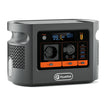
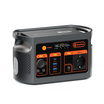

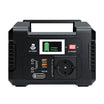
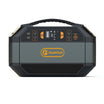

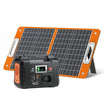

E106B and E112B have the same documented 100W/30W direct USB-C port ceilings. The decision is therefore about the complete device profiles, combined-use evidence, energy needs and carrying weight. E112B does not earn a faster-charging claim from its larger battery. Neither station is approved here for an exact laptop-and-tablet pair.
Compare the two direct routes first
| Documented item | E106B | E112B |
|---|---|---|
| USB-C1 PD ceiling | 100W | 100W |
| USB-C2 PD ceiling | 30W | 30W |
| Nominal battery energy | 384Wh | 1008Wh |
| Approximate station weight | 5.2kg | 11.2kg |
| Full station PD profiles and combined negotiated rates | Not established by these records | Not established by these records |
Those are exact-model manual-primary product values. E112B has 624Wh more nominal energy and approximately 6kg more station weight; these are simple differences, not measured runtime or a packed-bag comparison. Its separate 1200W AC figure is a shared maximum, with continuous and peak AC ratings unconfirmed. AC output does not settle a direct USB-C choice.
A named laptop and tablet expose the remaining gap
The Lenovo Yoga Pro 7 14APH8 PSREF, page 3 lists a 100W USB-C PD 3.0 adapter option and a 140W option that varies by country. Restrict this example to a machine supplied and approved for the 100W option. The Lenovo Tab P12 Pro PSREF, page 3 lists a 10V/3A (30W) USB-C adapter. Those two adapter descriptions do not verify that either station reproduces the required profiles.
USB-IF’s Power Delivery explanation describes device power requests and the 20V/5A route associated with 100W. Check a documented 5A-capable laptop cable for that route, the tablet’s accepted input and its specified cable, then the station’s supported profiles. No exact cable pair or station allocation table has been verified here. In particular, the tablet’s 10V/3A adapter label cannot be replaced by a generic “30W PD” assumption.
Start with review E106B’s two USB-C port limits and retain the device and cable requirements beside them. If the profile match cannot be established, keep the manufacturer-approved charging arrangement rather than trialling adapters to force a rate.
When each station belongs on the shortlist
- E106B: the lighter candidate if both exact direct routes and their combined use are confirmed, and a separately justified energy plan is sufficient. Its 5.2kg station weight is the concrete carrying advantage.
- E112B: a candidate when the same route checks pass and more nominal stored energy is useful enough to justify approximately 11.2kg. The larger battery is not evidence of improved port negotiation.
- Neither yet: a tablet-specific profile, exact cable rating or combined-use limit is unresolved. Resolve that issue before making capacity the deciding factor.
Three checks that can reverse the purchase decision
- The laptop is actually the 140W-adapter configuration. Reopen the requirements; it is not the 100W case described here.
- The tablet requires an unverified charging profile. Two matching watt numbers do not close that gap, even if both USB-C sockets are free.
- The plan requires both stated maximum rates together. Ask for exact combined-use documentation; do not infer it by adding the two ceilings.
For an energy estimate, use a measured, representative load and a justified usable-energy allowance. Dividing nominal Wh by 130W would assume both an unproven operating load and loss-free delivery. No charging time, number of charges or session duration is claimed here.
For the larger option, check E112B’s product details alongside the same device checklist. This is a first-party documentation comparison, not a side-by-side performance review.
FAQ
Does E112B give this pair a higher USB-C ceiling?
No. Both exact station records list C1 up to 100W PD and C2 up to 30W PD. More nominal energy does not change those listed per-port ceilings.
Is a 30W adapter label enough to choose the tablet cable?
No. Confirm the tablet’s accepted voltage/current and protocol together with the cable specification. The Tab P12 Pro’s listed 10V/3A adapter is a useful check against treating every 30W source as equivalent.
Can USB-C2 take over the 100W laptop route?
It cannot provide a 100W requirement: its listed ceiling is 30W. Any permitted lower-power laptop mode needs its own manufacturer evidence.
Does 100W plus 30W mean a proven 130W combined output?
No. The sum of separate port ceilings is not a simultaneous-load test or an allocation table. Obtain combined-use evidence for the exact station and device pair.
Should the 140W Yoga adapter configuration use the same conclusion?
No. Lenovo lists a 140W adapter option as well. That configuration is outside this 100W-labelled screening case, so check its requirements separately.
Next step
compare E112B’s energy and carry weight with your confirmed routes. Match the exact equipment and intended use before choosing a power source.
By FlashFish Miles. Method: documentation-based guidance from FlashFish and the linked primary sources, checked 8 November 2026. No complete setup was tested. The featured product illustration is not a record of this setup.





Laisser un commentaire
Ce site est protégé par hCaptcha, et la Politique de confidentialité et les Conditions de service de hCaptcha s’appliquent.