


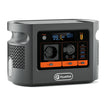
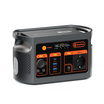

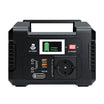
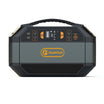
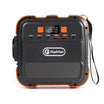

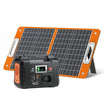

Short answer: stop the choice when the exact AC charger's waveform requirement is unknown. E200 provides modified-sine AC, while E106B provides pure-sine AC. That makes E106B the clearer waveform candidate, but pure sine alone does not approve the charger. The charger maker still needs to confirm voltage, frequency, power and any inverter restrictions for the exact regional model.
Quick comparison on the deciding fields
| Field | E200 | E106B | Decision meaning |
|---|---|---|---|
| AC waveform | Modified sine wave | Pure sine wave | Use the charger's own accepted-input guidance |
| European AC output | 230V route; frequency not provided in the exact record | 230V, 50Hz | A missing frequency is a separate stop field |
| Rated AC power | 200W | 600W shared AC ceiling | Compare with charger running and startup demand |
| Peak AC | 400W | Not provided | Do not invent E106B startup headroom |
| Nominal energy | 151Wh | 384Wh | Not a delivered-energy or runtime result |
| Station mass | About 1.85kg | About 5.2kg | Portability matters only after compatibility passes |
The correct answer may be no recommendation yet
A power station can be below the charger's wattage ceiling and still lack decisive waveform or input evidence. A pure-sine label reduces one uncertainty, but it does not replace the charger's manual, regional label or maker response. A modified-sine source may be accepted by some power supplies and rejected by others; do not transfer one charger's result to another model.
Build the charger evidence sheet
| Evidence field | What to capture | Stop condition |
|---|---|---|
| Manufacturer and exact model | Full model and regional version | Generic charger description only |
| Input voltage and frequency | Label and current manual values | Station output or frequency is missing or mismatched |
| Waveform or inverter guidance | Manual section or written manufacturer answer | Silence or a response for another model |
| Running and startup demand | Manufacturer input rating and any startup note | Demand exceeds evidence or station limit |
| Plug, adapter and environment | Approved regional connection and ventilation conditions | Improvised or damaged connection |
Decision-stage next step: complete that evidence sheet, then Compare current E200 and E106B Europe details. A blank waveform or frequency field is a reason to pause, not a reason to choose the larger station.
Three defensible outcomes
- The charger maker accepts modified-sine inverter power: E200 remains a candidate only if the exact voltage, frequency, running demand, startup behaviour and regional connection also pass.
- The charger requires pure-sine power: E200 is not the supported AC path. E106B remains a candidate, subject to every other input condition and its unknown peak value.
- The manufacturer is silent or the model cannot be resolved: neither station receives a charger-specific recommendation. Obtain a written answer or use a manufacturer-supported power path.
Where E200 may fit
The current E200 Europe page and exact-model record list 151Wh nominal capacity, 200W rated and 400W peak AC output, modified-sine waveform and approximately 1.85kg mass. That compact profile can matter after the charger maker explicitly accepts the source and every electrical field passes. The record does not provide AC frequency, so frequency cannot be assumed from another E200 variant or another station.
Where E106B may fit
The current E106B Europe page lists 230V 50Hz pure-sine AC with 600W shared power, 384Wh nominal energy and approximately 5.2kg mass. It is the clearer candidate when pure sine is required, but the record does not provide peak AC output and does not approve a particular charger. More power and energy do not fill a missing charger requirement.
Use the charger's manufacturer instructions
Electrical Safety First charger guidance tells users to read manufacturer instructions, use a charger for its intended purpose and check voltage when travelling. That supports the evidence rule here. It does not decide whether a named charger accepts modified-sine or pure-sine inverter power, so the charger maker remains the decisive source.
Advantages, disadvantages and risks
| Option | Advantages | Disadvantages and risks |
|---|---|---|
| E200 | Lower listed mass; documented 400W peak; compact nominal-energy class | Modified-sine AC; frequency missing; 200W rated ceiling; no charger approval |
| E106B | Pure-sine AC; 230V 50Hz; higher rated AC and nominal energy | Heavier; peak AC unknown; pure sine still does not prove charger fit |
| Pause and verify | Prevents a guess from becoming a purchase decision | Requires model-specific manufacturer evidence and may delay the choice |
Common mistakes
- Choosing by nominal Wh before checking the charger input.
- Treating a pure-sine label as complete compatibility evidence.
- Assuming E200 frequency from a related page or market variant.
- Using E200's documented peak to fill E106B's missing peak value.
- Turning one successful charger example into approval for a different charger.
FAQ
Is pure sine enough to approve E106B for any charger?
No. Voltage, frequency, running demand, startup behaviour, plug and manufacturer conditions still need to pass.
Can E200 be used if the manual does not mention waveform?
Do not treat silence as approval. Ask the charger manufacturer whether modified-sine inverter power is accepted for the exact model.
Does the charger wattage settle the choice?
No. Wattage is only one field; waveform, voltage, frequency, startup and connection conditions remain material.
Does E106B's larger battery prove longer runtime?
No fixed runtime follows from nominal Wh. A verified charger, measured load, conversion losses and reserve are still needed.
What if the maker confirms modified-sine operation?
E200 can remain a candidate if all other input and power conditions pass. The written answer is not a station test.
Sources and evidence limits
- FlashFish E200 Europe page and exact-model record — E200 ratings and modified-sine waveform; frequency and charger approval remain missing.
- FlashFish E106B Europe page and exact-model record — E106B pure-sine EU ratings; peak and charger approval remain missing.
- Electrical Safety First charger guidance — manufacturer-instruction and voltage checks; no model-specific waveform qualification.
Evidence checked 31 October 2026. No charger or station pair was tested and no manufacturer approved either path for a named device.
Choose only after the missing field is closed
E200 can be the compact candidate when modified-sine operation is explicitly accepted. E106B can be the clearer candidate when pure sine is required. When the charger's requirement remains unknown, the useful answer is to stop. Check the exact station pages before choosing, and keep the final recommendation conditional on the charger maker's evidence.




Laisser un commentaire
Ce site est protégé par hCaptcha, et la Politique de confidentialité et les Conditions de service de hCaptcha s’appliquent.