

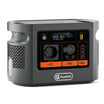

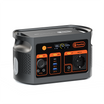


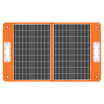
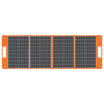


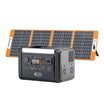

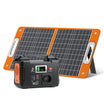


Safety and evidence boundary: no washing machine was tested with T2000. A washer combines water, a heater, drum motor, pump, controls and a fixed installation. Follow the exact appliance and station manuals; do not use an extension lead, leave the machine unattended or improvise earthing, RCD or building connections.
Regional warning: the current FlashFish Europe page lists a 230V/50Hz variant, but the authoritative local T2000 manual-derived record is 120V/60Hz. This guide does not transfer that record into Europe operating approval. Confirm the delivered SKU and current EU manual before any assessment.
Use WASH across the whole programme
| WASH gate | Evidence required | Stop condition |
|---|---|---|
| W — Washer label and manual | 230V/50Hz, rated or maximum input, plug, installation and programme limits | Only annual kWh, eco average or a missing label is available |
| A — Available headroom | Maximum heater/motor/pump demand plus every simultaneous station load | Above 2000W, exact-limit operation or undocumented transient demand |
| S — Supply and protection | Exact EU T2000 manual, direct intact connection, earth/RCD behaviour and dry placement | Regional conflict, extension lead, adaptor chain or uncertain protection |
| H — Human supervision | Correct installation, water/drain check and an adult present for the full cycle | Unattended, overnight, leaking, damaged, hot, tripping or abnormal operation |
What the 2200W reference proves
Electrical Safety First lists 2200W as a washing-machine reference rating. Compared with the T2000 page's 2000W continuous output, that example is 200W above the station ceiling. It is a clear non-fit on continuous watts alone.
The T2000's 4000W peak claim does not change that conclusion. Peak output is for short transients under manufacturer-defined conditions; it is not a 4000W continuous mode and does not approve a heating appliance rated above 2000W.
Why one wash cycle has several electrical loads
- Water heating: often the dominant high-power stage when a warm programme heats cold inlet water.
- Drum motor: changes speed and direction and may create transient demand.
- Drain pump and valves: add stage-specific loads.
- Controls and locking: small loads, but part of the complete machine.
- Other station loads: every charger, light or appliance reduces available headroom.
An EU energy label helps compare programme energy over a standard basis, but it is not the same as maximum instantaneous input. Average kWh per cycle cannot approve a 2000W inverter match.
Three bounded cases
1. A 2200W label or manual maximum
Do not use it with T2000 based on the current 2000W continuous rating. The 4000W peak headline does not cover a higher continuous heater load.
2. A machine documented at 1800W maximum
This is below 2000W on paper but leaves only 200W, or 10%, of nameplate headroom before other station loads and uncertainty. Without full-programme motor/heater evidence, the exact EU station manual and an approved direct protective arrangement, it remains unresolved rather than recommended.
3. A machine documented at 1000W maximum on the exact selected programme
More power margin makes it a better paper candidate, but it still needs voltage/frequency, installation, direct connection, earth/RCD, water, supervision and complete-cycle evidence. Lower watts do not create a runtime promise or remove fire and water risks.
Why runtime division is weak here
Dividing 1536Wh by a single watt number cannot predict a wash. Rated battery energy is not all delivered through AC, and the programme alternates heating, tumbling, pumping, waiting and spinning. Inverter overhead, battery state, temperature and the chosen water temperature also matter.
A responsible estimate needs a measured or manufacturer-documented stage profile for the exact machine and programme plus model-specific delivered-energy evidence. This article therefore gives no cycles-per-charge or minutes of washing.
Installation and fire boundaries
Electrical Safety First describes a washing machine as a large, high-power appliance and advises following the manufacturer, avoiding extension leads and not leaving it unattended. A portable source does not remove those rules. Keep the station away from leaks and hoses, preserve ventilation and stop for heat, smell, arcing, repeated trips, cable damage or abnormal machine behaviour.
Do not disconnect a protective earth, add a neutral-earth bond, use a household multiway, feed a wall socket or rely on an unverified plug-in RCD arrangement. If the complete source and protective path are unclear, use the approved household supply or ask a competent electrician.
Where T2000 may fit
- The exact washer and selected programme have a documented maximum comfortably below 2000W.
- The exact delivered T2000 EU label/manual confirms 230V/50Hz output and the intended standalone appliance use.
- The machine is correctly installed and uses an intact direct connection with a verified protective arrangement.
- No other station load removes headroom, and an adult supervises the complete cycle.
- The user accepts that runtime remains an evidence question, not a capacity-label promise.
Where T2000 does not fit
- The washer is rated above 2000W, at the exact limit or has no reliable maximum-input evidence.
- The plan uses an average energy-label figure, a cold/eco assumption or the 4000W peak claim as approval.
- An extension lead, adaptor chain, building back-feed or improvised earth/RCD arrangement is required.
- The Europe station manual, regional label, water installation or protective path is unresolved.
- The wash would be unattended, overnight or relied upon as a critical service.
A pre-use WASH worksheet
- Photograph the washer rating plate and T2000 delivered-SKU label.
- Obtain both current regional manuals and reject voltage/frequency conflicts.
- Record the maximum input for the exact programme—not only annual or per-cycle energy.
- Identify heater, motor and pump stages and any manufacturer startup limitations.
- Disconnect every unrelated station load and retain operating headroom.
- Confirm direct connection, installation, earth/RCD behaviour and dry station placement.
- If any evidence or safety gate is unresolved, do not connect the washer.
FAQ
Can a 2000W power station run a 2200W washing machine?
No. A 2200W rated input exceeds a 2000W continuous output ceiling. A surge headline is not permission to operate a higher continuous heating load.
Can an eco or cold programme make a washer compatible with T2000?
Not by assumption. A programme may change average energy, but the complete cycle can still use a heater, motor, pump and control peaks. Use a manufacturer-documented maximum input for the exact programme and retain headroom.
How long would T2000 run a washing machine?
This guide gives no fixed runtime. A wash cycle changes load by stage, rated 1536Wh is not all delivered through AC, and temperature, battery state, conversion losses and programme duration vary.
Can I plug a washing machine into an extension lead from T2000?
Electrical Safety First advises against plugging a washing machine into an extension lead. Do not improvise a long or multi-adaptor path; follow both exact manuals and obtain competent advice for any non-standard supply arrangement.
What must be checked before considering a washer with T2000?
Confirm the exact washer label and manual, maximum input across the full programme, T2000 EU label/manual, voltage/frequency, operating headroom, intact direct connection, dry installation, protective arrangement and continuous supervision.
Next step: after recording the washer's exact maximum input and regional supply requirements, Check the current T2000 specifications. Treat any unresolved manual, headroom or protective-path question as a stop condition.
Compare other FlashFish portable power stations when the measured load sits outside this model's evidence-backed fit.
Sources and evidence notes
- FlashFish Europe T2000 page and local product database — current rating context and explicit regional-manual conflict.
- Electrical Safety First washing-machine guidance — installation, extension and supervision boundaries.
- Electrical Safety First appliance ratings — 2200W non-fit reference.
- HSE electrical-equipment guidance — supply suitability, cable checks, RCD limits and competent-review principle.
Editorial viewpoint: WASH rejects both optimistic shortcuts: average programme energy is not maximum input, and a 4000W peak label is not a 4000W washing-machine supply. The whole cycle and complete protective arrangement must pass.
Evidence checked . Human review required before publication: exact EU T2000 SKU/manual, washer-specific programme evidence, qualified electrical and installation review, author/reviewer credentials, links, image crop and rendered FAQ/schema parity.




Laisser un commentaire
Tous les commentaires sont modérés avant d'être publiés.
Ce site est protégé par hCaptcha, et la Politique de confidentialité et les Conditions de service de hCaptcha s’appliquent.