

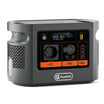
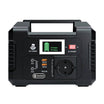

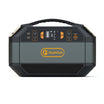
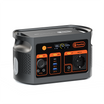







Short answer: sometimes, but a capacity below 100Wh is only one gate. The operating airline must still accept the exact device, decide how it is classified, specify where it must be carried and apply any route or airport restrictions. Never treat “under 100Wh” or “flight approved” as blanket permission.
This guide is for European passengers considering a compact portable power station. It is not boarding permission or a substitute for written instructions from every operating carrier on an itinerary.
The five BOARD gates
| Gate | Evidence to collect | Stop condition |
|---|---|---|
| Battery watt-hours | Wh printed on the exact unit and documented by the manufacturer | Value is missing, unreadable, contradictory or above the airline limit |
| Operator acceptance | Written rule or response from every operating airline | The airline refuses the product or will not confirm its classification |
| Assigned baggage position | Explicit cabin/checked-baggage instruction | The plan depends on checking an item that must remain in the cabin |
| Route-specific rules | Rules for every airport, segment and codeshare operator | One segment or authority applies a stricter rule |
| Damage and terminal protection | Undamaged case, protected switches and terminals, secure packing | Swelling, impact damage, heat damage, recall status or exposed terminals |
B: read watt-hours from the exact unit
Air-transport rules use watt-hours because this records stored energy. Do not decide from AC output watts, marketing model names or milliamp-hours alone. Photograph the label before travelling and carry the current manual or manufacturer specification.
The IATA traveller guidance says batteries up to 100Wh are generally allowed in carry-on baggage, batteries from 100Wh to 160Wh may be allowed with airline approval, and batteries over 160Wh are usually not permitted in passenger baggage. “Generally” is important: it is not an instruction for a named airline.
O: ask the operating airline, not only the booking site
The carrier operating the aircraft applies the baggage rule. A codeshare itinerary can show one airline brand while another airline flies the segment. Check every operator and keep the response with the booking.
Describe the item accurately: it is a portable power station with a built-in battery and multiple outputs. Ask the airline which category it uses. Do not choose “power bank,” “spare battery” or “portable electronic device” for the airline; classification is part of the question.
A: confirm where the unit must be carried
EASA’s lithium-battery recommendations say power banks should be treated as spare batteries and kept out of checked baggage. IATA also tells travellers to keep lithium-battery spares in the cabin and to remove relevant items if cabin baggage is taken at the gate.
A portable power station is not automatically identical to a pocket power bank. That is why the airline’s classification and baggage instruction must be recorded before travel. If the item must remain in the cabin, it must also fit the airline’s cabin size and weight allowance.
R: check every route and operator
Airport security, national dangerous-goods rules, airline policy, aircraft type and local operational limits can all matter. Repeat the check after a schedule or operating-carrier change. For a return journey, check the departure airport and airline again rather than assuming the outbound decision carries over.
D: inspect and protect the equipment
Do not travel with a swollen, leaking, recalled, heat-damaged or impact-damaged battery. Prevent unintended activation. Cover or otherwise protect exposed terminals and pack the unit so metal objects cannot bridge them. Follow any airline instruction for individual bags, cases or terminal caps.
Worked example: FlashFish A101
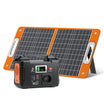
The manual-derived FlashFish product database records the A101 at 97.68Wh, with 120W continuous AC output, a mass of 1.2kg and dimensions of 158 x 158 x 90mm. The watt-hour value is below the common 100Wh threshold described by EASA and IATA.
| BOARD field | A101 evidence | Decision |
|---|---|---|
| Battery watt-hours | 97.68Wh in the authoritative local record | Below 100Wh, subject to physical-label confirmation |
| Operator acceptance | No airline-specific approval in the product database | Airline confirmation required |
| Assigned baggage position | No operator instruction in the product database | Airline classification and packing rule required |
| Route-specific rules | No itinerary supplied | Check every operating carrier and airport |
| Damage and protection | Cannot be assessed from specifications | Inspect the exact unit before travel |
The database does not provide an A101 chemistry value, so this article does not invent one. The current product page may use travel-oriented wording, but that wording cannot approve an airline, airport, route or security decision. The correct conclusion is narrow: 97.68Wh passes one common capacity screen; four other gates remain.
Copy this question to the airline
I plan to carry a FlashFish A101 portable power station with a built-in battery marked 97.68Wh. It weighs 1.2kg and measures 158 x 158 x 90mm. Please confirm how your airline classifies this exact item, whether it is accepted on flight [number/date], whether it must be in cabin baggage, how terminals and switches must be protected, and whether written approval or quantity limits apply.
If the reply only repeats a generic 100Wh rule, ask again for the device category and baggage position. Save the answer, but remember that staff may refuse damaged, incorrectly packed or non-compliant equipment at the airport.
Pre-flight packing checklist
- Photograph the watt-hour label and serial/model identifier.
- Save the operating airline’s written response and current baggage page.
- Check cabin-bag size and weight with the device included.
- Switch the unit fully off; prevent accidental activation.
- Do not use or charge it onboard unless the airline rules and crew explicitly permit that action.
- Protect terminals from keys, tools and other conductive objects.
- Inspect for swelling, cracks, odour, heat or liquid damage.
- Keep the unit accessible for security inspection.
- Recheck after any airline, route or schedule change.
When a compact FlashFish unit may fit
- The exact unit has a clear watt-hour label within the airline’s accepted limit.
- Every operating carrier accepts the classified item in writing.
- The traveller can keep it in the required baggage position and within size/weight limits.
- The unit is undamaged, switched off and packed with protected terminals.
When it does not fit—or the trip should pause
- The watt-hour label is missing or conflicts with the current product record.
- An airline refuses the item, cannot classify it or requires an approval you do not have.
- The itinerary includes a stricter operator, airport or jurisdiction.
- The unit is damaged, swollen, recalled or cannot be protected from activation and short circuit.
- The plan depends on a product-page phrase instead of the operating carrier’s decision.
Frequently asked questions
Is every portable power station under 100Wh allowed on a plane?
No. Capacity is only one gate; airline acceptance, classification, baggage position, route rules and equipment condition still apply.
Can a portable power station go in checked baggage?
Do not assume so. Ask the airline to classify the exact unit and state where it must be carried.
What does Wh mean on an airline battery rule?
Wh means watt-hours, a measure of stored energy. Use the marked and documented value for the exact battery.
Does “flight approved” on a product page establish boarding permission?
No. A product page cannot replace current airline, security and route rules.
What should I ask the airline?
Give the model, watt-hours, label battery type, dimensions and built-in-battery design, then ask about classification, packing and approval.
What if my itinerary uses two airlines?
Check every operating carrier and each segment; one airline cannot approve another operator’s policy.
Sources and further reading
- EASA lithium-battery recommendations—cabin, spare-battery and 100/160Wh context.
- IATA: Safe Travel with Lithium Batteries—traveller thresholds, packing and airline-confirmation guidance.
- FlashFish Europe A101 and the local product-source bundle—97.68Wh example and disclosed evidence limits.
Human review note: airline policies can change. Recheck every operating carrier and reconcile the A101 product-page wording before publication.





Laisser un commentaire
Tous les commentaires sont modérés avant d'être publiés.
Ce site est protégé par hCaptcha, et la Politique de confidentialité et les Conditions de service de hCaptcha s’appliquent.